


Choreographer and dance professor Ku Ming-shen (古名伸) is marking an unexpected birthday this weekend, the 25th anniversary of her troupe Ku and Dancers (古名伸舞蹈團).
“Personally I don’t feel excited,” she said in a telephone interview last month. “Where did all the years go?”
Twenty-five is an anniversary she never anticipated celebrating, since she never set out to form a troupe, and even in 1993, it was created on the spur of the moment — more for financial reasons than artistic.
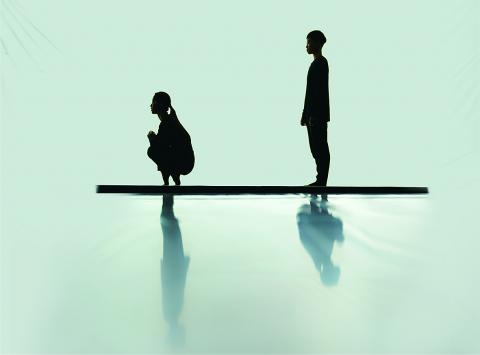
Photo courtesy of Ku and Dancers
“I just presented my work, never thought of having a company. Then my staff told me that [the government’s] policy had changed, you had to have a tax number to get funding,” she said.
“I thought of finding a unique, beautiful name, but didn’t have time. Then I thought of New York choreographers who have companies with their own names, like Merce Cunningham, so I just went with my name,” she said.
“A company is like a promise, like having a child … it must be true love, otherwise it’s too much trouble, too much difficulty, too much responsibility,” she said.
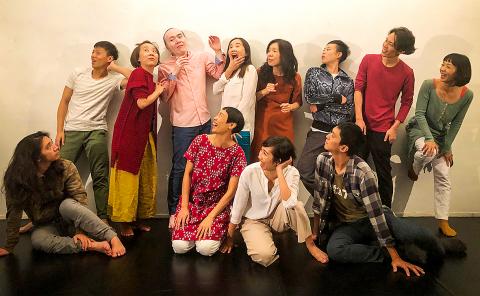
Photo courtesy of Ku and Dancers
Her anniversary program, YI XI WEI (夷希微的凝視) is a double bill, to represent the two lines she has taken.
Ku did her first contact improv performance 26 years ago, as part of a concert program with US dancer/choreographer Steve Paxton, the founder of contact improvisation.
“Every night I dressed up in a costume, soldier, surgeon, cook, basketball player; I talked, the characters became a kind of metaphor. I got into more and more contact improv … then merged my choreography and contact improv, like parallel lines,” she said.
“I love improve, it represents true life,” she said.
Ku took the title, YI XI WEI, from chapter 14 of Lao Tzu’s (老子) Tao Te Ching (道德經), which begins: “Look, it cannot be seen, so it is called invisible. Listen, it cannot be heard, so it is called soundless. Touch, it cannot be caught, so it is called elusive. These three cannot be examined, so they unite into one.”
She said the piece is about weight and gravity, with the dancers balancing on a 3m by 3m wheeled board, so it is always moving.
“I tried to find some movement to show how people survive when their foundation is not stable, and to show how the perspective of a choreographer and audience different, how everyone sees a work through their personal history,” she said.
The second half of the program, DECODE 2018, is an improvisational work, “to show what company really believes in,” she said.
Ku said creating the second piece was a big challenge for company, because she is using 11 dancers, several more than normal.
The dancers cover the spectrum, she said, with some in their 20s, some 30s, 40s, “and Chris [Chu, 朱星朗] and I in our 50s.”
“If dancers all look the same I don’t like it. It’s an aesthetic choice,” she added.
Ku said she feels her company is very special because the dancers do not change very often, so it is like family.
“Chris has been with me 25 years,” she noted.
“We met regularly, not just for productions. We know each other’s personalities, their families, how to deal with differences, we embrace like family, that’s what special,” she said.
The key is trust, she said, it is the foundation of the troupe.
“We don’t worry about what’s next, we know the person behind you will back you,” she said.
This story has been corrected since it was first published to show that 2018 is the 25th anniversary of the company, not 20th. The Taipei Times regrets the error.
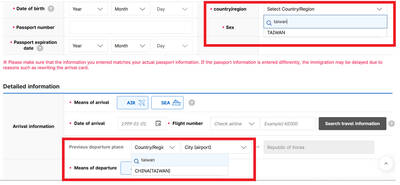
Jason Han says that the e-arrival card spat between South Korea and Taiwan shows that Seoul is signaling adherence to its “one-China” policy, while Taiwan’s response reflects a reciprocal approach. “Attempts to alter the diplomatic status quo often lead to tit-for-tat responses,” the analyst on international affairs tells the Taipei Times, adding that Taiwan may become more cautious in its dealings with South Korea going forward. Taipei has called on Seoul to correct its electronic entry system, which currently lists Taiwan as “China (Taiwan),” warning that reciprocal measures may follow if the wording is not changed before March 31. As of yesterday,
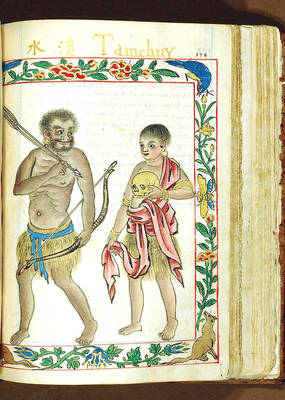
The Portuguese never established a presence on Taiwan, but they must have traded with the indigenous people because later traders reported that the locals referred to parts of deer using Portuguese words. What goods might the Portuguese have offered their indigenous trade partners? Among them must have been slaves, for the Portuguese dealt slaves across Asia. Though we often speak of “Portuguese” ships, imagining them as picturesque vessels manned by pointy-bearded Iberians, in Asia Portuguese shipping between local destinations was crewed by Asian seamen, with a handful of white or Eurasian officers. “Even the great carracks of 1,000-2,000 tons which plied
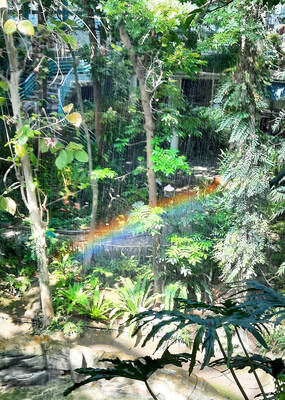
It’s only half the size of its more famous counterpart in Taipei, but the Botanical Garden of the National Museum of Nature Science (NMNS, 國立自然科學博物館植物園) is surely one of urban Taiwan’s most inviting green spaces. Covering 4.5 hectares immediately northeast of the government-run museum in Taichung’s North District (北區), the garden features more than 700 plant species, many of which are labeled in Chinese but not in English. Since its establishment in 1999, the site’s managers have done their best to replicate a number of native ecosystems, dividing the site into eight areas. The name of the Coral Atoll Zone might
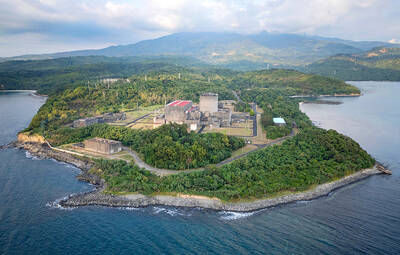
Nuclear power is getting a second look in Southeast Asia as countries prepare to meet surging energy demand as they vie for artificial intelligence-focused data centers. Several Southeast Asian nations are reviving mothballed nuclear plans and setting ambitious targets and nearly half of the region could, if they pursue those goals, have nuclear energy in the 2030s. Even countries without current plans have signaled their interest. Southeast Asia has never produced a single watt of nuclear energy, despite long-held atomic ambitions. But that may soon change as pressure mounts to reduce emissions that contribute to climate change, while meeting growing power needs. The


 RSS
RSS