


She has written some of Taiwan’s most popular romantic dramas, but years ago award-winning screenwriter Mag Hsu (徐譽庭) had her own heart broken when her then-boyfriend dumped her for her best friend.
“I somehow had a gut feeling that it would happen. My first love and my best friend shared many similar tastes — they picked the same clothes and liked the same kind of movies — so when he started a relationship with her, it wasn’t a big surprise to me,” recalls the 51-year-old, who is behind the screenplays of hit television series In Time with You (我可能不會愛你, 2011), Mars (戰神, 2004) and Meteor Garden 2 (流星花園2, 2002).
While most would harbor a grudge over having their beau stolen, Hsu’s experience gave her an unexpected brainwave for her debut film, Dear Ex (誰先愛上他的), which made its world premiere at the Far East Film Festival (FEFF) in Udine, Italy last month. Co-directed with music video director Hsu Chih-yen (許智彥), the family drama was one of 21 candidates for the festival’s newly-established award, the White Mulberry, which recognizes Asian directors presenting their first or second film.
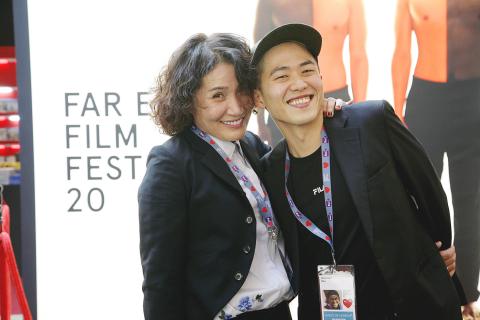
Photo Courtesy of Ricky Modena
“I was inspired to write a story about the third person who broke up a romance,” Mag Hsu says. “From my personal love story, I found out that the one you may regard as the ‘enemy’ who stole your love, could, in fact, be your friend, because we both loved the same person.”
In Dear Ex, the enemy in question is not a woman, but a man named Jay (Roy Chiu, 邱澤), the gay lover of the deceased Song Zheng-yuan (Spark Chen, 陳如山, of band Quarterback). After Song passes away from cancer, his widow Liu San-lian (Hsieh Ying-hsuan, 謝盈萱) discovers that her late husband made Jay the sole beneficiary of his life insurance policy, leaving her and their teenage son Cheng-xi (Joseph Huang) with nothing. Cheng-xi soon finds himself caught between his mother and Jay, who are at odds over both love and money.
“The four characters in our film, including the one that dies, are all very complex, and it wasn’t easy to depict them,” says Hsu Chih-yen, who is also making his film debut. A familiar face in Taiwan’s music industry, the 33-year-old has directed the videos of artists from major hip-hop label Kao!, including rappers Miss Ko, DJ Didilong and Soft Lipa.

Photo Courtesy of Far east film
“I read the script over and over again in all my waking hours,” he says, “and it took me about two months before I fully understood the characters.”
With their age gap of nearly 20 years and different fields of specialization, the directing duo comprising the older and younger Hsu may come across as an unlikely pairing. But Mag Hsu, who has previously directed for the stage, explains that it was a conscious decision on her part to rope a younger collaborator into this project and serve as a mentor figure.
“For me it’s a late start to be a director, so I wanted somebody young, pure and willing to tuck into the movie industry. I feel that I should be part of the generation guiding and coaching young filmmakers,” she says.
It turned out to be a complementary combination of skills, with Mag Hsu coaching the actors and Hsu Chih-yen taking charge of the film’s visuals. Notably, the first half of Dear Ex features several colorful animated sequences that depict the inner psyche of young protagonist Cheng-xi, of which were only added after a test screening with Mag Hsu’s friends.
“After some people watched our first cut, I was really sad because the reaction wasn’t as good as I had expected,” she says. “I was worried that this film might be left in the refrigerator forever, so we decided to retouch the film to make it more whimsical and appealing to younger viewers.”
It seems like their efforts have paid off — Dear Ex was received positively at the Far East Film Festival, with audiences praising its heartfelt storyline and snappy graphics.
“The response there was overwhelming,” Mag Hsu says. “On the other hand, predicting how Taiwanese audiences will react to our film is like fishing for a needle in the ocean, though I hope they will react the same way as those in Italy.”
Given Taiwan’s historic ruling towards legalizing same-sex marriage in May last year, it perhaps could not be a more well-timed release for Dear Ex, which is set to open in local theaters in September.
With that in mind, however, both directors are quick to assert that their film goes beyond its LGBT themes.
“The film is really about humanity and love. When it comes to love, there should not be any kind of discrimination,” Hsu Chih-yen says.
The sentiment is echoed by Mag Hsu. “Many people in the world have different views about love, and how to deal with love,” she says. “At the end of the day, I want this film to help us understand the real meaning of love, and resolve any opposing ideas.”

Taiwan’s English education system is being pulled apart by three opposing forces. Bilingual Nation 2030 pulls students toward English and global communication. Artificial Intelligence (AI) readiness pulls them toward digital judgment, verification and AI-mediated work. But Taiwan’s old exam culture pulls them back toward memorization, grammar drills, timed reading and correct answers. If the education system keeps using old exams to define success, it risks producing graduates who are neither genuinely bilingual nor genuinely AI-ready, but trained for tasks machines can already perform. The first force is Bilingual Nation 2030. Launched in 2018, the policy aimed to “help Taiwan’s workforce connect

It seems every few days one bumps into one of those “real man” comments in which Taiwan is urged to “face reality” or similar, and “make a deal,” with the speaker implying that soon it will be too late. “Deal” advocates always present themselves as having a superior grip on reality, and the manly ability to make the “hard choice.” Their testosterone-laden language often echoes that of Taiwan sellout advocates. Note that such commentary always specifies a process (“make a deal, work with, make progress”), never the end state of what occupation by a violent authoritarian colonialist state will entail. In

“Taiwan’s Opposition Leader Comes to US With a Message Straight Out of Beijing” read a May 31 headline in the Wall Street Journal. Top US administration officials and members of Congress almost certainly read the WSJ, and if there was a bullet point takeaway that people in Washington should absorb ahead of Chinese Nationalist Party (KMT) Chair Cheng Li-wun’s (鄭麗文) arrival in DC on June 9, that headline is it. The last few columns have discussed this very topic, and the timing is not coincidental. While those top officials likely do not read the Taipei Times, judging by the number
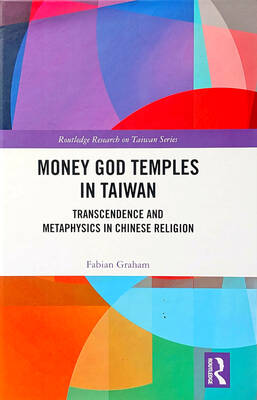
As someone who normally steers clear of books with “transcendence” or “metaphysics” in their subtitles, this reviewer — a casual observer of local belief systems since the 1990s — found Fabian Graham’s Money God Temples in Taiwan a challenging read. Those who’ve only dipped their toes into temple culture will likely need to parse several sections with special care if they’re to keep up with the author, a British ethnographic researcher whose previous books have investigated religious practices among ethnic Chinese in Southeast Asia. This scholarly volume examines a facet of Taiwan’s religious landscape that didn’t exist a century ago, and


 RSS
RSS