


High school outcasts, a housewife-turned-embezzler, dysfunctional siblings. The oddball films of Japanese director Daihachi Yoshida have always centered on individuals living on the fringe, and his latest feature The Scythian Lamb (羊之木), is no exception.
Currently showing in theaters, Yoshida’s black comedy casts the spotlight on yet another group of outsiders, this time in the more extreme sense of the word: six convicted murderers. They are the guinea pigs of a new government resettlement project to fight rural depopulation: place low-risk prisoners in the coastal town of Uobuka for 10 years, and if they can stay out of trouble, they will be permanently freed.
City official Tsukisue (played by Japanese pop idol Ryo Nishikido) is in charge of ensuring the new residents settle in: there is barber Fukumoto, former Yakuza member Ono, sexy Ota, reclusive Kurimoto, photographer-cum-fishing boat operator Sugiyama and the courteous Miyakoshi. But the greater concern lies in the possibility of these murderers reverting to their old ways. A body soon washes up on Uobuka’s pier, throwing the peaceful community into disarray.
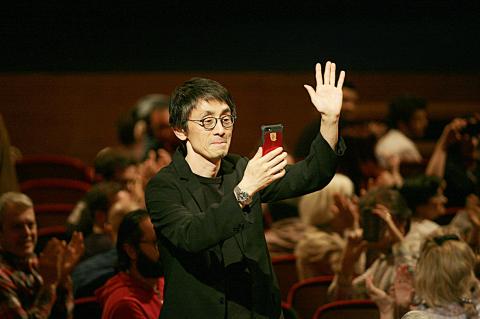
Photo courtesy of Ricky Modena
If The Scythian Lamb’s dystopian-like premise sounds like an episode of Black Mirror, you’re not alone — some critics have compared the film, which was adapted from a manga, to the hit Netflix television show. The British anthology series looks at the dark side of humanity’s innovations in an alternate present, such as how future governments may implement mass schemes for the greater good, at the expense of human existence.
“The manga explores a kind of experimentation in society that hasn’t been done before, which means it’s science fiction, so it contains similar aspects that you see in Black Mirror. And when I read the comic for the first time, I also considered the possibility of turning the book into a sci-fi movie,” Yoshida tells the Taipei Times, adding that he was impressed by the storyline on his first read.
The Scythian Lamb is based on the manga Hitsuji no Ki (The Sheep Tree) by Tatsuhiko Yamagami and Mikio Igarashi.
“I initially didn’t think I could film this manga, because the story is quite chaotic,” he says. “But at the same time, I was interested in how the comic not only touches on social problems in society, but also includes thriller elements.”
Whether such a novel prisoner resettlement scheme could prove effective in real life, however, is not the intention of the film, says the director. Unlike most Japanese movies, where good versus evil falls into absolute binaries and the world is seen in black and white, The Scythian Lamb posits the idea of a gray morality among its marginalized protagonists, in the process questioning our innate human capacity for tolerance and acceptance.
“Who is good, and who is bad — these are human roles that have been decided by us,” Yoshida says. “There are many in this world who are naturally not good people, yet they are still trying their best. And we’re going to have to co-exist with these people, even if we don’t know or understand them. Which leads to the big theme in my film: how generous can you be towards these strangers?”
For Yoshida, it’s a timely train of thought that hits close to home. Xenophobia is still prevalent in Japan, and strict refugee policies have kept the nation’s intake of asylum seekers consistently low amid the ongoing global migrant crisis.
“Japan is a country that is not very familiar with immigrant issues and we’re behind in tackling them. We’ve been a closed society up until 100 years ago. We need to open our minds a little bit more to understand these immigrant issues, and that’s something for me to think about as well.”
On a personal note, the director admits that he identifies with most of his characters when it comes to being singled out as the odd one in the field.
Yoshida took an unusual route into Japan’s film industry, having started out by making television commercials before debuting in 2007 with Funuke Show Some Love, You Losers!, which premiered at the Cannes Film Festival. Since then he has made six more feature films, including The Scythian Lamb and 2012’s The Kirishima Thing, which swept the best film and director prizes at Japan’s Academy Awards.
He says: “For genuine filmmakers who have not done anything except make movies, who started out like that from the beginning, they probably think of me as an outsider. But I don’t take that as a negative point. Instead I use it as a kind of drive to make good movies.”
That filmmaking drive persists today, though Yoshida adds that he is also motivated by another factor — to avoid becoming an idle couch potato.
“Making films makes me think more deeply about the problems our society faces. Without making films, I don’t find out anything. Instead, all I really want to do is watch football,” he says with a laugh.

Taiwan’s English education system is being pulled apart by three opposing forces. Bilingual Nation 2030 pulls students toward English and global communication. Artificial Intelligence (AI) readiness pulls them toward digital judgment, verification and AI-mediated work. But Taiwan’s old exam culture pulls them back toward memorization, grammar drills, timed reading and correct answers. If the education system keeps using old exams to define success, it risks producing graduates who are neither genuinely bilingual nor genuinely AI-ready, but trained for tasks machines can already perform. The first force is Bilingual Nation 2030. Launched in 2018, the policy aimed to “help Taiwan’s workforce connect

It seems every few days one bumps into one of those “real man” comments in which Taiwan is urged to “face reality” or similar, and “make a deal,” with the speaker implying that soon it will be too late. “Deal” advocates always present themselves as having a superior grip on reality, and the manly ability to make the “hard choice.” Their testosterone-laden language often echoes that of Taiwan sellout advocates. Note that such commentary always specifies a process (“make a deal, work with, make progress”), never the end state of what occupation by a violent authoritarian colonialist state will entail. In

“Taiwan’s Opposition Leader Comes to US With a Message Straight Out of Beijing” read a May 31 headline in the Wall Street Journal. Top US administration officials and members of Congress almost certainly read the WSJ, and if there was a bullet point takeaway that people in Washington should absorb ahead of Chinese Nationalist Party (KMT) Chair Cheng Li-wun’s (鄭麗文) arrival in DC on June 9, that headline is it. The last few columns have discussed this very topic, and the timing is not coincidental. While those top officials likely do not read the Taipei Times, judging by the number
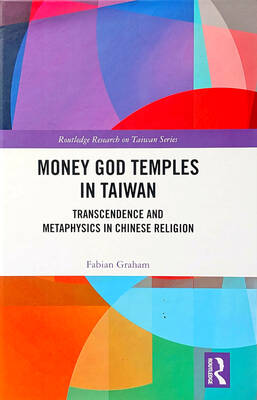
As someone who normally steers clear of books with “transcendence” or “metaphysics” in their subtitles, this reviewer — a casual observer of local belief systems since the 1990s — found Fabian Graham’s Money God Temples in Taiwan a challenging read. Those who’ve only dipped their toes into temple culture will likely need to parse several sections with special care if they’re to keep up with the author, a British ethnographic researcher whose previous books have investigated religious practices among ethnic Chinese in Southeast Asia. This scholarly volume examines a facet of Taiwan’s religious landscape that didn’t exist a century ago, and


 RSS
RSS