


Netherlands-based Spanish choreographer Ivan Perez Aviles likes experimentation and collaboration, as Taiwanese audiences saw with his work on Hui (迴) for the National Theater Concert Hall’s Dancing in Autumn series in 2015.
Hui was a massive collaboration for the National Theater that brought together Dance Forum Taipei (舞蹈空間), Amsterdam-based Anmaro Asia Arts and Scotland-based Cryptic, while the choreographing duties were split between Perez and Yang Ming-lung (楊銘隆).
This time around, Dance Forum and Perez have scaled down their new show for the 10th Taiwan International Festival of Arts (TIFA) to fit the National Experimental Theater, even as the size of the cast has grown from the original three dancers to 12.
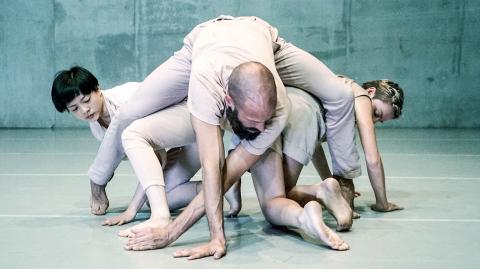
Photo courtesy of Alwin Poiana
Troupe founder and director Ping Heng (平珩) said one of her dancers, Chen Wei-yun (陳韋云), went to Europe last year to work with Perez on what became BECOMING, which premiered last summer at the B-Motion Festival in Bassano del Grappa, Italy before going on tour to London and the Netherlands.
Perez describes BECOMING as the outcome of his ongoing examination of movement and the body around the subject of fluid identities, and is part of Pivot Dance, which he said is a European project where choreographers, producers and audiences came together to investigate “new behaviors in the cultural sector.”
In an ever-changing world, societies are being shaped and changed through movement, be it the inflow of migrants and refugees, regions seeking their own identity or statehood, or the upcoming split of the UK from the EU.

Photo courtesy of AJ Korkidakis
Perez is interested in exploring how bodies explore the boundaries of established frames, of how they relate to one another and how they react to change. His works are known for their physical and emotional intensity.
BECOMING makes its Asian premiere tomorrow night. The dancers will be accompanied by Dutch musician Rutger Zuydervelt of Machinefabriek.
The show runs about 75 minutes, without intermission. There will be a post-show talk after Saturday’s matinee.
Breaking through set frames is a key element of the second TIFA program on offer this weekend, Nufonia Must Fall, at the National Concert Hall tomorrow night.
Nufonia is a live concert adaptation of a dialogue-free graphic novel of the same name penned by Canadian musician and DJ Eric San, whose performing and artistic nom de plume is Kid Koala.
The novel tells the story of Nufonia, a telephone-answering robot that loses its office job in favor of a newer model and ends up working in a sandwich shop. In the shop, Nufonia falls in love with one of the customers, and wants to create a song for her, even though it lacks music capabilities.
The concert is a mix of puppet theater, video, live music from a string quartet and electronic music.
Puppeteers Patrick Martel, Tyson Houseman and Veronica Barron create the action that is shown as a silent film above the heads of the Afiara Quartet and Kid Koala, with help from director of photography AJ Korkidakis and video editor Ben Knight.
The show runs 60 minutes without intermission and there are just a handful of tickets left.
Performance notes:
WHAT: BECOMING
WHEN: Tomorrow and Saturday at 7:30pm, Saturday and Sunday at 2:30pm
WHERE: National Experimental Theater (國家實驗劇場), 21-1 Zhongshan S Rd, Taipei City (台北市中山南路21-1號)
ADMISSION: Tickets are NT$800, available at NTCH box offices, online at www.artsticket.com and convenience store ticket kiosks. Tomorrow night is sold out, and a handful of seats are left for the other two shows
WHAT: DJ Kid Koala’s Nufonia Must Fall
WHERE: National Concert Hall, 21-1 Zhongshan S Rd, Taipei City (台北市中山南路21-1號)
WHEN: Tomorrow at 7:30pm
ADMISSION: A handful of NT$1,200 and NT$1,600 tickets are left, available at the NTCH box offices, online at www.artsticket.com.tw or at convenience store ticket kiosks

The Portuguese never established a presence on Taiwan, but they must have traded with the indigenous people because later traders reported that the locals referred to parts of deer using Portuguese words. What goods might the Portuguese have offered their indigenous trade partners? Among them must have been slaves, for the Portuguese dealt slaves across Asia. Though we often speak of “Portuguese” ships, imagining them as picturesque vessels manned by pointy-bearded Iberians, in Asia Portuguese shipping between local destinations was crewed by Asian seamen, with a handful of white or Eurasian officers. “Even the great carracks of 1,000-2,000 tons which plied

It’s only half the size of its more famous counterpart in Taipei, but the Botanical Garden of the National Museum of Nature Science (NMNS, 國立自然科學博物館植物園) is surely one of urban Taiwan’s most inviting green spaces. Covering 4.5 hectares immediately northeast of the government-run museum in Taichung’s North District (北區), the garden features more than 700 plant species, many of which are labeled in Chinese but not in English. Since its establishment in 1999, the site’s managers have done their best to replicate a number of native ecosystems, dividing the site into eight areas. The name of the Coral Atoll Zone might

On Monday morning, in quick succession, the Chinese Communist Party (CCP) and the Chinese Nationalist Party (KMT) released statements announcing “that the Central Committee of the Communist Party of China and General Secretary Xi Jinping (習近平) have invited KMT Chairwoman Cheng Li-wun (鄭麗文) to lead a delegation on a visit to the mainland” as the KMT’s press release worded it. The KMT’s press release added “Chairwoman Cheng expressed her gratitude for the invitation and has gladly accepted it.” Beijing’s official Xinhua news release described Song Tao (宋濤), head of the Taiwan Work Office of the CCP Central Committee, as
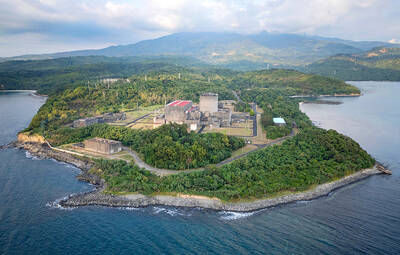
Nuclear power is getting a second look in Southeast Asia as countries prepare to meet surging energy demand as they vie for artificial intelligence-focused data centers. Several Southeast Asian nations are reviving mothballed nuclear plans and setting ambitious targets and nearly half of the region could, if they pursue those goals, have nuclear energy in the 2030s. Even countries without current plans have signaled their interest. Southeast Asia has never produced a single watt of nuclear energy, despite long-held atomic ambitions. But that may soon change as pressure mounts to reduce emissions that contribute to climate change, while meeting growing power needs. The


 RSS
RSS