


Dutch and French art historians on Monday unveiled the surprising results of 18 months of painstaking restoration work on a pair of 17th century portraits by Dutch master Rembrandt.
The portraits of a newly married Dutch couple were jointly bought in 2015 by the Netherlands and France for US$174 million from the wealthy Rothschild banking family in an unprecedented deal.
Teams from the Louvre in Paris and the Rijksmuseum in Amsterdam spent the past 18 months researching the paintings, before carefully removing at least six layers of old varnish as part of “an exciting adventure” to restore the canvases.
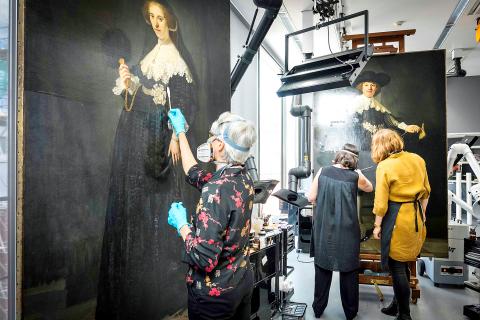
Photo: AFP
“They are undoubtedly completely painted by Rembrandt up to the smallest detail,” Rijksmuseum general director Taco Dibbits told reporters Monday, adding they were Rembrandt’s first and only full-length portraits of a married couple.
Wrangling over the portraits, captured around the time of the couple’s wedding in 1634, had threatened to sour relations between France and the Netherlands.
But the accord reached to avoid a bidding war will now see the two portraits alternate between the Rijksmuseum and the Louvre.

Photo: AFP
Affluent Amsterdam couple Marten Soolmans, 20, and Oopjen Coppit, 22, commissioned Rembrandt to paint the separate portraits.
Both dressed fashionably in black with white lace ruffles, Soolmans is depicted holding a glove in his left hand, while Coppit holds a gold chain topped by a black-feathered fan and wears a four-row pearl necklace, with a band of pearls in her hair.
Using sophisticated scientific techniques, including ultra-violet scans, X-rays and macro X-ray fluorescence, restorers determined the two paintings once shared the same large piece of canvas. It remains unknown however if the portraits were painted together and then separated, although restorers believe the canvas was split prior to painting.
HIDDEN DETAILS
Close analysis also revealed hidden details, such as doorways behind each person which Rembrandt later covered over by painting in a simple black curtain as a background.
The restoration has infused the paintings with new light, to show off the “incredible modernity” of Rembrandt’s original work, said Dibbits.
The details stand out, such as the exquisite lace ruffles on Marten’s shoes. It “feels as if you press them they will bounce back,” he said.
Sebastien Allard, head of the Louvre’s paintings department, praised what he called “an innovative” project, which after complicated negotiations “finally came to a European solution to protect cultural heritage.”
The project was a first for the team of restorers, who under a “prenuptial” agreement had to collaboratively agree on every detail of the restoration, Dibbits quipped.
Discussions are still underway as to how the paintings will be framed when they go back on exhibition — the Louvre preferring gilt frames, while the Rijksmuseum prefers plain black wood.
For Anne Lepage, a restorer with the Louvre, it proved an enriching experience as the two teams shared their techniques, as they approached the two portraits with “great respect.”
“You never touch a painting without having done research, analysis and working with the archives. It’s like putting together a file on a sick person before even intervening,” she tsays.
She said restorers always felt the weight of the painting’s history and heritage, saying the aim was to “transmit it as close to the original as possible.”
The canvases had been viewed publicly only once in the past 150 years, during a 1956 exhibition at the Rijksmuseum, as since being acquired by the Rothschilds in the late 19th century, they had been mainly hung in a bedroom.
The works will now go on show in the Rijksmuseum from March 6 in an exhibition called “High Society” and then move back to the Louvre. They are due to alternate between the two museums every five years and then every eight years. Under the terms of the deal, they cannot be lent to any other establishment.

For many people, Bilingual Nation 2030 begins and ends in the classroom. Since the policy was launched in 2018, the debate has centered on students, teachers and the pressure placed on schools. Yet the policy was never solely about English education. The government’s official plan also calls for bilingualization in Taiwan’s government services, laws and regulations, and living environment. The goal is to make Taiwan more inclusive and accessible to international enterprises and talent and better prepared for global economic and trade conditions. After eight years, that grand vision is due for a pulse check. RULES THAT CAN BE READ For Harper Chen (陳虹宇), an adviser

Traditionally, indigenous people in Taiwan’s mountains practice swidden cultivation, or “slash and burn” agriculture, a practice common in human history. According to a 2016 research article in the International Journal of Environmental Sustainability, among the Atayal people, this began with a search for suitable forested slopeland. The trees are burnt for fertilizer and the land cleared of stones. The stones and wood are then piled up to make fences, while both dead and standing trees are retained on the plot. The fences are used to grow climbing crops like squash and beans. The plot itself supports farming for three years.

The breakwater stretches out to sea from the sprawling Kaohsiung port in southern Taiwan. Normally, it’s crowded with massive tankers ferrying liquefied natural gas from Qatar to be stored in the bulbous white tanks that dot the shoreline. These are not normal times, though, and not a single shipment from Qatar has docked at the Yongan terminal since early March after the Strait of Hormuz was shuttered. The suspension has provided a realistic preview of a potential Chinese blockade, a move that would throttle an economy anchored by the world’s most advanced and power-hungry semiconductor industry. It is a stark reminder of

May 4 to May 10 It was once said that if you hadn’t performed at the Sapphire Grand Cabaret (藍寶石大歌廳), you couldn’t truly be considered a star. Taking the stage at the legendary Kaohsiung club was more than just a concert. Performers were expected to entertain in every sense, wearing outlandish or revealing costumes and staying quick on their feet as sharp-tongued, over-the-top hosts asked questions and delivered jokes that would be seen as vulgar, even offensive, by today’s standards. Opening in May 1967 during a period of strict political and social control, Sapphire offered a rare outlet for audiences in


 RSS
RSS