


Little-known yet knock-out stunning places like Pingtung County’s Hayouxi Hot Spring (哈尤溪溫泉) perfectly illustrate just how the country’s natural landscape is capable of constantly rewarding and surprising the curious explorer. Although slowly becoming better known, Hayouxi Hot Spring doesn’t even appear on many maps that mark many far less magnificent thermal sources.
The rocks of this kilometer-long gorge of hot spring activity are clothed in a variety of beautiful mineral-and-bacteria-painted colors in many shades of red, orange, yellow, green, grey and brown.
Hot spring bathers may be disappointed — apart from Dawu Hot Spring (大武溫泉), at about the halfway point of the trip, there are no places to take a hot spring bath here — but it’s those incredible colors, plus the beauty and ruggedness of the gorge, as well as the impressive remoteness of the place, that really repay a visit.
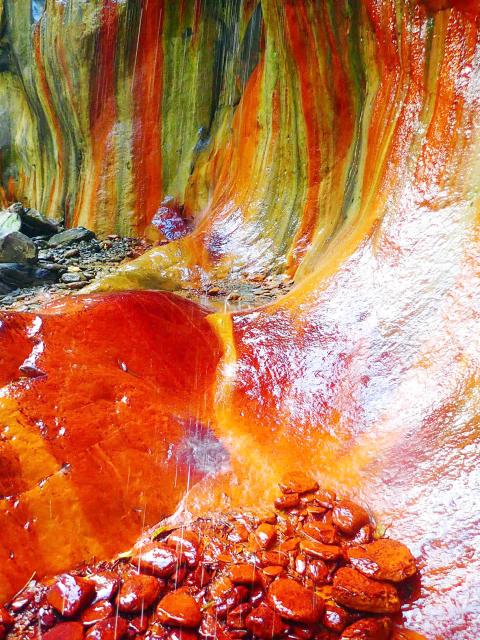
Photo: Richard Saunders
REMOTE
Hayouxi Hot Spring lies in a very remote spot, deep in the central mountains of southern Taiwan. Until 2009, it was very hard to reach and rarely visited. In that year, however, Typhoon Morakot roared across Taiwan, bringing masses of sand, gravel and rock down the gorge of the Yiliaobei Creek (隘寮北溪), leaving a wide, level river bed, and made the 12km journey upstream from the nearest road access a much easier trip than before. In fact, at weekends during the season, local villagers now take groups of visitors up the gorge in high-clearance four-wheel drive (4WD) vehicles to within a kilometer of the hot springs.
The jumping-off spot for Hayouxi Hot Spring is the Rukai Aboriginal village of Wutai (霧台). Major improvements in the quality of the mountain road that connects Wutai with the outside world (including Taiwan’s highest bridge), make it an easier place to reach than it was a few years ago.
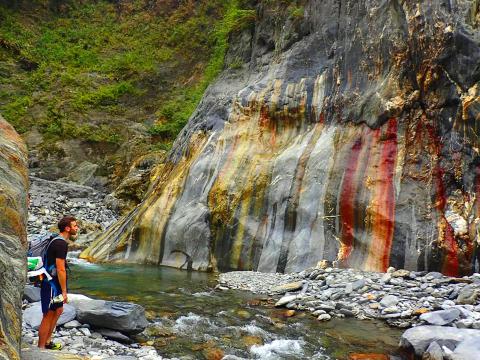
Photo: Richard Saunders
From Wutai take a side road down into the gorge below to Dawu (大武), another, smaller, Aboriginal settlement and park near the long but intimidatingly narrow Guairen (古仁人橋) suspension bridge across the Yiliaobei Creek. It’s suitable for cars, but quite a tight fit for bigger vehicles. Walk down to the very broad riverbed at the far side of the bridge and simply start walking upstream.
Although Hayouxi Hot Spring gorge is stunning, the walk up to it is pleasant, but not much more for the most part. The mountain walls rise high and sheer in several places, and the river itself is fast-flowing and crystal-clear, but despite some amazing stretches it becomes a slightly monotonous 11km trudge along tracks worn through the rock-choked riverbed by the jeeps. Apart from noisy vehicles, large numbers of mountain bikes come this way on weekends, as well as a few hikers.
DAWU HOT SPRING
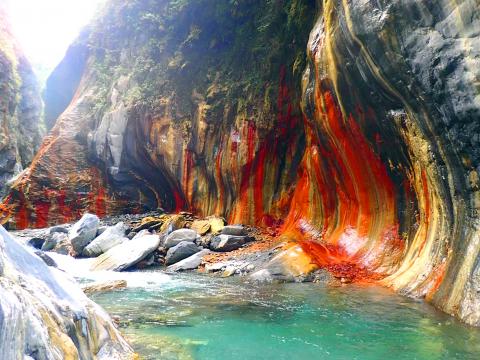
Photo: Richard Saunders
One section of the route, close to the halfway point, is rather impressive, as the gorge briefly and impressively tightens when the river squeezes through a cleft between sheer cliffs. Just after this is Dawu Hot Spring, which bubbles up into a large-ish pool below the cliffs. The water is stained a slightly unappealing bright orange-ochre color by bacteria and/or minerals, but is pleasantly hot. It’s a popular camping spot, since this is the only hot spring to bathe in on the route, so expect plenty of 4WDs, tents and families at weekends.
Above Dawu Hot Spring, it’s more of the same, following the track upstream beneath the towering sides of the wide gorge, with plenty more river crossings. At the very obvious confluence, take the river on the right. It remains fairly wide and open for a spell, then on the right bank there’s a large, flat area of land where 4WDs park and some hikers camp. This, thankfully, marks the farthest point that vehicles can reach, and from here, everyone must make the last part of the journey on foot.
The gorge narrows, and heading upstream, a tall and very attractive waterfall soon comes into view, plunging down the side of the gorge on the right. At its foot and nearby are the last good camping spots on the route.
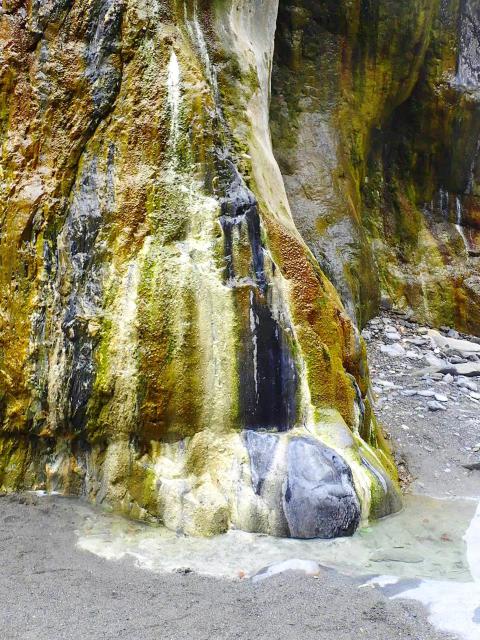
Photo: Richard Saunders
At the next corner the first signs of hot spring activity appear in the shape of a bright orange-colored rock, on the right. From here it’s another 15 to 20-minute walk to the small waterfall that makes further access up the gorge tricky without ropes. The delicate arc of a hot spring waterfall in the gorge leaps out from the right wall of the gorge just before this, but it’s just the last of many amazing, colorful formations passed on that last stunning kilometer.
The hot spring gorge is an astonishing place, and demands several visits at different times of the day. Try to spend the night, and visit once in the late afternoon (after the last 4WDs have left) and again early the following morning, when the golden hour (before the sun starts shining directly into the gorge) makes all those natural colors seem to almost glow.
IF YOU GO
Hayouxi Hot Spring is only accessible during the dry season, which is generally between January or February and April. The river has to be crossed many times during the walk up, and while it’s generally only thigh-deep in most places, and poses no special difficulty during the winter, it becomes far too high to cross after the plum rains start in late April or early May — and after heavy rain at any time of the year. Whatever time you visit, you’ll need your own wheels, as there’s no public transport anywhere nearby. Wear a pair of old shoes or sandals with heel straps for the walk up, and plan to have wet feet for the four or five hours it takes to walk from Dawu Bridge to the hot spring gorge.
The water in the stream is sweet and pure for drinking (after filtering or boiling).
Richard Saunders is a classical pianist and writer who has lived in Taiwan since 1993. He’s the founder of a local hiking group, Taipei Hikers, and is the author of six books about Taiwan, including Taiwan 101 and Taipei Escapes. Visit his Web site at www.taiwanoffthebeatentrack.com.

Jason Han says that the e-arrival card spat between South Korea and Taiwan shows that Seoul is signaling adherence to its “one-China” policy, while Taiwan’s response reflects a reciprocal approach. “Attempts to alter the diplomatic status quo often lead to tit-for-tat responses,” the analyst on international affairs tells the Taipei Times, adding that Taiwan may become more cautious in its dealings with South Korea going forward. Taipei has called on Seoul to correct its electronic entry system, which currently lists Taiwan as “China (Taiwan),” warning that reciprocal measures may follow if the wording is not changed before March 31. As of yesterday,

The Portuguese never established a presence on Taiwan, but they must have traded with the indigenous people because later traders reported that the locals referred to parts of deer using Portuguese words. What goods might the Portuguese have offered their indigenous trade partners? Among them must have been slaves, for the Portuguese dealt slaves across Asia. Though we often speak of “Portuguese” ships, imagining them as picturesque vessels manned by pointy-bearded Iberians, in Asia Portuguese shipping between local destinations was crewed by Asian seamen, with a handful of white or Eurasian officers. “Even the great carracks of 1,000-2,000 tons which plied
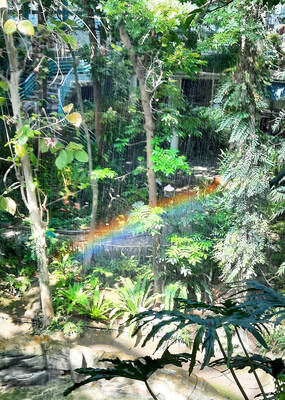
It’s only half the size of its more famous counterpart in Taipei, but the Botanical Garden of the National Museum of Nature Science (NMNS, 國立自然科學博物館植物園) is surely one of urban Taiwan’s most inviting green spaces. Covering 4.5 hectares immediately northeast of the government-run museum in Taichung’s North District (北區), the garden features more than 700 plant species, many of which are labeled in Chinese but not in English. Since its establishment in 1999, the site’s managers have done their best to replicate a number of native ecosystems, dividing the site into eight areas. The name of the Coral Atoll Zone might
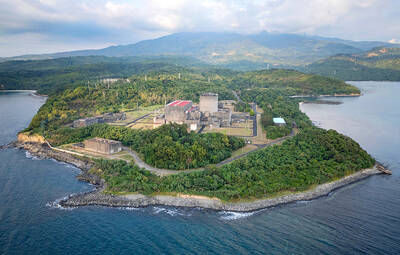
Nuclear power is getting a second look in Southeast Asia as countries prepare to meet surging energy demand as they vie for artificial intelligence-focused data centers. Several Southeast Asian nations are reviving mothballed nuclear plans and setting ambitious targets and nearly half of the region could, if they pursue those goals, have nuclear energy in the 2030s. Even countries without current plans have signaled their interest. Southeast Asia has never produced a single watt of nuclear energy, despite long-held atomic ambitions. But that may soon change as pressure mounts to reduce emissions that contribute to climate change, while meeting growing power needs. The


 RSS
RSS