


The Teahouse of the August Moon is a classic of American fiction about World War II and its aftermath in the Pacific region. It was first published in 1951, two years before the author’s novel about Taiwan’s “white terror,” A Pail of Oysters [reviewed in Taipei Times Feb. 28, 2016]. It was made into a successful stage play, and then filmed, and now the novel itself has been re-issued in a smart new edition.
The book is set in Japan’s Okinawa when the island was under American occupation. Sneider had himself been stationed there and must have observed first hand the clash of cultures the novel focuses on. But the book is essentially a comedy, starting as a satire on US mind-sets at the time and then moving to contrast these with typical Japanese ways of looking at the world.
The Americans are determined to promote democracy and set up schools for formal education. The Okinawans, by contrast, inhabit a culture where barter takes precedence over any cash value, and where progress takes the form of cultivating sumo wrestling, kabuki theater (including Chikamatsu’s plays), the tea ceremony, flower arrangement, the production of reed sandals and the establishment of a teahouse suitable for geisha girls to operate in.
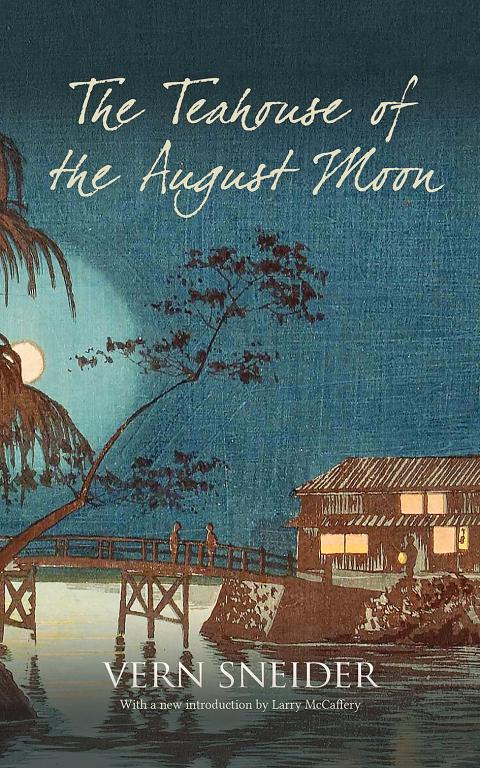
The Americans have a Plan B, canned food rations and strict dress codes. They’re overseen by a typical Protestant authority-figure, Colonel Purdy, whose wife back in the US is urging the establishment of a Women’s League for Democratic Action. Geisha, however, hardly fit in with this ideal. “Prostitutes!” exclaims Purdy. Well, not exactly, reply the Okinawans.
At the center of the plot is a Captain Fisby who, clearly representing Sneider’s views, quickly becomes a convert to Japanese ways. Two geisha have arrived in his village, and he sets about building a teahouse for them, trading salt for fish, fish for bamboo, bamboo for reeds with which to make tatami mats, and so on. His key local assistant soon becomes enamored of one of the geisha, and it isn’t long before Fisby finds himself acting as a go-between.
But the trade that happens far from Colonel Purdy’s supervision soon expands to include exports to nearby China of Okinawan specialties such as lacquer ware, bamboo cricket cages, dried and processed shark fin, fish cakes, soy sauce, goat-hair calligraphy brushes, ink-wells made of polished red rock and indigo dye. The locals are all immensely happy with these developments, and Fisby’s attempts to introduce a monetary system on the island for the first time are easily circumvented.
Eventually Purdy himself, seeing that there are profits to be made, is won over, even though he wants to compromise by organizing the locals into production lines, something that goes against their pride in having created the finished product on their own. The Teahouse of the August Moon (i.e. the moon of the mid-autumn festival) is nonetheless eventually opened, to universal celebration.
This in a way constitutes an optimistic fantasy. The values and traditions of the defeated country win out over those of the occupying super-power, with the occupiers happy to join in the jamboree. Sneider clearly dreamed that this might have been the case, but modern Japan probably bears a closer resemblance to the US than to traditional Okinawan culture as presented here.
Nevertheless, The Teahouse of the August Moon is hugely prescient in literary terms. The mockery of American short-sightedness clearly anticipates the far more trenchant satire of Joseph Heller in Catch 22 (1961) and Kurt Vonnegut in Slaughterhouse Five (1969), let alone the brutal hysteria of Stanley Kubrick’s 1964 film Dr. Strangelove and Francis Coppola’s Apocalypse Now (1979). The reason for Teahouse’s lighter tone is that it doesn’t depict actual combat (Sneider himself was never under fire), even though the Battle of Okinawa had been one of the bloodiest confrontations of the entire war, with 84,000 Japanese and 75,000 Americans and their allies killed. Half the population of Okinawa disappeared.
If in the last analysis I enjoyed A Pail of Oysters more, it was perhaps because it is set in Taiwan (I have never been to Okinawa), and because it contains more somber elements, notably two young lovers who are executed by the Chinese Nationalist Party (KMT) on the grounds of their suspected Communist sympathies. Teahouse, by contrast is comic throughout, albeit with serious insights included in the general depiction.
There’s quite a bit to be learned, too, from this book and its appendices — that the Japanese currency under US occupation was called “invasion yen,” that the best lacquer ware came from the Ryuku Islands (today the source of much contention), that the Okinawan village Sneider commanded was called Tobaru, and that the 1956 film of the book starred Marlon Brando in a Japanese role.
Nonetheless, the most extraordinary feature of this novel remains the absence of battle scenes, as mentioned above. The Battle of Okinawa ended on June 22, 1945, and the novel appears to take place between June and September of that year. In theory the fighting could have been over before the plot begins, but even so the total absence of wounded Okinawans, and of any reference to dead ones (one very minor case excepted), remains mysterious.
Some have seen this as indicating that Sneider’s is a dream world, but others argue that what he’s depicting is a world that could, if attitudes allowed, have been a real one. Either way, this is a book to be perused and digested, not only in its own right, but also in the context of fictional portraits of the US in World War II as a whole.

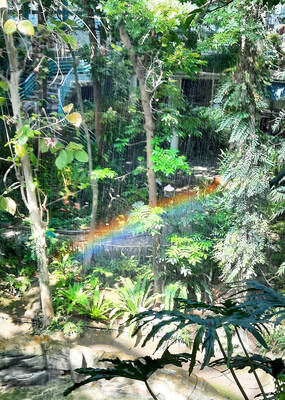
It’s only half the size of its more famous counterpart in Taipei, but the Botanical Garden of the National Museum of Nature Science (NMNS, 國立自然科學博物館植物園) is surely one of urban Taiwan’s most inviting green spaces. Covering 4.5 hectares immediately northeast of the government-run museum in Taichung’s North District (北區), the garden features more than 700 plant species, many of which are labeled in Chinese but not in English. Since its establishment in 1999, the site’s managers have done their best to replicate a number of native ecosystems, dividing the site into eight areas. The name of the Coral Atoll Zone might
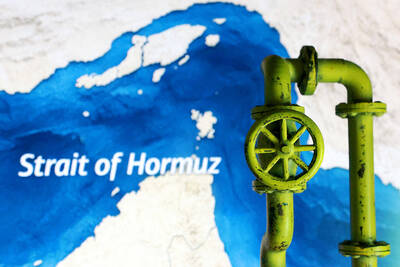
The US war on Iran has illuminated the deep interdependence of Asia on flows of oil and related items as raw materials that become the basis of modern human civilization. Australians and New Zealanders had a wake up call. The crisis also emphasizes how the Philippines is a swatch of islands linked by jet fuel. These revelations have deep implications for an invasion of Taiwan. Much of the commentary on the Taiwan scenario has looked at the disruptions to world trade, which will be in the trillions. However, the Iran war offers additional specific lessons for a Taiwan scenario. An insightful

On Monday morning, in quick succession, the Chinese Communist Party (CCP) and the Chinese Nationalist Party (KMT) released statements announcing “that the Central Committee of the Communist Party of China and General Secretary Xi Jinping (習近平) have invited KMT Chairwoman Cheng Li-wun (鄭麗文) to lead a delegation on a visit to the mainland” as the KMT’s press release worded it. The KMT’s press release added “Chairwoman Cheng expressed her gratitude for the invitation and has gladly accepted it.” Beijing’s official Xinhua news release described Song Tao (宋濤), head of the Taiwan Work Office of the CCP Central Committee, as
Polling data often confirms what we expect, but sometimes it throws up surprises. When examined over time, some patterns appear that speak to something bigger going on. In this column, whenever possible, Formosa’s polls are used. Despite the sometimes cringeworthy antics of Formosa’s Chairman, Wu Tzu-Chia (吳子嘉), the data produced includes detailed breakdowns crucial for analysis. It has also been conducted monthly 11-12 times a year for many years with many of the same questions, allowing for analysis over time. When big shifts do occur between one month and the next it is usually in response to some event in


 RSS
RSS