


Kisaku Suzuki, creator of the world’s first sushi robot, once ran a company that made candy-wrapping machines. And he was angry.
Why had the Japanese government embarked on a policy to limit rice production, effectively paying some farmers to keep their paddy fields idle? For Suzuki, rice was the sacred heart of the country’s economy. He started to think about how to make the staple food more popular, so that Japan had no reason to restrict the crop.
And that’s when it came to him: he would use his firm’s knowledge of candy-packaging machines to develop the robot. The idea, while off-the-wall in the mid-1970s, had a simple premise. If he could lower the cost of making sushi by mechanizing parts of the process and reducing the need for highly paid chefs, he could bring the previously elite Japanese dish to the masses, and in doing so increase demand for rice.
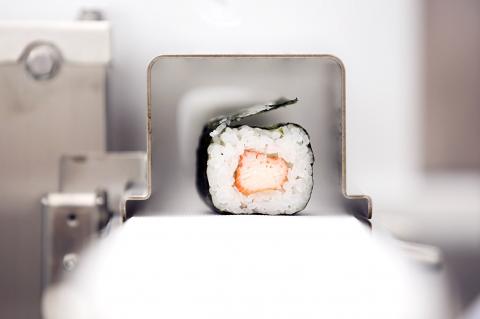
Photo: Bloomberg
Four decades later, Suzumo Machinery’s robots are used by about 70,000 customers around the world, ranging from sushi chains to factories, and account for about 70 percent of the market for the equipment at restaurants, according to Suzumo’s estimates. Kaiten sushi, also known as conveyor-belt sushi, has become a US$6 billion industry in Japan alone, partly thanks to Suzuki’s invention.
Cheap sushi “couldn’t have happened without our machines,” says Ikuya Oneda, who succeeded Suzuki as Suzumo president in 2004, a year before the founder died, and took over his life’s work. “You can certainly say that.”
HARD PRESSED
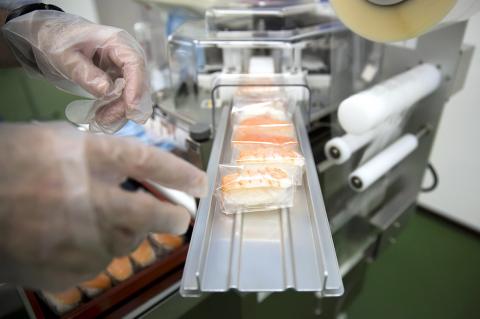
Photo: Bloomberg
When Suzuki started to create his robot, he met nothing but resistance. In 1976, sushi was largely a food for special occasions. It was mostly sold through a legion of small restaurants, where artisan chefs dispensed morsels with no price tags and charged how they saw fit.
Not surprisingly, those chefs were up in arms when they heard about Suzumo’s plan. In their view, it took 10 years to train someone to make sushi. No machine could possibly do the job. Suzumo asked some of the very people it was trying to depose to give their opinions on the prototype.
“They said, ‘This is no good, this is terrible, I don’t know what this is,’” said Oneda, 73, who became chairman of the company this year.
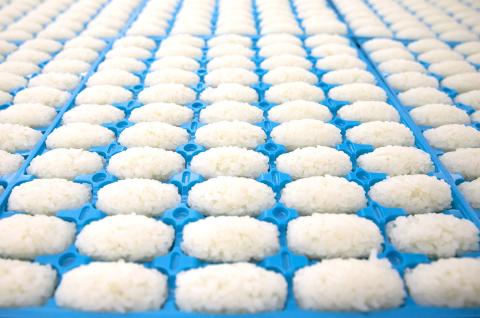
Photo: Bloomberg
After three years, Suzumo was nowhere near its goal and running out of cash. We thought “the company would go down the tubes,” Oneda said. “We thought about quitting.”
Suzumo stuck with the task, and two years later the sushi chefs finally said the machine was usable. In 1981, the company completed its first robot, which formed sushi rice into balls called nigiri. These days, it offers 28 different sushi machines.
“What they’ve done is allow kaiten restaurants to democratize and make good Japanese food affordable and accessible,” says Robin Rowland, chairman and chief executive officer of Yo!, a UK sushi chain with almost 100 restaurants globally. “We serve 7 million guests a year. You’re talking about 500 to 600 dishes on our belts in the UK. It’s a lot of food. And you need to automate some of that.”
CHANGING TIMES
But even so many years later, the debate still rages about the machines. For purists, if you use robots, it just isn’t the same.
“It’s an entirely different genre,” says Yoshikazu Ono, son and heir of Jiro Ono, the master chef featured in the documentary Jiro Dreams of Sushi. “Sushi isn’t just balls of rice. The process is the most important thing. It requires relentless practice to make just one piece of sushi rice — things like how you select, prepare and cook the rice, how much water you use and so on. You can’t get that from a robot.”
At the headquarters of Kura, about an hour south of Osaka, Kunihiko Tanaka bristles when he hears that argument. For the president and founder of Japan’s second-largest sushi chain, and a longtime Suzumo customer, the artisans are on the wrong side of history.
“The era where it’s OK to make sushi with your bare hands is over,” Tanaka says, referring to artisan sushi chefs in general. “They still do that, and say that is the real sushi. Things that should be changed should be changed.”
Already, about three-quarters of Japanese people say that when they eat sushi, it’s from a conveyor belt, according to a survey published by fishery company Maruha Nichiro in March. Almost half of them choose which restaurant based on price.
Michael Booth, a food writer whose latest book, The Meaning of Rice, is set for publication in next month, sees room for both types.
“I want everyone to get a chance to taste what amazing sushi from Jiro tastes like, because it’s a very, very different experience,” Booth says. “But then again, cheap, mass-produced sushi is like the entry drug into the sushi world, and that can be a good thing, too. People are exposed and may become curious as to what great sushi tastes like.”
RISE AND FALL OF RICE
In a sense, Suzumo dealt a blow to one part of traditional Japan, the artisan sushi business, so that another could prosper, the rice industry. It was an act of political subversion, attempting to derail the government’s policy of controlling the price of rice.
“As tastes became westernized, demand for rice began to decline,” says Eiji Minemura, an official at Japan’s agriculture ministry. “We took the policy of decreasing production to adjust to oversupply.”
Oneda and his colleagues’ actions show they never agreed. After developing their first sushi machines, they helped pioneer an iconic Japanese hamburger that uses rice patties instead of bread. They helped mechanize the kitchens of rice-bowl restaurants. And they even made a California roll sushi robot, as they targeted US demand for the food as a healthy and trendy choice.
It’s true that by one narrow definition, Suzumo didn’t succeed. Japan has kept controlling rice production since first introducing the policy in 1971. And demand for rice has fallen.
Still, the company’s share price has more than tripled since a low in February last year. Investors think Suzumo will benefit from the labor shortage in Japan and the overseas sushi boom, Oneda says. Of the three analysts covering the stock, all recommend buying. The shares rose 1.1 percent on Thursday of last week in Tokyo.
But for all the fanfare, Oneda, as he carries on Suzuki’s legacy, is still thinking about rice.
“Do you eat a proper breakfast?” he asks the Japanese reporter. “What do you eat? I bet it’s bread, right?”
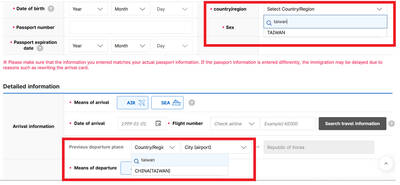
Jason Han says that the e-arrival card spat between South Korea and Taiwan shows that Seoul is signaling adherence to its “one-China” policy, while Taiwan’s response reflects a reciprocal approach. “Attempts to alter the diplomatic status quo often lead to tit-for-tat responses,” the analyst on international affairs tells the Taipei Times, adding that Taiwan may become more cautious in its dealings with South Korea going forward. Taipei has called on Seoul to correct its electronic entry system, which currently lists Taiwan as “China (Taiwan),” warning that reciprocal measures may follow if the wording is not changed before March 31. As of yesterday,

The Portuguese never established a presence on Taiwan, but they must have traded with the indigenous people because later traders reported that the locals referred to parts of deer using Portuguese words. What goods might the Portuguese have offered their indigenous trade partners? Among them must have been slaves, for the Portuguese dealt slaves across Asia. Though we often speak of “Portuguese” ships, imagining them as picturesque vessels manned by pointy-bearded Iberians, in Asia Portuguese shipping between local destinations was crewed by Asian seamen, with a handful of white or Eurasian officers. “Even the great carracks of 1,000-2,000 tons which plied
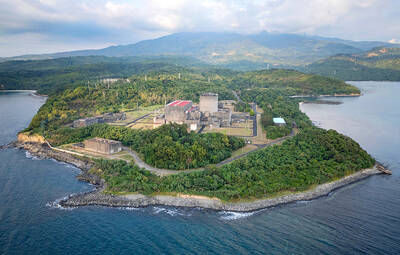
Nuclear power is getting a second look in Southeast Asia as countries prepare to meet surging energy demand as they vie for artificial intelligence-focused data centers. Several Southeast Asian nations are reviving mothballed nuclear plans and setting ambitious targets and nearly half of the region could, if they pursue those goals, have nuclear energy in the 2030s. Even countries without current plans have signaled their interest. Southeast Asia has never produced a single watt of nuclear energy, despite long-held atomic ambitions. But that may soon change as pressure mounts to reduce emissions that contribute to climate change, while meeting growing power needs. The
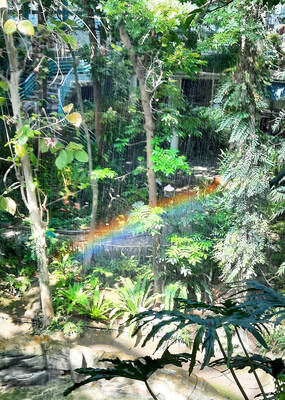
It’s only half the size of its more famous counterpart in Taipei, but the Botanical Garden of the National Museum of Nature Science (NMNS, 國立自然科學博物館植物園) is surely one of urban Taiwan’s most inviting green spaces. Covering 4.5 hectares immediately northeast of the government-run museum in Taichung’s North District (北區), the garden features more than 700 plant species, many of which are labeled in Chinese but not in English. Since its establishment in 1999, the site’s managers have done their best to replicate a number of native ecosystems, dividing the site into eight areas. The name of the Coral Atoll Zone might


 RSS
RSS