


Yilan County is so easy to reach these days that many favorite hiking spots in this beautiful corner of Taiwan are now feasible as day trips, yet I still have a nostalgia for the old days, when travelling there almost always meant taking a long bus ride along Highway No. 9.
Before the 12.9km Hsuehshan Tunnel (雪山隧道) opened in 2006, it took over two hours to travel from Taipei to the hot spring town of Jiaosi (礁溪). Sure, taking the train was quicker, and on a bright, sunny day the Pacific was a magnificent sight through the train window, but I’d happily forgo speed and relative comfort just to savor each time that marvelous few minutes when, after the bus had crossed the border between Taipei and Yilan, the road commenced the long descent to the Lanyang Plain (蘭陽平原) and the ocean, 600 meters below. Both came, abruptly and memorably, into view as the snaking road wound its way down the steep escarpment.
This part of Yilan County is one of the wettest corners of Taiwan, and the copious rainfall waters a stunning landscape of emerald-green, jungle-covered mountainsides dropping to a pancake-flat coastal plain of flooded paddy fields. Before developers moved in after the tunnel was built, the Lanyang Plain was a mass of bright green paddies during the wet summer months, dotted with solitary farmers houses and low-lying tombs, each of which to this day becomes a tiny island in a huge, shallow lake that forms after heavy rains. Today, the lush, forest-covered mountain slopes remain as pristine as they were, abruptly towering above the plain, and streaked with a series of impressive waterfalls which were the main reasons I used to make the long trip out from Taipei a couple of decades ago.
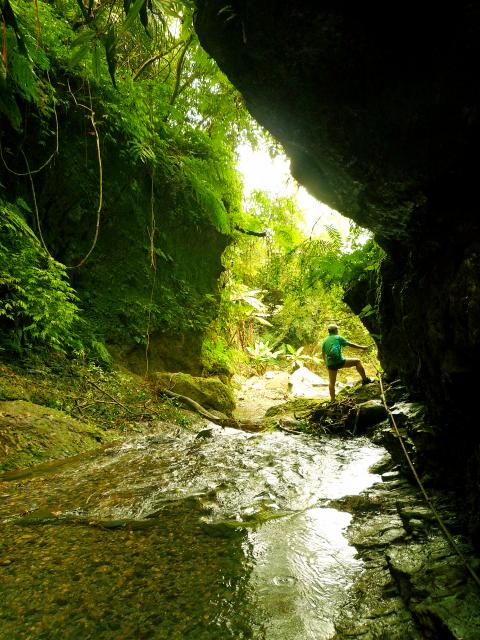
Photo: Richard Saunders
REMAINING WATERFALLS
The opening of Freeway No. 5 not only led to the extraordinarily rapid development of northern Yilan County, but also brought about one rather unusual casualty. The four Jinying Waterfalls (金盈瀑布) once included one of the highest in Yilan County. Today all four are dry, after the drilling of Hsuehshan Tunnel led to the draining of the stream that fed them. Five sets of waterfalls do, however, still plunge off the mountain escarpment (the northeast edge of the Snow Mountain Range) onto the Lanyang Plain between the tunnel and Jiaosi, and a couple of them have been popular weekend destinations for decades. The finest, however, was still a very well-kept secret just a decade ago, when I discovered it from the only post (in a popular Chinese-language hiking blog) to mention it in those days.
The morning we first visited the waterfall is a perfect example of the joys and sometimes amazing rewards of exploring “undiscovered” places. As we followed the directions I’d deciphered from the blog, neither I nor my friend were expecting much. In the one photo of it on the blog post, the waterfall looked pretty dull, half hidden behind a huge mass of rock and undergrowth that jutted out in front of it.
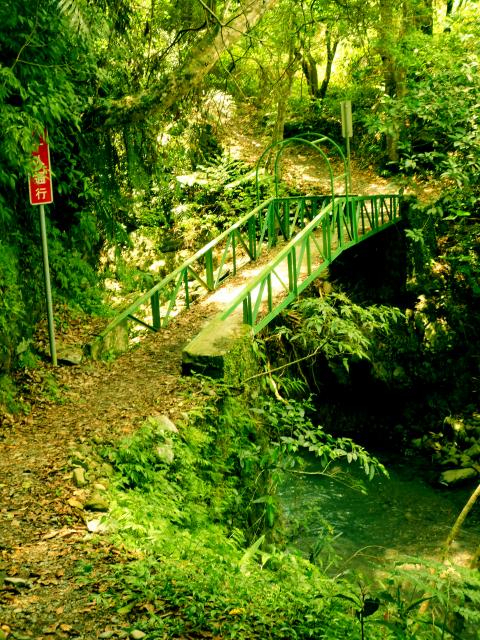
Photo: Richard Saunders
We almost didn’t find it. We walked straight past the indistinct trail that dropped down to the stream below the waterfall, and only discovered it by accident after we’d given up and were returning to the car. Expectations rose when the trail ended at a stream flowing through an attractive gorge, and our curiosity was truly piqued when, after wading upstream for about five minutes, the stream emerged from a tight, crack-like gorge. Ten minutes later we were standing right in front of Yuemeikeng Waterfall (月眉坑瀑布), staring in wonder at its beauty.
SECRET NO MORE
Nine years later, the once well-kept secret of Yuemeikeng Waterfall is little-known no more. Nowadays it’s hard to miss the once faint trail that leads down to the stream below the waterfall, and scraps of trail following the bank upstream allow hikers to keep their feet dry a bit longer, until the final, unavoidable 100-meter river trace up to the base of the waterfall. It’s almost certain that slightly tricky final approach to the waterfall keeps the numbers of visitors down to reasonable numbers: visit on a weekend and you may well have a local river tracing group and a few other hikers for company; on a weekday, you could be the only visitor.
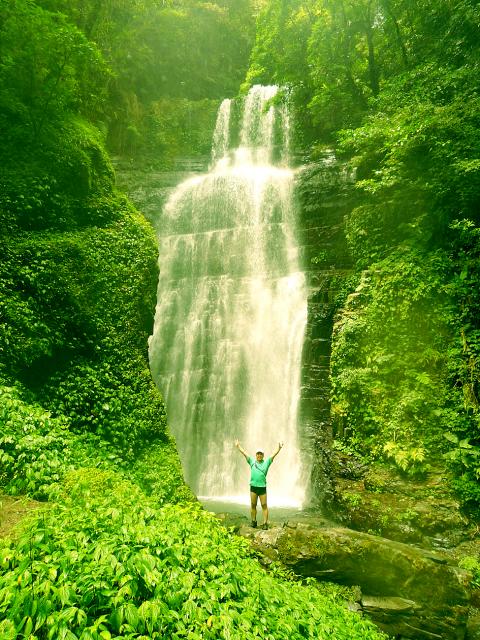
Photo: Richard Saunders
To get there from the Wufengchi Scenic Area car park (a 10-minute shuttle bus ride from Jiaosi bus station), follow a path beside the stream to a large weir. Cross the stream immediately above it and follow a track gently uphill for about 10 minutes.
At a junction just after passing a small shrine, bear right, cross the stream by an iron footbridge, and follow the trail on the opposite bank. In about 10 minutes, take a clear trail on the left, and in about five minutes it joins the stream below the waterfall. Now simply wade upstream (or take the patches of trail beside the stream for the first five minutes) and the waterfall is a rough 15-minute walk/wade upstream.
The pool at the base of the waterfall is a perfect place to cool down on a hot summer day, but the waterfall is great for a visit year-round. If visiting in the cooler months, before heading back to the city, though, be sure to treat those legs to a leisurely soak in one of the wonderful hot springs at nearby Jiaosi. After all, it’s less than an hour back to Taipei.
Richard Saunders is a classical pianist and writer who has lived in Taiwan since 1993. He’s the founder of a local hiking group, Taipei Hikers, and is the author of six books about Taiwan, including Taiwan 101 and Taipei Escapes. Visit his Web site at www.taiwanoffthebeatentrack.com.

For many people, Bilingual Nation 2030 begins and ends in the classroom. Since the policy was launched in 2018, the debate has centered on students, teachers and the pressure placed on schools. Yet the policy was never solely about English education. The government’s official plan also calls for bilingualization in Taiwan’s government services, laws and regulations, and living environment. The goal is to make Taiwan more inclusive and accessible to international enterprises and talent and better prepared for global economic and trade conditions. After eight years, that grand vision is due for a pulse check. RULES THAT CAN BE READ For Harper Chen (陳虹宇), an adviser

Traditionally, indigenous people in Taiwan’s mountains practice swidden cultivation, or “slash and burn” agriculture, a practice common in human history. According to a 2016 research article in the International Journal of Environmental Sustainability, among the Atayal people, this began with a search for suitable forested slopeland. The trees are burnt for fertilizer and the land cleared of stones. The stones and wood are then piled up to make fences, while both dead and standing trees are retained on the plot. The fences are used to grow climbing crops like squash and beans. The plot itself supports farming for three years.
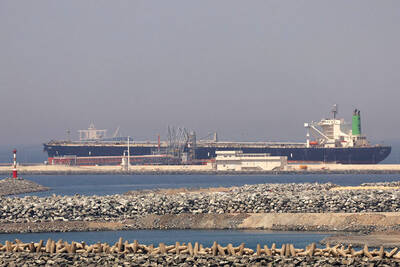
The breakwater stretches out to sea from the sprawling Kaohsiung port in southern Taiwan. Normally, it’s crowded with massive tankers ferrying liquefied natural gas from Qatar to be stored in the bulbous white tanks that dot the shoreline. These are not normal times, though, and not a single shipment from Qatar has docked at the Yongan terminal since early March after the Strait of Hormuz was shuttered. The suspension has provided a realistic preview of a potential Chinese blockade, a move that would throttle an economy anchored by the world’s most advanced and power-hungry semiconductor industry. It is a stark reminder of

May 4 to May 10 It was once said that if you hadn’t performed at the Sapphire Grand Cabaret (藍寶石大歌廳), you couldn’t truly be considered a star. Taking the stage at the legendary Kaohsiung club was more than just a concert. Performers were expected to entertain in every sense, wearing outlandish or revealing costumes and staying quick on their feet as sharp-tongued, over-the-top hosts asked questions and delivered jokes that would be seen as vulgar, even offensive, by today’s standards. Opening in May 1967 during a period of strict political and social control, Sapphire offered a rare outlet for audiences in


 RSS
RSS