


Entering Yao Chung-han’s (姚仲涵) exhibition is like being transported into the belly of an alien spacecraft. First, darkness. Then, a blaring sound of static and blinding luminescence. The lights throughout the gallery start dancing to the beat of mixed electronic sounds, bouncing back and forth and then traveling across the room.
This is the inside of An Electronic Monster (光電獸), which invaded Taipei’s Project Fufill Art Space on July 15.
Yao’s beasts are the fruit of his intrigue for deconstructing everyday objects and using parts of them to build something new.
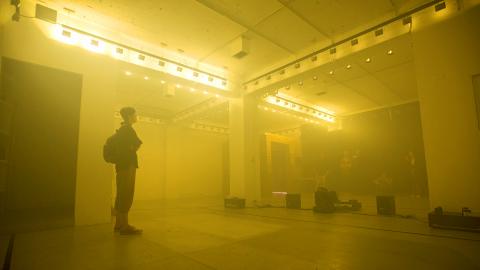
Photo courtesy of Wang Chun Li
Visitors will see in the gallery lamps with circular light bulbs, ceiling lights, a spotlight, a fog machine and a computer that orchestrates their actions. All of this is synced to the soundtrack of reverberating beats composed by Yao.

.Photo courtesy of Project Fulfill Art Space
“I tried different sounds and light patterns inside the gallery to figure out what transmits the best feeling.” he says.
The sounds alternate between high and low-frequency noises, sounds of flickering lights, static, footsteps and metallic scratching. Their vibrations come from the ceiling and bounce off of every wall and corner. Combined with the lights, the result is an entrancing, yet claustrophobic, visual and auditory overload
DANCE OF LIGHT AND SOUND
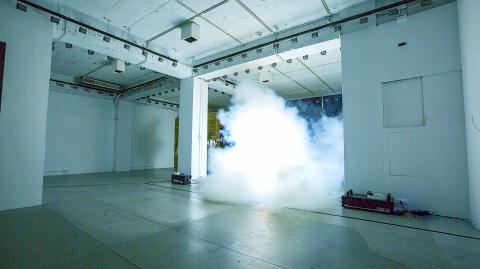
Photo courtesy of Wang Chun Li
Two monsters make up the regular exhibit. Electronic Monster #2 — Ceiling experiments with the audience’s perception of space through the use of illumination and darkness. A line of light bulbs hangs from the corners of the ceiling and, turning on and off with the music in a hypnotizing choreography.
The computer arranging the performance sits in the middle of the room. A digital clock on its screen counts down the awakening of Electronic Monster #3 — On the Hour.
Every hour, the clock triggers a chain of events. The room becomes eerily quiet and dark. A beam of light in the center of the gallery breaks through the darkness and triggers an explosion of fog that quickly saturates the gallery’s atmosphere.
TAMING THE MONSTERS
Yao is the third component of the exhibit, but visitors will only see him during his Laser Lamp Live Performances — or LLLPs — where he introduces additional objects and elements to further the chaos.
Using a special microphone connected to the lights and a board that controls the sound frequencies, he traces patterns on the ground making the whole installation dance with the vibrations created by each stroke.
The most intriguing part of his performance is the use of a violet laser light. Like the microphone, the beam is also connected to the rest of the installation. Yao interrupts the laser using rapid finger movements resembling those of a concert pianist, and the elements in the room dance to his will.
Yao’s exhibition and live performance are both very immersive experiences. Never had a virtually empty space feel so intense and captivating using only light and sound.
“I want to give life to light.” he says.
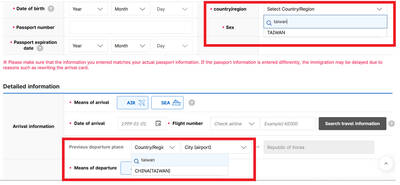
Jason Han says that the e-arrival card spat between South Korea and Taiwan shows that Seoul is signaling adherence to its “one-China” policy, while Taiwan’s response reflects a reciprocal approach. “Attempts to alter the diplomatic status quo often lead to tit-for-tat responses,” the analyst on international affairs tells the Taipei Times, adding that Taiwan may become more cautious in its dealings with South Korea going forward. Taipei has called on Seoul to correct its electronic entry system, which currently lists Taiwan as “China (Taiwan),” warning that reciprocal measures may follow if the wording is not changed before March 31. As of yesterday,

The Portuguese never established a presence on Taiwan, but they must have traded with the indigenous people because later traders reported that the locals referred to parts of deer using Portuguese words. What goods might the Portuguese have offered their indigenous trade partners? Among them must have been slaves, for the Portuguese dealt slaves across Asia. Though we often speak of “Portuguese” ships, imagining them as picturesque vessels manned by pointy-bearded Iberians, in Asia Portuguese shipping between local destinations was crewed by Asian seamen, with a handful of white or Eurasian officers. “Even the great carracks of 1,000-2,000 tons which plied
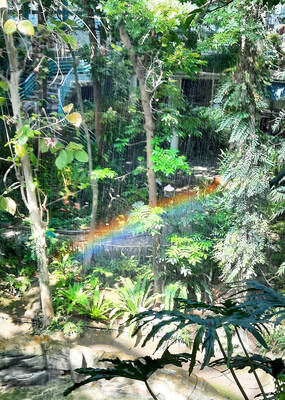
It’s only half the size of its more famous counterpart in Taipei, but the Botanical Garden of the National Museum of Nature Science (NMNS, 國立自然科學博物館植物園) is surely one of urban Taiwan’s most inviting green spaces. Covering 4.5 hectares immediately northeast of the government-run museum in Taichung’s North District (北區), the garden features more than 700 plant species, many of which are labeled in Chinese but not in English. Since its establishment in 1999, the site’s managers have done their best to replicate a number of native ecosystems, dividing the site into eight areas. The name of the Coral Atoll Zone might
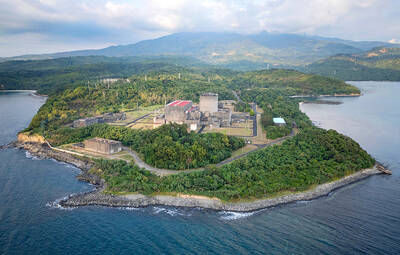
Nuclear power is getting a second look in Southeast Asia as countries prepare to meet surging energy demand as they vie for artificial intelligence-focused data centers. Several Southeast Asian nations are reviving mothballed nuclear plans and setting ambitious targets and nearly half of the region could, if they pursue those goals, have nuclear energy in the 2030s. Even countries without current plans have signaled their interest. Southeast Asia has never produced a single watt of nuclear energy, despite long-held atomic ambitions. But that may soon change as pressure mounts to reduce emissions that contribute to climate change, while meeting growing power needs. The


 RSS
RSS