


Vonny Chen’s (陳雅芳) voice breaks as she talks about Taiwan’s long-time independent activists, even though she has lived her entire life in Indonesia.
“Sometimes I say I’m Taiwanese because my father’s blood is running through mine,” she says, adding that she loves Taiwan.
Chen does not feel optimistic about Taiwanese independence, citing China’s political and economic strength. But the “dream” carries emotional significance as her father, Chen Chih-hsiung (陳智雄), was the first independence activist to be executed, which occurred on May 28, 1963.
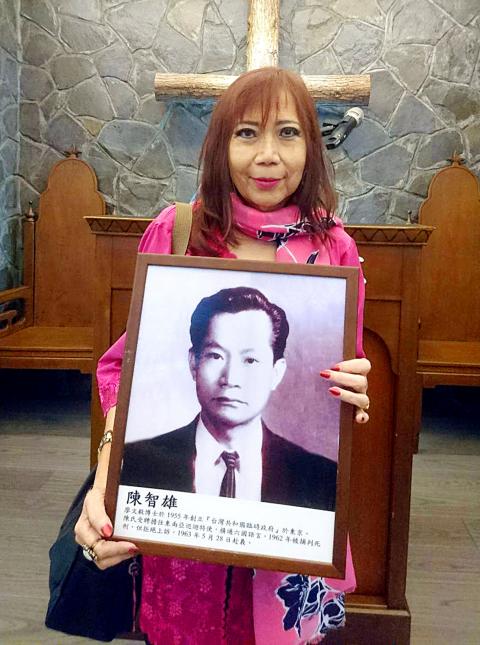
Photo courtesy of Sherry Huang
Although Chen, 67, is in poor health and doesn’t speak Mandarin, she insisted on visiting Taiwan last month for the unveiling of her father’s monument at Nantou County’s Holy Mountain Ecological Educational Park, where other human rights, democracy and independence activists are honored. She spent a month in Taiwan, traveling to Green Island where her father was incarcerated and meeting with independence activists and former political prisoners who knew her father. On the 54th anniversary of her father’s execution, she prayed in front of his ashes.
FROM HATRED TO PRIDE
Chen says she used to hate her father for abandoning the family, often thinking that he loved Taiwan more than his children. It wasn’t until she had her own child that she tried to contact her father, only to learn in 1979 through Taiwan’s representative office in Indonesia that he was dead. She made her first trip to Taiwan in 1980, but did not learn much because of martial law.
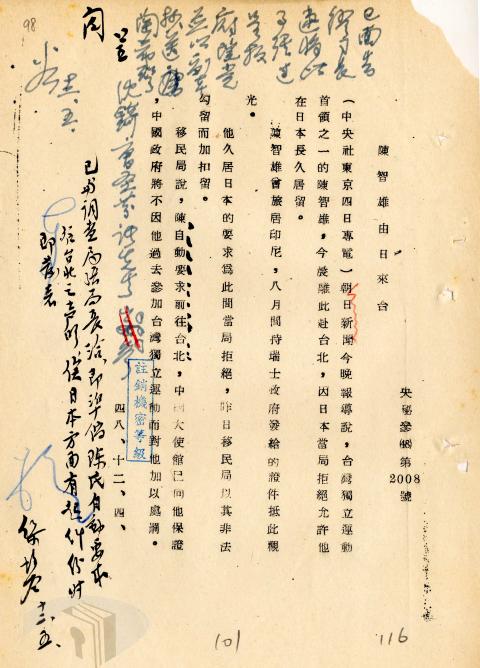
Photo courtesy of Linda Arrigo
It was only on her seventh trip, in 2013, that she learned the reason for his execution. She received documents about her father from the National Archives, including his will and final letter to his three children, which stated, “I died for the people of Taiwan,” in Japanese.
“I don’t know why [they] kept these letters for so many years without giving them to us, and why they preserved them when they didn’t care about them,” she says.
Chen also learned of the way her father was executed through his prison-mate Liu Chin-shih (劉金獅). Liu told Vonny Chen that a rag was stuffed in Chen Chih-hsiung’s mouth to prevent him from yelling “Long Live Taiwan Independence” and his feet cut off so he couldn’t stand with his head held high.
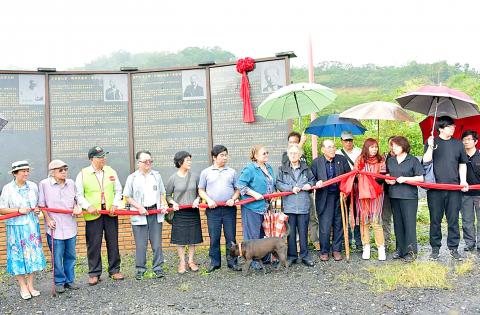
Photo courtesy of Sherry Huang
“I’m old, and it’s not easy for me to move on,” she says. “Every time I think of that, I feel heartbroken.”
Chen is now proud of her father, stating that she could never do what he did. She’s more upset that the government kept her father’s will, in which he asked a friend to take care of his children.
“When my father left my mother, we had nothing,” she says. “My father used all the money to help Taiwanese [in Indonesia]. My mother said she cooked a lot because they came to eat at our house. If they didn’t have anything, my father helped them.”
She wonders if life would have been different if the friend had received the news.
“[In a sense], they tried to kill us too,” she says.
NOT A HERO
Chen Chih-hsiung first arrived in Indonesia in 1945 as a translator for the Japanese army. He stayed in the country as a jewelry dealer after the war and, according to his daughter, traveled the area to buy weapons to support the Indonesian independence movement.
In 1946, he fell in love and eloped with his landlady’s niece, who was 16 at the time, but eventually returned to stay with her family. Vonny Chen, the second of three children, was born in 1949. Chen says her father had arranged for the family to leave Indonesia with him in 1951, but her grandmother prevented them from going to the bus stop. He would still visit every now and then, and Chen last saw him when she was seven years old.
“We only saw him for an hour because our grandmother was afraid he would kidnap us,” she says.
During those years, Chen Chih-hsiung worked closely with Japan-based independence activist Thomas Liao (廖文毅), serving as the Republic of Taiwan Provisional Government’s (台灣共和國臨時政府) ambassador to Southeast Asia. He later joined Liao in Japan, but the Chinese Nationalist Party (KMT) forced him back to Taiwan with help from Japanese authorities, who promised to leave him alone if he ceased his independence activities. He obviously did not, forming a group that aimed to “end the brutal reign of the KMT” in 1961.
Vonny Chen and her brothers visited Taiwan several times throughout the 1980s, finally tracking down an aunt who was a nun in Yilan. She learned through her aunt that Chen Chih-hsiung was executed, but was warned not to ask further questions.
In 2003, Chen and her family received NT$5 million from the government in compensation for his death, but no details were provided. It would take another 10 years for Chen to find out why her father died.
“It’s been a long journey full of tears,” she says.
Vonny Chen was surrounded by people who knew her father or shared his goal of Taiwan independence during her month in Taiwan, but she laments that outside of that circle, few people know who he is.
“Some say my father is a hero,” she says. “But for Taiwan, he’s not a hero. That’s why they killed him. My father would be Taiwan’s hero if it were independent. But if not, nobody knows about him.”
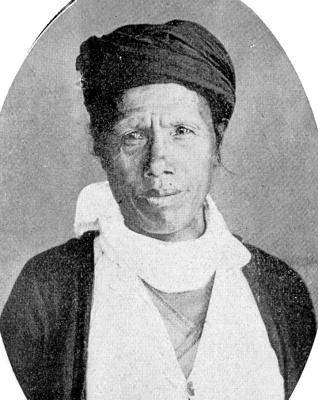
May 11 to May 17 Traversing the southern slopes of the Yushan Range in 1931, Japanese naturalist Tadao Kano knew he was approaching the last swath of Taiwan still beyond colonial control. The “vast, unknown territory,” protected by the “fierce” Bunun headman Dahu Ali, was “filled with an utterly endless jungle that choked the mountains and valleys,” Kano wrote. He noted how the group had “refused to submit to the measures of our authorities and entrenched themselves deep in these mountains … living a free existence spent chasing deer in the morning and seeking serow in the evening,” even describing them as

Yesterday, the Democratic Progressive Party (DPP) nominated legislator Puma Shen (沈伯洋) as their Taipei mayoral candidate, the Chinese Nationalist Party (KMT) put their stamp of approval on Wei Ping-cheng (魏平政) as their candidate for Changhua County commissioner and former legislator Tsai Pi-ru (蔡壁如) of the Taiwan People’s Party (TPP) has begun the process to also run in Changhua, though she has not yet been formally nominated. All three news items are bizarre. The DPP has struggled with settling on a Taipei nominee. The only candidate who declared interest was Enoch Wu (吳怡農), but the party seemed determined to nominate anyone
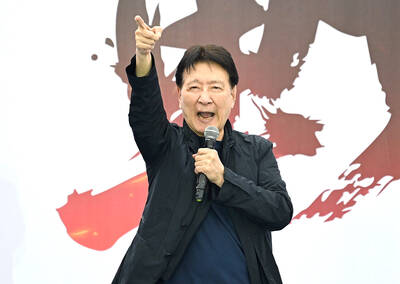
In a sudden move last week, opposition lawmakers of the Chinese Nationalist Party (KMT) and Taiwan People’s Party (TPP) passed a NT$780 billion special defense budget as a preemptive measure to stop either Chinese leader Xi Jinping (習近平) or US President Donald Trump from blocking US arms sales to Taiwan at their summit in Beijing, said KMT heavyweight Jaw Shaw-kong (趙少康), speaking to the Taipei Foreign Correspondents Club on Wednesday night in Taipei. The 76-year-old Jaw, a political talk show host who ran as the KMT’s vice presidential candidate in 2024, says that he personally brokered the deal to resolve
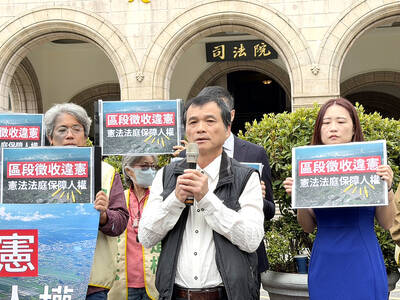
What government project has expropriated the most land in Taiwan? According to local media reports, it is the Taoyuan Aerotropolis, eating 2,500 hectares of land in its first phase, with more to come. Forty thousand people are expected to be displaced by the project. Naturally that enormous land grab is generating powerful pushback. Last week Chen Chien-ho (陳健和), a local resident of Jhuwei Borough (竹圍) in Taoyuan City’s Dayuan District (大園) filed a petition for constitutional review of the project after losing his case at the Taipei Administrative Court. The Administrative Court found in favor of nine other local landowners, but


 RSS
RSS