


A ‘godfather’ of Thai politics is using cash and contacts to transform his once poor, forgotten rice-farming fiefdom into an unlikely sporting Camelot, complete with a football stadium and racetrack set to host the MotoGP.
Newin Chidchob, a 58-year-old native son of Buriram in Thailand’s agrarian northeast, has enticed super-rich investors into his vision of a sports hub amid the rice fields.
The swaggering former MP has already delivered two venues that now dominate Buriram, a sleepy town whose 30,000 population could be seated more than three times over in them.
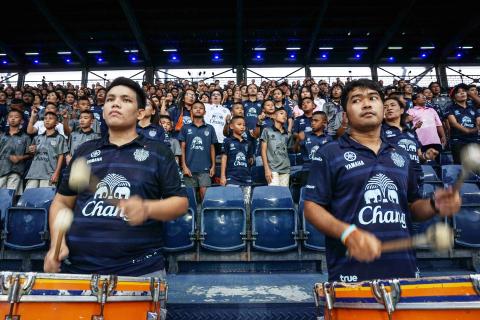
Photo: AFP
First, in 2011, came the imposing Thunder Castle, a mega millions football stadium purpose-built for leading Thai Premier League side Buriram United. It was followed three years later by a US$58.9 million racing circuit, the first Formula One certified track in Thailand. According to Thai sports authorities the circuit secured the rights this week to stage a leg of the prestigious 2018 MotoGP, a personal coup for Newin who has been lobbying hard to bring the event to his flagship venue. The motorcycling extravaganza would pour millions of dollars into Buriram, which was once among Thailand’s poorest provinces.
“I wanted to create something that this country didn’t have,” Newin told AFP from the grandstand as GT race teams prepared for a recent competition.
“Now we’ve changed this town from being a place people pass through, from a city with no tourists, to one that now has around three million visitors a year.”
Thanks to the sporting makover, Buriram is a rare pocket of economic vibrancy in northeastern Thailand, a farming region whose development lags far behind Bangkok and the tourist destinations of the beach-streaked south.
Locals are the first to say that none of it would be possible without Newin, known by some as the Baron of Buriram. “We never dreamed we would have these kind of stadiums,” said school teacher Janpen Pansri, one of many residents wearing the blue kit of Buriram’s football team. “But whenever Newin announces he’s going to do something, he does it,” she added. “We all give our hearts to him.”
THE KINGMAKER
Much of Thailand is carved up into the domains of influential families who dominate local political and economic life.
Buriram is no different.
Patronage, power and ruthless decision-making have shaped Newin’s rise to the top.
Before making his mark with sport, Newin spent two decades in Thailand’s bear-pit political arena, trading favors and switching teams just in time to land on the winning side.
“It’s over boss,” he famously told his former friend, ex-premier Thaksin Shinawatra by phone in 2008 after throwing his weight behind the rival Democrats — a mercenary move that earned him the moniker “The Kingmaker.” Newin was later banned from politics for vote-buying and retreated to his power base in Buriram, bringing his passions — football and big bikes — with him.
He bought a small football club based near Bangkok, moved it to Buriram, and housed the squad in a gleaming stadium which towers above the ramshackle, one-storey homes common to the area.
Seven years on, Buriram United is one of the kingdom’s top teams — sponsored by a Who’s Who of Bangkok’s business elite — with five league titles and regular appearances in the Asian Champions league.
Newin, often seen cruising through town on his Ducati, also drew on wealthy Bangkok friends to erect the 1,400-acre racing circuit.
The track is named after its top sponsor Chang Beer, a booze giant owned by one the kingdom’s richest and most influential billionaires. Newin says sport not politics has brought the boom to Buriram.
“I was a politician for over 20 years, but I couldn’t make people in this city richer or happier in the way I have in the past seven years of being a regular person,” he said.
“For those who live in other provinces — I hope that they will also have at least one person in their town is like me.”
MAN OF THE PEOPLE
Newin boasts of the speed in which his stadiums were built — a contrast to the delays that hobble government-backed infrastructure projects.
“No-one (in Buriram) is more influential than him,” said Chaiya Chotikavanik, a retired politics professor from Buriram Rajabhat University. Even without an official post, “Newin has the type of power that means if he suggests how things should be, people listen,” Chotikavanik added.
This influence has been carefully burnished by his man-of-the-people image. Renowned for eating at local pad thai joints, Newin readily lends his name — and cash — to all manner of community events.
Thousands of jobs have been created by the stadiums, with 5,000 new hotel rooms and hundreds of restaurants built in their wake. But the biggest beneficiary of Buriram’s sporting ascent is likely to be the wily Newin himself.
Politics was like “living in hell,” he says with a grin, swatting away rumors of a return to the fray once Thailand emerges from junta control.
“Now that I’m out of it I feel like I’m in heaven. Now wherever I go people love me.”
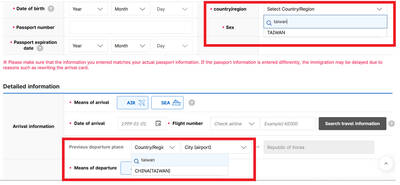
Jason Han says that the e-arrival card spat between South Korea and Taiwan shows that Seoul is signaling adherence to its “one-China” policy, while Taiwan’s response reflects a reciprocal approach. “Attempts to alter the diplomatic status quo often lead to tit-for-tat responses,” the analyst on international affairs tells the Taipei Times, adding that Taiwan may become more cautious in its dealings with South Korea going forward. Taipei has called on Seoul to correct its electronic entry system, which currently lists Taiwan as “China (Taiwan),” warning that reciprocal measures may follow if the wording is not changed before March 31. As of yesterday,
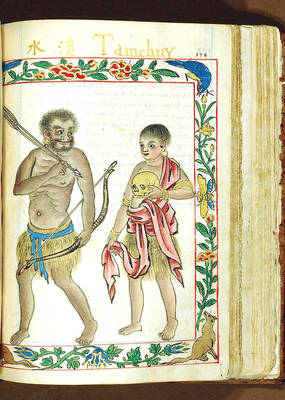
The Portuguese never established a presence on Taiwan, but they must have traded with the indigenous people because later traders reported that the locals referred to parts of deer using Portuguese words. What goods might the Portuguese have offered their indigenous trade partners? Among them must have been slaves, for the Portuguese dealt slaves across Asia. Though we often speak of “Portuguese” ships, imagining them as picturesque vessels manned by pointy-bearded Iberians, in Asia Portuguese shipping between local destinations was crewed by Asian seamen, with a handful of white or Eurasian officers. “Even the great carracks of 1,000-2,000 tons which plied
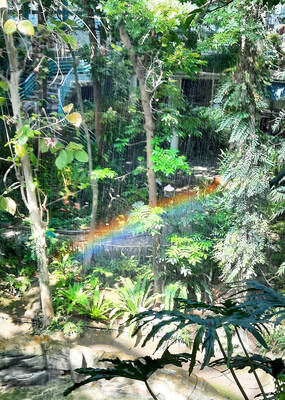
It’s only half the size of its more famous counterpart in Taipei, but the Botanical Garden of the National Museum of Nature Science (NMNS, 國立自然科學博物館植物園) is surely one of urban Taiwan’s most inviting green spaces. Covering 4.5 hectares immediately northeast of the government-run museum in Taichung’s North District (北區), the garden features more than 700 plant species, many of which are labeled in Chinese but not in English. Since its establishment in 1999, the site’s managers have done their best to replicate a number of native ecosystems, dividing the site into eight areas. The name of the Coral Atoll Zone might
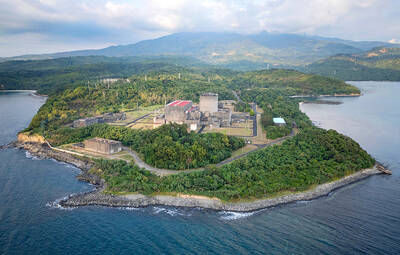
Nuclear power is getting a second look in Southeast Asia as countries prepare to meet surging energy demand as they vie for artificial intelligence-focused data centers. Several Southeast Asian nations are reviving mothballed nuclear plans and setting ambitious targets and nearly half of the region could, if they pursue those goals, have nuclear energy in the 2030s. Even countries without current plans have signaled their interest. Southeast Asia has never produced a single watt of nuclear energy, despite long-held atomic ambitions. But that may soon change as pressure mounts to reduce emissions that contribute to climate change, while meeting growing power needs. The


 RSS
RSS