


The crested black macaque shot to fame when one of the monkeys snapped grinning selfies and became embroiled in a US court battle — but the tussle over copyright is the least of the rare animal’s worries.
In a remote corner of their native Indonesia, amid smoking volcanoes and dense jungles, the monkeys face a far greater threat as they are aggressively hunted to be eaten.
“In other places some macaque species are facing extinction because of shrinking habitat,” Yunita Siwi from Selamatkan Yaki, a foundation that aims to protect the primate, told AFP.
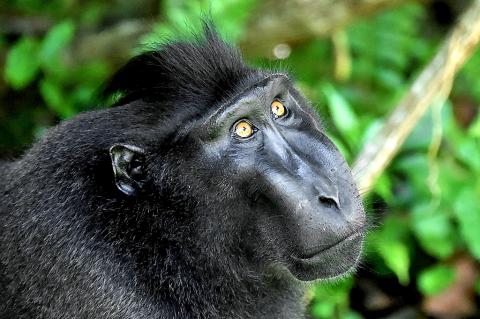
Photo: Bay Ismoyo, AFP
“But here the habitat is getting smaller — and people are eating the monkeys.”
Authorities and activists are stepping up efforts to persuade villagers on Sulawesi island to stop consuming the critically endangered monkeys, one of many exotic creatures that form part of the local indigenous community’s diet.
The animal, whose scientific name is Macaca nigra, is part of a kaleidoscope of exotic wildlife found across Indonesia, including tigers and orangutans, who face a range of threats from poachers to the destruction of their habitat.
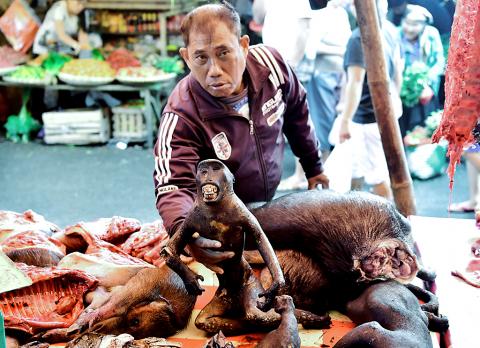
Photo: Bay Ismoyo, AFP
On a recent trip to Sulawesi’s Tangkoko nature reserve, some of the amber-eyed, black-haired macaques, known in the local language as yaki, frolicked in a small river while others climbed palm trees and knocked coconuts to the ground.
Among those living in Tangkoko is Naruto, who shot to fame after grabbing a British wildlife photographer’s camera and snapping some selfies.
The pictures led to a legal fight after animal rights activists PETA brought the case to a San Francisco court arguing that Naruto should own the copyright — a claim rejected by a judge last year.
The approximately 2,000 monkeys living in the 8,800-hectare reserve enjoy protection because they are in a restricted area, but that is not the case for about 3,000 others estimated to be in jungles elsewhere in the province of North Sulawesi.
‘TASTY LIKE DOG’
The macaque’s meat is prized by the ethnic Minahasan people, a largely Christian group in the world’s most populous Muslim-majority country, who have no reservation about eating exotic animals, unlike Indonesia’s Islamic communities.
“I like the taste, hot and spicy, it is similar to wild boar or dog,” Nita, a 32-year-old local Minahasan who gave only her first name, told AFP.
At a market in Tomohon city, a stomach-churning array of burnt, mutilated animals were on offer. Black crested macaques — flame-roasted and whole, with pained grimaces etched on their faces — were on tables for sale alongside piles of sliced-open pythons, burnt bats and dogs.
The macaques and some other animals at the market are protected by Indonesian law and officials have in the past raided the site, leading to violent clashes with vendors.
But the trade in exotic creatures was still booming during a recent visit, with some local travel agents even offering tours to adventurous foreign travelers.
The demand for the meat has prompted Minahasan hunters to go far and wide in search of the macaque, heading in pickups to remote parts of the island.
‘NAIL IN COFFIN’
The population of Macaca nigra in its natural habitat on Sulawesi has dropped more than 80 percent in four decades, from an estimated 300 per square kilometer in 1980 to just 45 per square kilometer in 2011, researchers say.
The International Union for Conservation of Nature classifies the monkey as critically endangered. As well as being threatened by their status as a local delicacy, the monkey’s natural habitat is being destroyed by expansion of settlements and agricultural lands.
As the population has fallen, the local wildlife protection agency and activists have started campaigning to save them. Tents manned by activists explaining that the monkey is protected have been set up at local markets, while billboards have been put up by roadsides to warn people that they face up to five years in jail if they hunt the creatures. NGOs and the local government have pushed schools to include lessons on conservation, including about the Macaca nigra, in their curriculum.
Campaigners have also reached out to churches in the mainly Christian area to urge priests to preach that humans are the guardians of Earth and must protect endangered creatures like the monkeys, said activist Siwi.
They are also seeking to highlight the macaques’ key role in supporting biodiversity. As they swing through the jungle canopy, the macaques disperse seeds and encourage growth of some trees, according to Stephan Lentey of the Macaca Nigra Project NGO.
But campaigners warn that villagers’ hunger for the meat heaps extra pressure on a creature already threatened by habitat loss.
Hunting the animals for food “is the final nail in the coffin for a dwindling population,” said Simon Purser of the Sulawesi-based Tasikoki wildlife rescue center.

If one asks Taiwanese why house prices are so high or why the nation is so built up or why certain policies cannot be carried out, one common answer is that “Taiwan is too small.” This is actually true, though not in the way people think. The National Property Administration (NPA), responsible for tracking and managing the government’s real estate assets, maintains statistics on how much land the government owns. As of the end of last year, land for official use constituted 293,655 hectares, for public use 1,732,513 hectares, for non-public use 216,972 hectares and for state enterprises 34 hectares, yielding

The small platform at Duoliang Train Station in Taitung County’s Taimali Township (太麻里) served villagers from 1992 to 2006, but was eventually shut down due to lack of use. Just 10 years later, the abandoned train station had become widely known as the most beautiful station in Taiwan, and visitors were so frequent that the village had to start restricting traffic. Nowadays, Duoliang Village (多良) is known as a bit of a tourist trap, with a mandatory, albeit modest, admission fee of NT$10 giving access to a crowded lane of vendors with a mediocre view of the ocean and the trains

The March/April volume of Foreign Affairs, long a purveyor of pro-China pablum, offered up another irksome Beijing-speak on the issues and solutions for the problems vexing the People’s Republic of China (PRC) and the US: “America and China at the Edge of Ruin: A Last Chance to Step Back From the Brink” rang the provocative title, by David M. Lampton and Wang Jisi (王緝思). If one ever wants to describe what went wrong with US-PRC relations, the career of Wang Jisi is a good place to start. Wang has extensive experience in the US and the West. He was a visiting

One of the challenges with the sheer availability of food in today’s world is that lots of us end up spending many of our waking hours eating. Whether it’s full meals, snacks or desserts, scientists have found that it’s not uncommon for us to be mindlessly grazing at some point during all of our 16 or so waking hours. The problem? As soon as this food hits the bloodstream in the form of glucose, it initiates the release of the hormone insulin. This in turn activates a switch present in every one of our cells, which is responsible for driving cell


 RSS
RSS