


Just as I am willing to see the romantic classical ballets — Swan Lake, Giselle et al — done by a variety of companies, I am also willing to take a chance on William Shakespeare’s works in a variety of adaptations and languages — condensed English versions, Beijing opera, Russian, Chinese. At the core, theoretically, the same heart should be beating.
However, I had to admit defeat as I left the National Theater on Friday night after seeing the OKT/Vilnius City Theatre’s two-act production of Hamlet, as staged by Lithuanian director Oskaras Korsunovas.
Perhaps it was the language barrier, though the National Theater’s wonderful new surtitle screens, large squares on either side of the proscenium that were big enough for both Chinese and English translations to be shown at the same time, are a vast improvement over the old vertical rectangles, and made it easy to follow along.
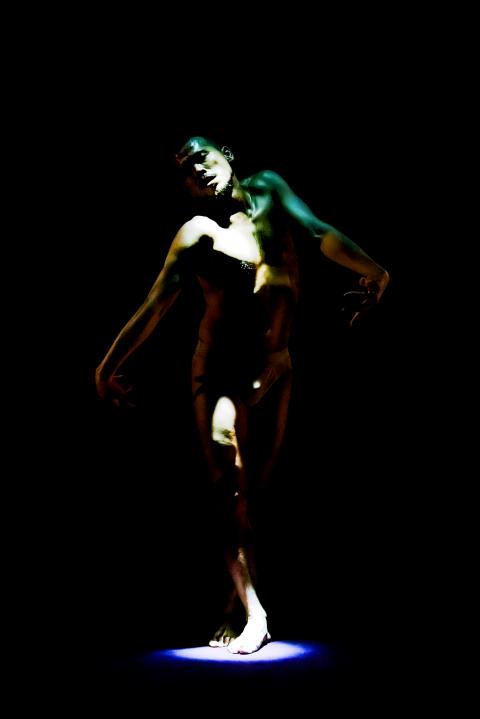
Photo Courtesy of Chen Chang-chih
It was the details that nagged at me. Why was there a creature in Act I, costumed in a large black cape, big black neck ruffle, black bondage hood and red-lit nose bulb crawling around the stage like some huge misshapen mastiff, complete with the occasional growl?
Or what to make of the large white rat’s head — and tail — seen peering above the mirrored moveable make-up desks in Act I, only to reappear on an actor otherwise costumed in a white Elizabethan courtier’s outfit in Act II, with lots of squeaking coming over the sound system? Another sign that something is rotten in the state of Denmark?
But most of all, why were Hamlet’s childhood buddies, Rosencrantz and Guildenstern, campily dressed (and acting) in black baby-doll dresses and clutching tiny purses in Act I and then in long black velvet Elizabethan-like dresses — for a while — in Act II?
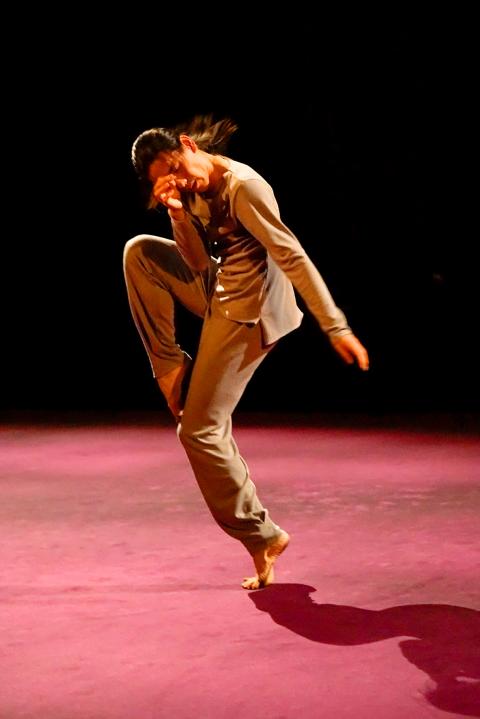
Photo Courtesy of the National Theater Concert Hall
I understand that Korsunovas’ philosophy is to present modern works like classical theater and the classics like contemporary works, which was amply demonstrated by the staging and pacing of his Hamlet, but does that require black bondage hoods?
Yet there were many details to admire: the mirrored make-up tables — the basic set elements — which were moved about to form walls or curtains; the all-white flowered bower scene for Ophelia; the mix-and-match costuming (by Agne Kuzmickaite, who was also credited with Korsunovas for the set) that ranged through the ages from black hoodies for the men, to long cloaks, to slip dresses and long jersey gowns for Ophelia and Gertrude, to a very low-cut black vinyl mini-dress and knee-high boots for the queen.
Most of all, there were some fine performances, especially by Darius Meskauskas in the lead role, Dainius Gavenonis, who doubles as King Claudius and the ghost of Hamlet’s father and Vaidotas Martinatis as Polonius.
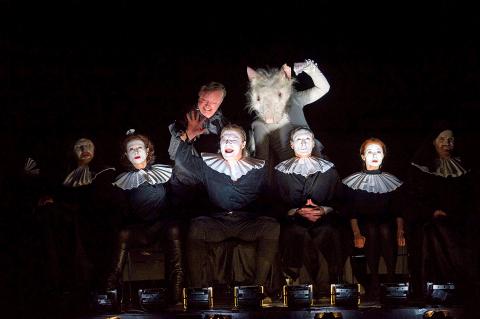
Photo Courtesy of National Theater Concert Hall
So while I felt some defeat in leaving the theater, overall it was worth it to have battled the rain to make the show.
The weather on Saturday was much better, and so was the performance Free Steps (自由步—身體的眾生相) in the Experimental Theater. Like Hamlet, Free Steps was part of the Taiwan International Festival of Arts.
Su Wei-chia (蘇威嘉), who was a National Performing Arts Center-National Theater and Concert Hall artist-in-residence last year, began working on his Free Steps project in 2013, but its origins date back almost a decade to his graduation project for his master’s degree.
He wanted to explore dance at its most basic, though the dancer’s bodies, steps, movements, emotions and rhythms and he has created several versions of Free Steps, including one for the Experimental Theater as part of the 2015 Innovation Series-Dance, set on six women and one man.
For this latest version, Su turned to some familiar collaborators, Chen Wu-kang (陳武康) and Chou Shu-yi (周書毅), who along with Su were cofounders of the all-male dance collective Horse (驫舞劇場) in 2004, as well as sound designer Yannick Dauby and lighting designer Liu Chia-ming (劉家明).
It was wonderful to see Chen and Chou dance, as both men have focused more on choreographing for others in recent years. It would have been even better if they had danced together, but the program, which is a collection of six solos, divided evenly between the pair, kept them apart.
Each solo gave viewers a chance to compare and contrast Chou and Chen as dancers, as well as the mood and message of each solo.
Chou’s slow opening solo in a circle of light was a study in contrasts — his bright turquoise top and grey shorts against the bright light against the darkness that surrounded him — while his curving upper body movements strained against the bond that kept his feet rooted in a small circle of space, creating an image of a human helix.
Chen was more minimally dressed for his first solo, a pair of white briefs that almost looked like a diaper, but he had the entire stage floor to explore, and his movements were more abrupt, even jerky, compared to Chou.
Chou’s second and third solos see him low to the ground, his tightly contorted upper body in contrast to the often sweeping arc of a leg, or the dagger-point of a sharply extended foot, but still smooth and graceful — as opposed to Chen’s isolationist/popping second solo that saw his hands almost glued to the front of his hips while the rest of his body jerked and stuttered.
Chen’s third solo saw him almost nude, planted in one spot, feet in ballet’s fifth position, as the tortuous movements of his upper body rippled in the shadows cast by a single spotlight directly above his head.
While the two men’s movements were often confined, there was a lot of room for improvisation, which Chen said left him feeling very free, while the single-minded focus both men exuded gave the audience the freedom to create their own interpretations for each dance, and dancer.
Su’s six solos — together with the soundscape and lighting — created a single vision , as compared with Hamlet the previous night, where the sum was not greater than its parts.

Jason Han says that the e-arrival card spat between South Korea and Taiwan shows that Seoul is signaling adherence to its “one-China” policy, while Taiwan’s response reflects a reciprocal approach. “Attempts to alter the diplomatic status quo often lead to tit-for-tat responses,” the analyst on international affairs tells the Taipei Times, adding that Taiwan may become more cautious in its dealings with South Korea going forward. Taipei has called on Seoul to correct its electronic entry system, which currently lists Taiwan as “China (Taiwan),” warning that reciprocal measures may follow if the wording is not changed before March 31. As of yesterday,
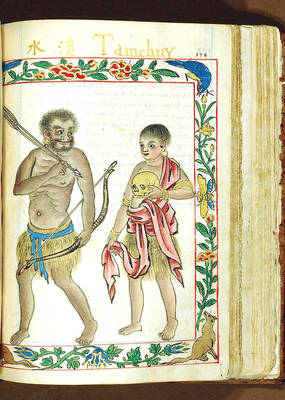
The Portuguese never established a presence on Taiwan, but they must have traded with the indigenous people because later traders reported that the locals referred to parts of deer using Portuguese words. What goods might the Portuguese have offered their indigenous trade partners? Among them must have been slaves, for the Portuguese dealt slaves across Asia. Though we often speak of “Portuguese” ships, imagining them as picturesque vessels manned by pointy-bearded Iberians, in Asia Portuguese shipping between local destinations was crewed by Asian seamen, with a handful of white or Eurasian officers. “Even the great carracks of 1,000-2,000 tons which plied
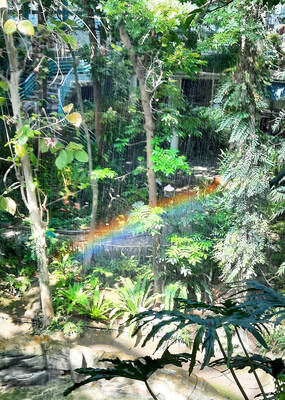
It’s only half the size of its more famous counterpart in Taipei, but the Botanical Garden of the National Museum of Nature Science (NMNS, 國立自然科學博物館植物園) is surely one of urban Taiwan’s most inviting green spaces. Covering 4.5 hectares immediately northeast of the government-run museum in Taichung’s North District (北區), the garden features more than 700 plant species, many of which are labeled in Chinese but not in English. Since its establishment in 1999, the site’s managers have done their best to replicate a number of native ecosystems, dividing the site into eight areas. The name of the Coral Atoll Zone might
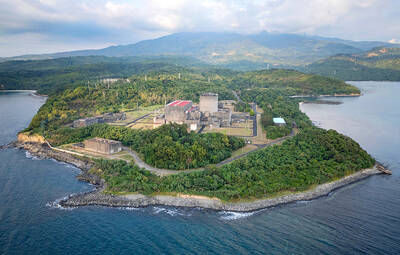
Nuclear power is getting a second look in Southeast Asia as countries prepare to meet surging energy demand as they vie for artificial intelligence-focused data centers. Several Southeast Asian nations are reviving mothballed nuclear plans and setting ambitious targets and nearly half of the region could, if they pursue those goals, have nuclear energy in the 2030s. Even countries without current plans have signaled their interest. Southeast Asia has never produced a single watt of nuclear energy, despite long-held atomic ambitions. But that may soon change as pressure mounts to reduce emissions that contribute to climate change, while meeting growing power needs. The


 RSS
RSS