


It is a pity that funding problems and theater availability kept the Kaohsiung City Ballet (KCB, 高雄城市芭蕾舞團) from bringing its 14th annual Dance Shoe (點子鞋) production to Taipei this year; the show in Tainan on Saturday last week featured a surprising winner.
I traveled to Tainan at the invitation of the company and I’m so glad I did for three reasons: Lai Hung-chung (賴翃中), Cheng I-han (鄭伊涵) and Chien Lin-yi (簡麟懿).
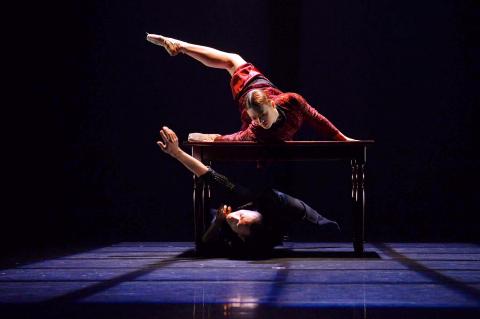
Lai’s piece, Raining in the Room, the second work on the four-dance program, was a revelation: he has really matured as a choreographer and this duet was so much stronger than the previous works he has created for the Dance Shoe series.
Photos Courtesy of Liu Ren-haur
Watching Raining in the Room, I felt much like I did when I saw Benson Tsai’s (蔡博丞) Little Star (小小星辰) in the 2014 Dance Shoe show — that here was a choreographer on the cusp of making his name. Tsai ended up founding his own company later that year and over the past two years has picked up a slew of choreography awards at competitions and festivals in Europe. It would be wonderful if Lai finds similar success.
Like his piece in last year’s Dance Shoe, Grim Winter (凜凜), Lai blended popping and isolationist techniques with contemporary dance and traditional ballet for Raining in the Room. However, this year, everything just clicked: the choreography — which swung between goth romance to almost Tim Burtonesque creepiness, the costumes and the lighting.
The always wonderful Cheng’s steely resoluteness sometimes overshadowed her partner in Grim Winter, Huang Yu-hsuan (黃于軒), but her former Taipei National University of the Arts (國立臺北藝術大學) classmate Chien had no trouble holding his own with her. His angular body was a match for her long legs and they just flowed together and apart.
Photos Courtesy of Liu Ren-haur
There were a couple of times that Lai’s choreography had Cheng collapsing inward; she succeeded in making it look as if the air was being sucked right out of her entire body.
I remembered Chien, who spent three years working in Japan with Jo Kanamori’s Noism troupe, from his solo in Meimage Dance Company’s New Choreographer Project in August last year. In that martial-arts flavored solo, Chiu (囚), he was a prisoner confined by a square of light. He has now moved back to Taiwan, so hopefully we will see a lot more of him in the future.
The costumes for Raining in the Room were an almost Victorian-looking claret lace top and wide-legged pants with black collar and pant cuffs for Cheng and an equally severe, but more modern black top and pants for Jiann, giving the pair a steampunk appearance that fit well with the choreography. It might have been a trick of the lighting, but the color of Cheng’s outfit was almost the same hue as the table, so that at times her body seemed to dissolve into the tabletop, adding another dimension to the creepiness factor.
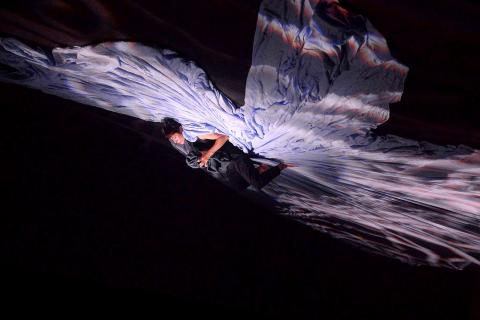
The program finished on an equally strong note: Wang Kuo-chuen’s (王國權) Ku shan shwei (枯山水), a very adult pas de trois featuring Ally Yeh (葉麗娟) and Tseng Ting-kai (曾鼎凱). It opened with Tseng’s very dramatic dropping of stones and Wang’s slow, swirling contraction of a large dropcloth on the floor, before focusing on the very Audrey Hepburn-looking Yeh, who divided her attention between the two men.
Wang Wei-ming (王維銘), a former Cloud Gate Dance Theatre (雲門舞集) dancer who teaches at Shu-Te University in Kaohsiung, last year gave Dance Shoe a collection of solos for five women, The Stories They Told (她們在說故事). This year he performed his own solo, the aptly titled Moonlight (月光), set to Claude Debussy’s Claire de Lune. It was a lovely ode to passion by a middle-aged man betwitched by the moon on a nightime stroll.
The first dance of the night, Tai Ting-ru’s (戴鼎如) Sya yu de ren (下雨的人), was competently performed by Tai, Hsu Chia-jung (許佳蓉) and Lee Hsin (李欣), but it never seemed to go anywhere and paled in comparison with the rest of the program.
KCB founder Chang Hsiu-ru (張秀如) has provided a much-need platform for young Taiwanese choreographers and dancers from southern Taiwan with the Dance Shoe shows. It would be a shame if funding problems make this year’s production the last in the series.
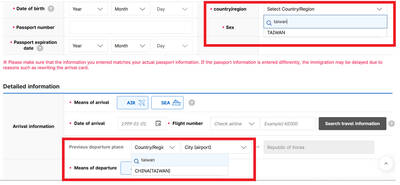
Jason Han says that the e-arrival card spat between South Korea and Taiwan shows that Seoul is signaling adherence to its “one-China” policy, while Taiwan’s response reflects a reciprocal approach. “Attempts to alter the diplomatic status quo often lead to tit-for-tat responses,” the analyst on international affairs tells the Taipei Times, adding that Taiwan may become more cautious in its dealings with South Korea going forward. Taipei has called on Seoul to correct its electronic entry system, which currently lists Taiwan as “China (Taiwan),” warning that reciprocal measures may follow if the wording is not changed before March 31. As of yesterday,
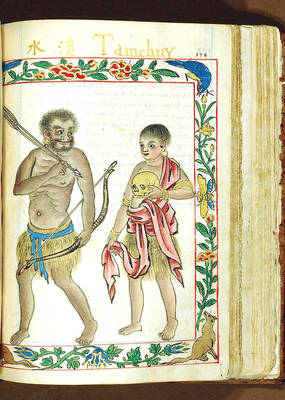
The Portuguese never established a presence on Taiwan, but they must have traded with the indigenous people because later traders reported that the locals referred to parts of deer using Portuguese words. What goods might the Portuguese have offered their indigenous trade partners? Among them must have been slaves, for the Portuguese dealt slaves across Asia. Though we often speak of “Portuguese” ships, imagining them as picturesque vessels manned by pointy-bearded Iberians, in Asia Portuguese shipping between local destinations was crewed by Asian seamen, with a handful of white or Eurasian officers. “Even the great carracks of 1,000-2,000 tons which plied
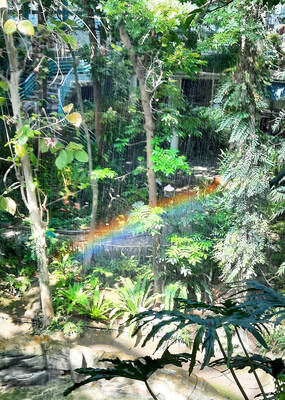
It’s only half the size of its more famous counterpart in Taipei, but the Botanical Garden of the National Museum of Nature Science (NMNS, 國立自然科學博物館植物園) is surely one of urban Taiwan’s most inviting green spaces. Covering 4.5 hectares immediately northeast of the government-run museum in Taichung’s North District (北區), the garden features more than 700 plant species, many of which are labeled in Chinese but not in English. Since its establishment in 1999, the site’s managers have done their best to replicate a number of native ecosystems, dividing the site into eight areas. The name of the Coral Atoll Zone might
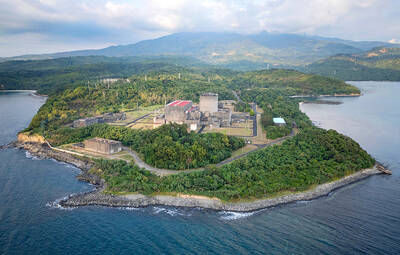
Nuclear power is getting a second look in Southeast Asia as countries prepare to meet surging energy demand as they vie for artificial intelligence-focused data centers. Several Southeast Asian nations are reviving mothballed nuclear plans and setting ambitious targets and nearly half of the region could, if they pursue those goals, have nuclear energy in the 2030s. Even countries without current plans have signaled their interest. Southeast Asia has never produced a single watt of nuclear energy, despite long-held atomic ambitions. But that may soon change as pressure mounts to reduce emissions that contribute to climate change, while meeting growing power needs. The


 RSS
RSS