


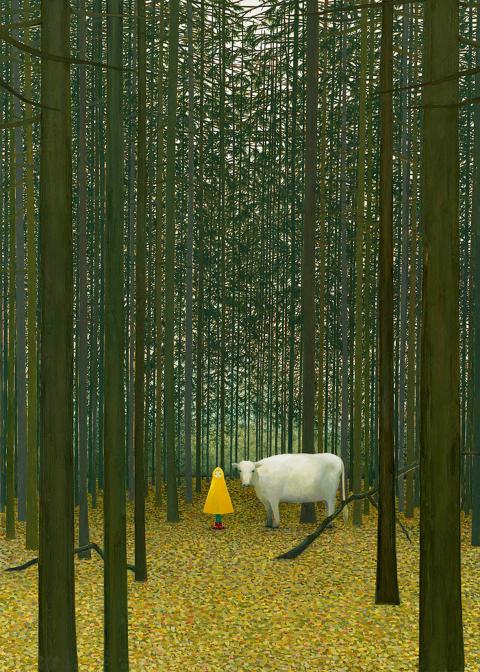
Tomohiro Shimizu’s semi-surrealist paintings are derived from a feeling of utter loneliness, but are beautiful and contemplative. The Japanese artist moves away from his part-humorous, part-farcical paintings of cherubic cartoon girls with long black hair in his latest solo exhibition, Wanderlust (漫遊派), at Pon Ding. He paints landscapes instead — snowy forests, grassy plains and enchanting marshlands. Some of his paintings still contain a single person, but they’re smaller and not as prominent. Nature is his protagonist here, while people are just pawns in the grand scheme of things. Though his intention is to convey a sense of desolateness, his use of bright colors and whimsical, swirling brush strokes can’t help but make the viewer wonder if being lost and alone is such a bad thing after all.
■ Pon Ding (朋丁), 6, Ln 53, Zhongshan N Rd Sec 1, Taipei City (台北市中山北路一段53巷6號), tel: (02) 2537 7281. Open Tuesdays to Sundays from 11am to 8pm
■ Until Jan. 22
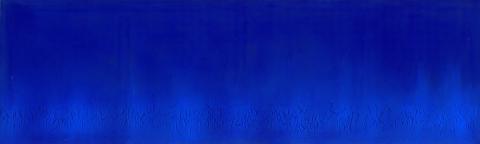
Photo courtesy of Chini Gallery
On display at Treasure Hill Artist Village is Good Morning (早安 — 就是早安), a sequel to Yo Yang’s (楊雅淳) 2014 exhibition Good Night. The photographer continues to explore the idea of life and death as a cycle, using plants, flowers and fruit as metaphors. While flowers appear beautiful to the naked eye, they take on a different form when seen up close, and Yang makes liberal use of his macro function to capture these grotesque details. His message is simple: beauty is only skin deep. Also, all beautiful things must come to an end, but this is not necessarily a bad thing, especially if we view life as a cycle.
■ Treasure Hill Artist Village (寶藏巖國際藝術村), 2, Ally 14, Ln 230, Dingzhou Rd Sec 3, Taipei City (台北市汀州路三段230巷14弄2號), tel: (02) 2364-5313. Open Tuesday to Sundays from 11am to 6pm
■ Until Jan. 22
Tomohiro Shimizu, An Oracle (2016).
Scotland, the land of whiskey, is known in art circles for hosting a prestigious artist residency program. Taking place at Glenfiddich Distillery, the residency lasts for three months and immerses artists into local culture through activities such as weekly ceilidhs, or gatherings involving folk music and dancing. For 12 years, IT Park Gallery has been sending Taiwanese artists to take part in the program, and the works of these artists, created during their time at Glenfiddich, can now be viewed at the exhibition Springs Eternal: Glenfiddich Artists in Residence — 12 Years from Taiwan (療癒之泉—格蘭菲迪台灣藝術家駐村計畫12週年) , at the Kuandu Museum of Fine Arts. The number 12 is also auspicious as it takes 12 years to age Glenfiddich’s best known whiskey. The lineup of artists includes Agi Chen (陳怡潔), Wang Jun-jieh (王俊傑) and this year’s artist in residence, Lin Kun-ying (林昆穎).
■ Kuandu Museum of Fine Arts (關渡美術館), 1 Xueyuan Rd, Taipei City (台北市學園路1號), tel: (02) 2896-1000 X 2432. Open Tuesdays to Sundays from 10am to 5pm
■ Until Feb. 12
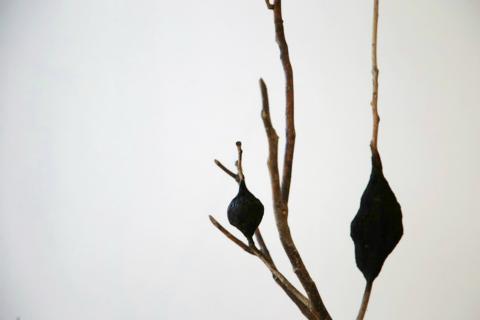
Photo courtesy of TFAM
Opening tomorrow at Chini Gallery is Formless Perfection (觀止無形), a joint exhibition featuring the works of three female artists and Royal College of Art, London, alumni: Jo Hsieh (謝貽娟), Suling Wang (王淑鈴) and the late Hung Yi-chen (洪藝真). Hsieh cites Buddhist philosophy and the principle of yin and yang in her artwork, which uses different hues of blue to create a hypnotic and lulling effect. Wang, who recently moved back to Taiwan, paints outdoors in the outskirts of her hometown of Taichung, where she embeds seeds, leaves, twigs and other foliage in layers of paint. In so doing, she reminds viewers to be more aware of their natural surroundings. Chen’s work, by contrast, is more abstract, and attempts to draw the viewer’s attention to the process of creating a painting — particularly the relationship between canvas, paint and frame — rather than the actual painting itself.
■ Chini Gallery (采泥藝術), 48, Lane 128 Jingye 1st Rd, Taipei City (台北市敬業一路128巷48號), tel: (02) 7729-5809. Open Tuesdays to Sundays from 10:30am to 7pm
■ Opens tomorrow. Until Feb. 19
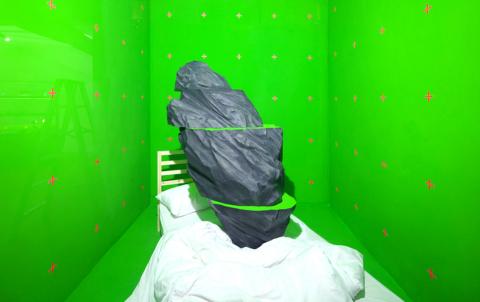
Photo courtesy of TFAM
Works by the 12 finalists of the 2016 Taipei Arts Awards (2016 台北美術獎) are currently on view at the Taipei Fine Arts Museum (TFAM). The annual contest, funded by the Taipei City Government, is open to all Taiwanese artists. This year’s 12 finalists include Hsu Chiao-yen (許喬彥), who turns cheap, everyday materials such as plastic bags and crumpled banners into celestial-like installations. Wang Pei-hsuan’s (王佩瑄) elaborate installations and video art, which reflect on the interconnectedness between private experiences and memories and a globalized world, are also on display. Another finalist is Chuang Pei-hsin (莊培鑫), who creates absurd and disturbing installations inspired by her visit to a meteorite crater during a trip to Iceland.
■ Taipei Fine Arts Museum (TFAM, 台北市立美術館), 181, Zhongshan N Rd Sec 3, Taipei (台北市中山北路三段181號), tel: (02) 2595-7656. Open Tuesdays to Sundays from 9:30am to 5:30pm and until 8:30pm on Saturdays
■ Until March 19
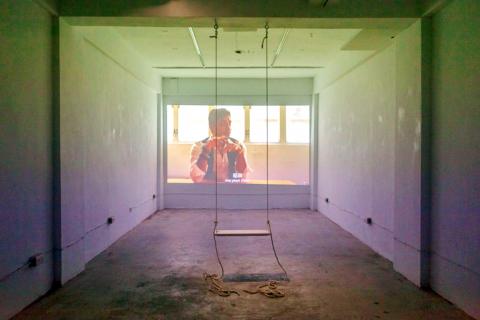
Photo courtesy of TFAM
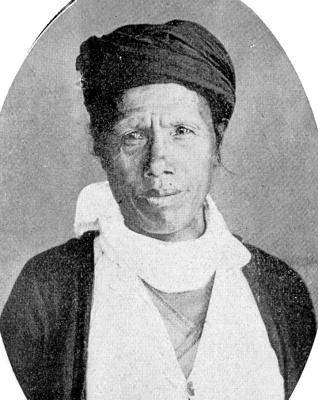
May 11 to May 17 Traversing the southern slopes of the Yushan Range in 1931, Japanese naturalist Tadao Kano knew he was approaching the last swath of Taiwan still beyond colonial control. The “vast, unknown territory,” protected by the “fierce” Bunun headman Dahu Ali, was “filled with an utterly endless jungle that choked the mountains and valleys,” Kano wrote. He noted how the group had “refused to submit to the measures of our authorities and entrenched themselves deep in these mountains … living a free existence spent chasing deer in the morning and seeking serow in the evening,” even describing them as
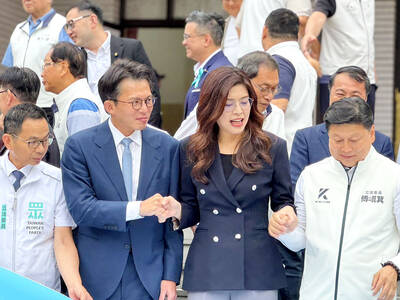
As a different column was being written, the big news dropped that Chinese Nationalist Party (KMT) caucus whip Fu Kun-chi (傅?萁) announced that negotiations within his caucus, with legislative speaker Han Kuo-yu (韓國瑜) of the KMT, party Chair Cheng Li-wun (鄭麗文), Taichung Mayor Lu Shiow-yen (盧秀燕) and Taiwan People’s Party (TPP) Chair Huang Kuo-chang (黃國昌) had produced a compromise special military budget proposal. On Thursday morning, prior to meeting with Cheng over a lunch of beef noodles, Lu reiterated her support for a budget of NT$800 or NT$900 billion — but refused to comment after the meeting. Right after Fu’s

Yesterday, the Democratic Progressive Party (DPP) nominated legislator Puma Shen (沈伯洋) as their Taipei mayoral candidate, the Chinese Nationalist Party (KMT) put their stamp of approval on Wei Ping-cheng (魏平政) as their candidate for Changhua County commissioner and former legislator Tsai Pi-ru (蔡壁如) of the Taiwan People’s Party (TPP) has begun the process to also run in Changhua, though she has not yet been formally nominated. All three news items are bizarre. The DPP has struggled with settling on a Taipei nominee. The only candidate who declared interest was Enoch Wu (吳怡農), but the party seemed determined to nominate anyone
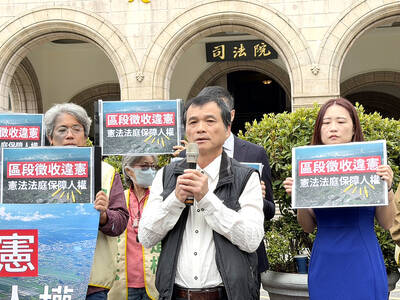
What government project has expropriated the most land in Taiwan? According to local media reports, it is the Taoyuan Aerotropolis, eating 2,500 hectares of land in its first phase, with more to come. Forty thousand people are expected to be displaced by the project. Naturally that enormous land grab is generating powerful pushback. Last week Chen Chien-ho (陳健和), a local resident of Jhuwei Borough (竹圍) in Taoyuan City’s Dayuan District (大園) filed a petition for constitutional review of the project after losing his case at the Taipei Administrative Court. The Administrative Court found in favor of nine other local landowners, but


 RSS
RSS