


On the shelves are endless rows of old drinking glasses produced by brands such as Yakult and Taiwan Beer. A bespectacled lady donning a handmade felt brooch she purchased from Nepal picks up a small glass.
“This one is over 50 years old, just like me,” says Retro Nana (Chang Min-min, 張敏敏), who runs the shop I’m looking through.
I came to know of Retro Nana’s store, Nostalgic Future (意思意思), from an American friend on the hunt for antique Taiwan Beer glasses. It was the one item that Retro Nana refused to sell and after an hour-long debate, she relented and sold the cups — but only after making him promise that he would only drink Taiwan Beer out of them.
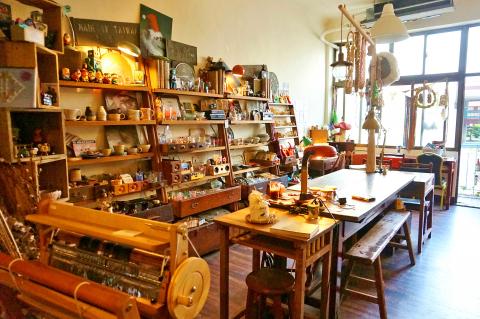
Photo: Dana Ter, Taipei Times
It took a few wrong turns and a couple of curses directed at Google Maps to locate Nostalgic Future. The store wasn’t always so difficult to find. Previously, it was located at 14, Lane 14, Dihua Street Sec 1. In Chinese, 14 14 or yisi yisi (一四一四) is a homonym for the store’s Chinese name, yisi yisi (意思意思) which means “meaning meaning.”
Retro Nana moved to the current location near Zhongshan MRT in 2013 as she felt that Dihua Street had become “too commercialized.”
SHARING SIMPLE PLEASURES
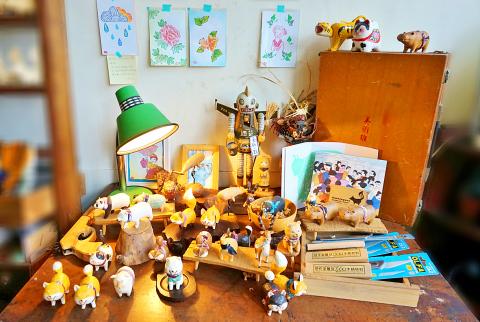
Photo: Dana Ter, Taipei Times
I gather from the display of handmade canvas bags on the roadside in front of a dark stairwell that the stairs must lead to Nostalgic Future.
Inside is a mish-mash of antiques collected from her travels around the world and handmade crafts by young Taiwanese artists.
Her desire to foster in young people a love for handicrafts stems ultimately from wanting to share simple pleasures she experienced growing up, for instance, knitting dolls or drawing greeting cards.
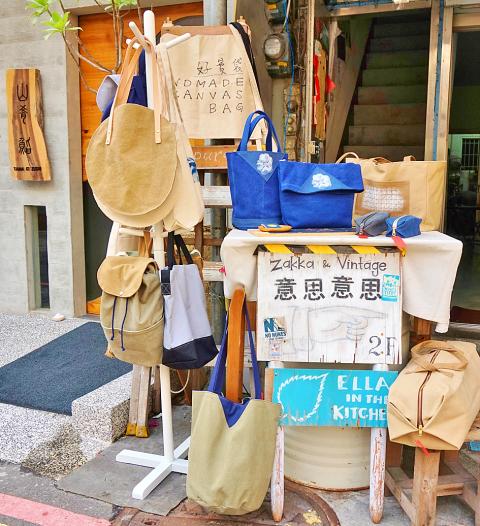
Photo: Dana Ter, Taipei Times
Retro Nana explains that the bags I saw on the roadside were made by a young artist and that no two bags are alike. The artist teaches a couple of workshops on the third floor, though when I visit, two other workshops are taking place: book-binding and wood carving.
The tiny animal figurines sitting on a small wooden table by the second-floor balcony were made by students in the wood carving workshop.
They hold other workshops too. Tie-dyeing, sewing clothes and berets, making felt slippers and leather baggage tags. Her husband also teaches photography classes using old 8mm film cameras.
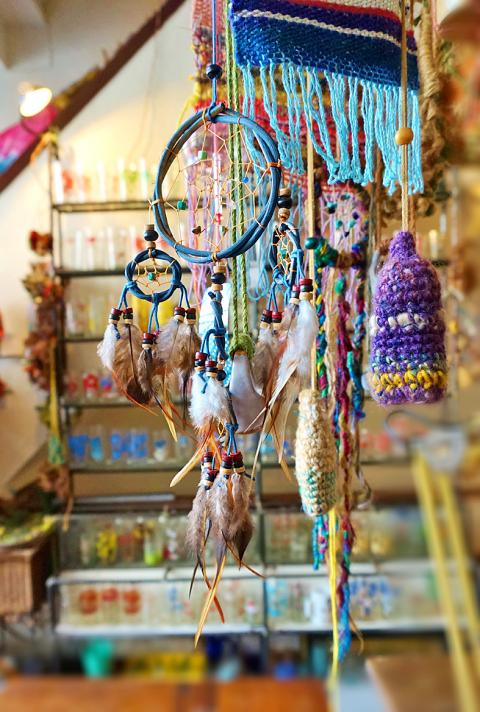
Photo: Dana Ter, Taipei Times
The list goes on and on and Retro Nana can’t even remember some of the classes they hold.
There’s just one rule while in class: “When we have students who talk too loud, we’ll tell them to speak softer,” she says.
Picking up another drinking glass, Retro Nana says she used to drink from cups like these when she was younger.
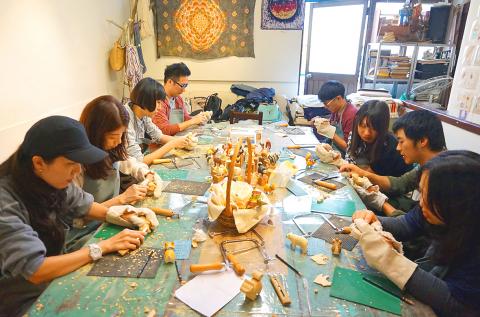
Photo: Dana Ter, Taipei Times
“Isn’t it wonderful to share these things with young people?”
OBJECTS CULLED FROM THROUGHOUT THE GLOBE
Retro Nana started collecting these items in her early 20s, around the same time that she began traveling abroad.
“I spent all my money on traveling instead of saving up to buy a house,” she laughs.
There’s no hint of regret in her voice.
She traveled to Hong Kong first, then to the Philippines despite her friends telling her that it was “too dangerous” to visit the country by herself.
“People in Taiwan can be so close-minded,” she says.
Clasping her hand over her mouth, she exclaims: “Sorry if I’m too frank!”
Wanderlust — fueled by watching foreign films — led her to Thailand, Malaysia, Indonesia, France, Italy and all over the US. Each time she brought home spoils from different countries — ceramic bowls, stereos, comic books and a gigantic sculpture of a menacing-looking dog from Germany, which greets visitors at the top of the stairwell.
She stored her knick-knacks in her parents’ house and as her collection expanded, her father threatened to throw some away. That’s when she had the brilliant idea of opening a store.
“I didn’t have a job,” Retro Nana says, unapologetically. “So I decided that it would be worth my time to showcase all my collectibles and make people fall in love with retro stuff.”
Ironically, it’s young people who are more nostalgic these days, she adds. While there are many who go for mass production, commercial items, more and more are buying vintage. It makes the experience more meaningful.
■ Nostalgic Future (意思意思), 16-2, Ln 64 Nanjing W Rd, Taipei City (台北市南京西路64巷16-2號) is open Fridays to Mondays from 1pm to 9pm
■ For more information on classes, visit: www.facebook.com/nostalgicfuture1414

If one asks Taiwanese why house prices are so high or why the nation is so built up or why certain policies cannot be carried out, one common answer is that “Taiwan is too small.” This is actually true, though not in the way people think. The National Property Administration (NPA), responsible for tracking and managing the government’s real estate assets, maintains statistics on how much land the government owns. As of the end of last year, land for official use constituted 293,655 hectares, for public use 1,732,513 hectares, for non-public use 216,972 hectares and for state enterprises 34 hectares, yielding
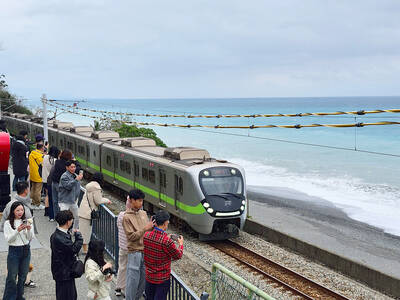
The small platform at Duoliang Train Station in Taitung County’s Taimali Township (太麻里) served villagers from 1992 to 2006, but was eventually shut down due to lack of use. Just 10 years later, the abandoned train station had become widely known as the most beautiful station in Taiwan, and visitors were so frequent that the village had to start restricting traffic. Nowadays, Duoliang Village (多良) is known as a bit of a tourist trap, with a mandatory, albeit modest, admission fee of NT$10 giving access to a crowded lane of vendors with a mediocre view of the ocean and the trains

The March/April volume of Foreign Affairs, long a purveyor of pro-China pablum, offered up another irksome Beijing-speak on the issues and solutions for the problems vexing the People’s Republic of China (PRC) and the US: “America and China at the Edge of Ruin: A Last Chance to Step Back From the Brink” rang the provocative title, by David M. Lampton and Wang Jisi (王緝思). If one ever wants to describe what went wrong with US-PRC relations, the career of Wang Jisi is a good place to start. Wang has extensive experience in the US and the West. He was a visiting
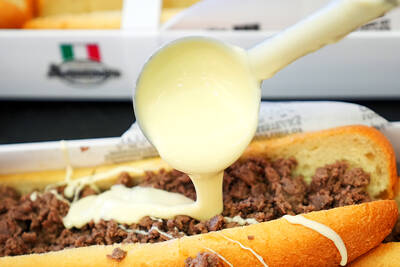
One of the challenges with the sheer availability of food in today’s world is that lots of us end up spending many of our waking hours eating. Whether it’s full meals, snacks or desserts, scientists have found that it’s not uncommon for us to be mindlessly grazing at some point during all of our 16 or so waking hours. The problem? As soon as this food hits the bloodstream in the form of glucose, it initiates the release of the hormone insulin. This in turn activates a switch present in every one of our cells, which is responsible for driving cell


 RSS
RSS