


To the untutored ear, the Beijing dialect can sound like someone talking with a mouthful of marbles, inspiring numerous parodies and viral videos. Its colorful vocabulary and distinctive pronunciation have inspired traditional performance arts such as cross-talk, a form of comic dialogue, and kuaibanr, storytelling accompanied by bamboo clappers.
But the Beijing dialect is disappearing, a victim of language standardization in schools and offices, urban redevelopment and migration. In 2013, officials and academics in the Chinese capital began a project to record the dialect’s remaining speakers before it fades away completely. The material is to be released to the public as an online museum and interactive database by year’s end.
“You almost never hear the old Beijing dialect on the city streets nowadays,” said Gao Guosen, 68, who has been identified by the city government as a “pure” speaker. “I don’t even speak it anymore with my family members or childhood friends.”
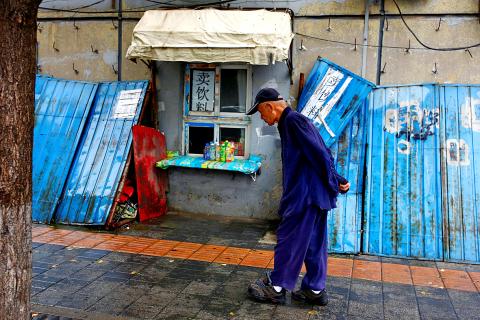
Photo: Reuters/Thomas Peter
The dialect’s most marked characteristic is its habit of adding an “r” to the end of syllables. This, coupled with the frequent “swallowing” of consonants, can give the Beijing vernacular a punchy, jocular feel. For example, buzhidao (不知道), standard Chinese for “I don’t know,” becomes burdao in the Beijing dialect. Laoshi (老師), or teacher, can come out sounding laoer.
In the 1930s, China’s Republican government began defining and promoting a common language for the country, referred to in English as Mandarin, that drew heavily, but far from completely, on the Beijing dialect. The Communist government’s introduction of an official Romanization system in the 1950s reinforced standardized pronunciation for Chinese characters. These measures enhanced communication among Chinese from different regions, but they also diminished the relevance of dialects. A 2010 study by Beijing Union University found that 49 percent of local Beijing residents born after 1980 would rather speak Mandarin than the Beijing dialect, while 85 percent of migrants to Beijing preferred that their children learn Mandarin.
The remaking of the city has also played a role in diluting the language. Into the mid-20th century, much of Beijing’s population lived clustered in the hutongs, or alleyways, that crisscrossed the neighborhoods surrounding the Forbidden City. Today, only a small fraction of an estimated 3,700 hutongs remain, their residents often scattered to apartment complexes on the city’s outskirts. And the city has become a magnet for migrants from other parts of China. According to China’s last national census, an average of about 450,000 people moved to Beijing each year between 2000 and 2010, making about one-third of Beijing’s residents nonlocals.
Gao, a diminutive man with a booming voice, remembers how different it used to be.
“Until this project, I didn’t even know that what I was speaking was a dialect, because everyone around me used to speak like that,” Gao said in his new apartment, not far from the hutong where he lived for more than 60 years.
According to the UN, nearly 100 Chinese dialects, many of them spoken by China’s 55 recognized ethnic minorities, are in danger of dying out. Efforts are also underway in Shanghai, as well as in Jiangsu and five other provinces, to create databases as part of a project under the Ministry of Education to research dialects and cultural practices nationwide.
Yet the potential loss of the Beijing dialect is especially alarming because of the cultural heft it carries.
“As China’s ancient and modern capital, Beijing and thus its linguistic culture as well are representative of our entire nation’s civilization,” said Zhang Shifang, a professor at the Beijing Language and Culture University who oversaw the effort to record native speakers. “For Beijing people themselves, the Beijing dialect is an important symbol of identity.”
The dialect is a testament to the city’s tumultuous history of invasion and foreign rule. The Mongol Empire ruled China in the 13th and 14th centuries. The Manchus, an ethnic group from northeast Asia, ruled from the mid-17th century into the 20th. As a result, the Beijing dialect contains words derived from both Mongolian and Manchurian. The intervening Ming dynasty, which maintained its first capital in Nanjing for several decades before moving to Beijing, introduced southern speech elements.
The dialect varied within the city itself. The historically wealthier neighborhoods north of the Forbidden City spoke with an accent considered more refined than that found in the poorer neighborhoods to the south, home to craftsmen and performers.
For Gao, the vanishing dialect of his youth is nothing to be mourned, although he is happy that more people are paying attention.
“Society needs a unified language and culture to develop,” he said. “If we restored the old things, then the road ahead wouldn’t exist.”
“But I love to listen to the Beijing dialect,” he said. “It is something innate. When I speak the Beijing dialect, it comes naturally from my heart.”
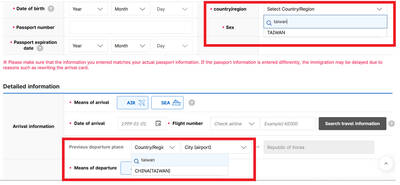
Jason Han says that the e-arrival card spat between South Korea and Taiwan shows that Seoul is signaling adherence to its “one-China” policy, while Taiwan’s response reflects a reciprocal approach. “Attempts to alter the diplomatic status quo often lead to tit-for-tat responses,” the analyst on international affairs tells the Taipei Times, adding that Taiwan may become more cautious in its dealings with South Korea going forward. Taipei has called on Seoul to correct its electronic entry system, which currently lists Taiwan as “China (Taiwan),” warning that reciprocal measures may follow if the wording is not changed before March 31. As of yesterday,
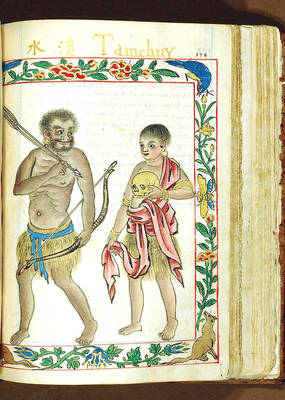
The Portuguese never established a presence on Taiwan, but they must have traded with the indigenous people because later traders reported that the locals referred to parts of deer using Portuguese words. What goods might the Portuguese have offered their indigenous trade partners? Among them must have been slaves, for the Portuguese dealt slaves across Asia. Though we often speak of “Portuguese” ships, imagining them as picturesque vessels manned by pointy-bearded Iberians, in Asia Portuguese shipping between local destinations was crewed by Asian seamen, with a handful of white or Eurasian officers. “Even the great carracks of 1,000-2,000 tons which plied

On Thursday, former Taipei mayor and founder of the Taiwan People’s Party (TPP) Ko Wen-je (柯文哲) was sentenced to 17 years in prison and had his civil rights suspended for six years over corruption, embezzlement and other charges. Seven others related to the case were also handed prison sentences, while two were found not guilty. It has been a bad week for the TPP. On Tuesday, prosecutors charged Chinese immigrant Xu Chunying (徐春鶯) with suspicion of taking part in Beijing-directed election interference. Xu has strong links to the TPP, which once offered her a party list legislator nomination. Tuesday also
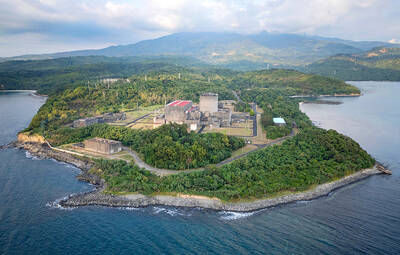
Nuclear power is getting a second look in Southeast Asia as countries prepare to meet surging energy demand as they vie for artificial intelligence-focused data centers. Several Southeast Asian nations are reviving mothballed nuclear plans and setting ambitious targets and nearly half of the region could, if they pursue those goals, have nuclear energy in the 2030s. Even countries without current plans have signaled their interest. Southeast Asia has never produced a single watt of nuclear energy, despite long-held atomic ambitions. But that may soon change as pressure mounts to reduce emissions that contribute to climate change, while meeting growing power needs. The


 RSS
RSS