


One of the most beautiful sights of Taiwan’s fall season are the lotus ponds, mere bodies of muddy water much of the year, but with the colder weather, the surface becomes carpeted with dark green lily pads that are decorated with the delicate pink and white lotus flowers. The flower is a symbol of purity rising up above a mundane and corrupt world and is revered by both Buddhists and Hindus as a flower associated with the sacred or divine. Its roots are buried in the muck beneath, dirty tubular things that would seem to have little appeal.
While almost the whole plant can be put to culinary use, it is this tubular root, called the rhizome, which is the most prized — this despite their off-white flesh and canals that give it a frankly bizarre appearance. Once you get beyond its unusual appearance, though, lotus root turns out to be a particularly versatile ingredient that can be used in everything from soups and pickles to stir-fries and sweets.
The flavor of lotus root is very bland, but in the kitchen it is prized for its ability to absorb the flavors around it. One food blogger describes it as “the tofu of the vegetable kingdom,” a comparison that is not without usefulness, but it should not put tofu-haters off, for apart from its ability to form a sounding board for other flavors, it also has other valuable culinary features, most notably its texture, which is similar to water chestnuts or Chinese sand pear (水梨), and can be used as a substitute for the former in some instances.
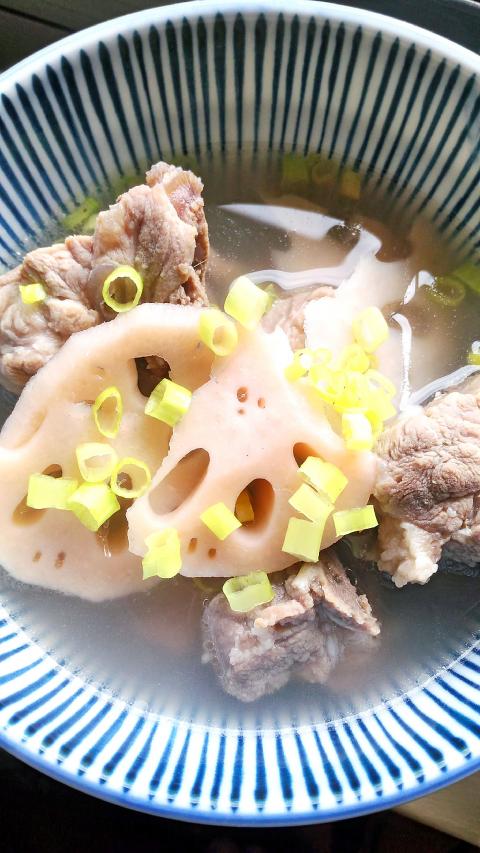
Photo: Ian Bartholomew
But just to get back to the basics for a moment, one of the things I belatedly realized was that the lotus and the water lily are two quite different beasts, and while lily roots (百合) have their own distinct place in the Asian culinary heritage, botanically they are quite separate, as they are also in Chinese pharmacology. They are both cooling foods that are used for cooling inflammations and soothing distempered stomachs, but when properly prepared, they offer quite distinct flavor and textural profiles. Made into puree for sick children, they are easily interchangeable, and my own distaste for both lotus and lily (not that I could tell them apart), stem from this medicinal use.
It is important that for all its medicinal qualities, lotus root does require some care in selection and preparation to be fully enjoyed. There are distinct differences in texture between the base and top of the root, each being suitable for different preparations. The base can be excessively fibrous and is best avoided unless you have some experience working with this ingredient. The tops are the best section for pickling, and the mid-section offers the best balance of firmness and crunch, and is recommended for making lotus root and pork soup (recipe below).
There are a variety of dishes that make use of the air holes that give lotus root its strange appearance, including stuffing said holes with flavored glutinous rice or using them rather in the manner of rotelle (little wheels) pasta, in which the holes hold thickened sauces. Though these all make for interesting, if not necessarily attractive, visual presentations, lotus root really shines in the simplest preparations.
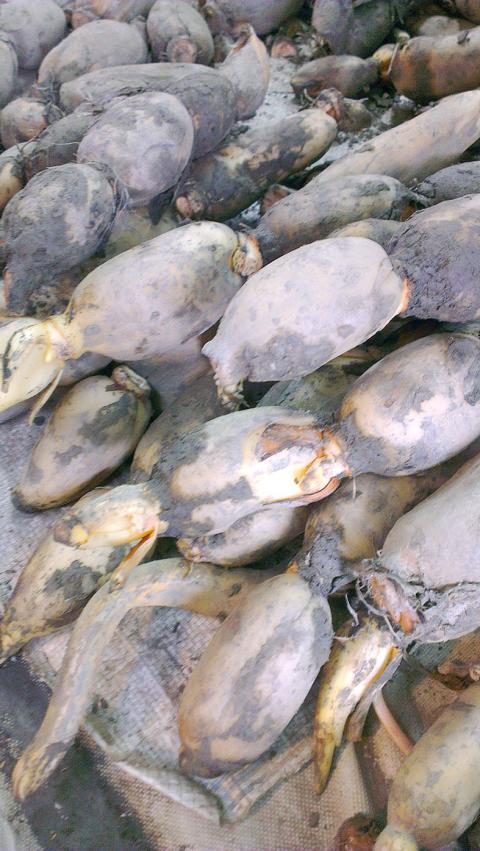
Photo: Ian Bartholomew
Stir fried or shallow fried lotus root has a lovely crunchy texture, as does a well made lotus root pickle, and stewed the root can retain a nice firmness and serve a function similar to potato in enriching a braise and providing filling starch. With local potatoes out of season at the moment, lotus root offers plenty of possibilities, and can serve as a great adjunct to many foods.
A personal favorite is adding them to pork burger patties, a simple mixture of minced meat, spring onions, minced lotus root, garlic, sesame oil and bread crumbs, held together with egg. This goes particularly well with a chili and soy dipping sauce. In this dish you get a hint of the exotic, but nothing that is off putting, and it has proved a successful gateway to introducing children to an otherwise “odd” vegetable.
While its flavor may not particularly excite, its list of health benefits are startling. According to organicfacts.net, these include “its ability to improve digestion, reduce cholesterol, lower blood pressure, boost the immune system, prevent various forms of cancer, balances mood and relieves depression, increases circulation and maintain proper enzymatic activity in the body.”
Additionally, it is low in calories, and also provides an excellent source of dietary fiber. Most importantly, however, it is now easily available at traditional markets, fresh from the murky mire, and often not very much cleaned when put on sale. These are the ones to buy. Some stalls will also sell cleaned and peeled lotus root, purportedly providing a service to the consumer, but be aware that lotus root naturally oxidizes, and those clean white roots, so much more attractive than muddy nodules, may have been bleached to maintain a marketable whiteness. Go for mud every time!
Lotus Root and Pork Soup
Recipe
(Serves 4)
Lotus root is a perfect ingredient for absorbing flavors and setting off the flavor of fresh pork ribs. It is the antithesis of another traditional Taiwan soup, shitake mushroom and pork soup, where it is the mushrooms that give the pork flavor. Here the starchy lotus root ever so slightly thickens the soup but basically the flavor of the pork is allowed to stand on its own. Fresh pork ribs from a local butcher, rather than frozen, are preferable for this dish, with meaty neck my own preferred cut, though any kind of short rib is perfectly good. Additions of ginger, Chinese dates or seaweed can all be used to build up the flavor, but prepared in its most basic form, the dish has a simple beauty all its own.
Ingredients
500g pork neck or short ribs
200g lotus root
1/8 cup rice wine
1 tsp salt
1/2 tsp white pepper
1 tsp rice vinegar
1 liter water
Directions
1. Peel the lotus root and slice into disks.
2. Wash the neck chops thoroughly under cold running water.
3. Bring a pot of water to the boil. Add the meat and bring back to a boil. Allow to boil for no more than a minute before pouring off the water and setting the meat aside.
4. Bring a pot with 1 liter of water to a boil. Toss in the lotus root and bring back to a boil. Add the meat, rice wine and vinegar.
5. Bring back to a boil then turn down the heat to low and cover. Cook over a low flame for 45 minutes.
6. Season with salt and white pepper 10 minutes or so before the soup is ready.
7. Serve with a good quality soy sauce for dipping.
Ian Bartholomew runs Ian’s Table, a small guesthouse in Hualien. He has lived in Taiwan for many years writing about the food scene and has decided that until you look at farming, you know nothing about the food you eat. He can be contacted at Hualien202@gmail.com.

The Portuguese never established a presence on Taiwan, but they must have traded with the indigenous people because later traders reported that the locals referred to parts of deer using Portuguese words. What goods might the Portuguese have offered their indigenous trade partners? Among them must have been slaves, for the Portuguese dealt slaves across Asia. Though we often speak of “Portuguese” ships, imagining them as picturesque vessels manned by pointy-bearded Iberians, in Asia Portuguese shipping between local destinations was crewed by Asian seamen, with a handful of white or Eurasian officers. “Even the great carracks of 1,000-2,000 tons which plied

It’s only half the size of its more famous counterpart in Taipei, but the Botanical Garden of the National Museum of Nature Science (NMNS, 國立自然科學博物館植物園) is surely one of urban Taiwan’s most inviting green spaces. Covering 4.5 hectares immediately northeast of the government-run museum in Taichung’s North District (北區), the garden features more than 700 plant species, many of which are labeled in Chinese but not in English. Since its establishment in 1999, the site’s managers have done their best to replicate a number of native ecosystems, dividing the site into eight areas. The name of the Coral Atoll Zone might

On Monday morning, in quick succession, the Chinese Communist Party (CCP) and the Chinese Nationalist Party (KMT) released statements announcing “that the Central Committee of the Communist Party of China and General Secretary Xi Jinping (習近平) have invited KMT Chairwoman Cheng Li-wun (鄭麗文) to lead a delegation on a visit to the mainland” as the KMT’s press release worded it. The KMT’s press release added “Chairwoman Cheng expressed her gratitude for the invitation and has gladly accepted it.” Beijing’s official Xinhua news release described Song Tao (宋濤), head of the Taiwan Work Office of the CCP Central Committee, as

Nuclear power is getting a second look in Southeast Asia as countries prepare to meet surging energy demand as they vie for artificial intelligence-focused data centers. Several Southeast Asian nations are reviving mothballed nuclear plans and setting ambitious targets and nearly half of the region could, if they pursue those goals, have nuclear energy in the 2030s. Even countries without current plans have signaled their interest. Southeast Asia has never produced a single watt of nuclear energy, despite long-held atomic ambitions. But that may soon change as pressure mounts to reduce emissions that contribute to climate change, while meeting growing power needs. The


 RSS
RSS