


Over the past few decades, Stan Lai (賴聲川) has established a reputation as one of the most celebrated Chinese-language playwrights and directors. His works include more than 30 original plays, two feature films and four operas. Lai, who was born in the US and is based in Taiwan, has written classics like Secret Love in Peach Blossom Land (暗戀桃花源, 1986), now an iconic play in contemporary Chinese theater, while still continuing to experiment with new forms, as seen in his eight-hour epic, A Dream Like a Dream (如夢之夢, 2000), which has audiences sitting on swivel chairs in the center of the stage.
He is a co-founder of the Performance Workshop in Taiwan and the Wuzhen Theater Festival in China. Last year he opened his first theater, Theater Above, a 699-seat venue in Shanghai. Most recently, he directed San Francisco Opera’s production of the Chinese classic Dream of the Red Chamber (紅樓夢), which had its premiere early this month. In a recent interview, Lai spoke about changes in the theater industry in China and Taiwan and how his Buddhist beliefs influence his writing.
Amy Qin: When did you first start writing plays?
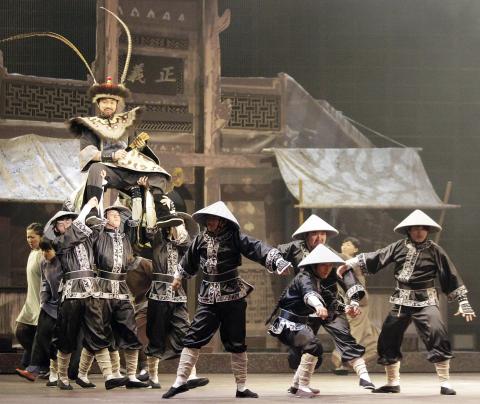
Photo: Chan Chao-yang, Taipei Times
Stan Lai: I started writing plays in 1983. As a new teacher in Taiwan just having received my PhD from Berkeley, I found a great lack of teaching materials for my students, who didn’t read English. Since Taiwan had been under martial law for so long, there wasn’t a body of creative work — plays — and there were very few translated materials to fall back on as teaching material, so I decided to create my own.
AQ: What was the environment for theater in Taiwan like at the time?
SL: It was a time when there was no theater industry in Taiwan, so no professional anything — writers, directors, actors, designers, scene shops, etc. Not even a theater with a fully functioning fly system. So my way of creating new works also was my way of conducting actor training and general training in creating works for the theater, with the larger context being the lack of theater facilities or even a style of training or performing.
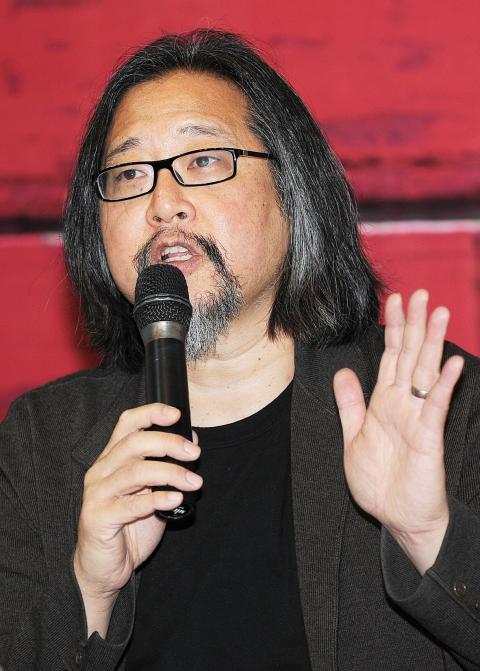
Photo: Sung Chih-hsiung, Taipei Times
The new works I was making reflected the fact that we were forming a new grammar of theater in the Chinese language, working in a vacuum with little or no points of reference from the past. My fourth play, That Evening, We Performed Crosstalk (那一夜,我們說相聲, 1985), was a breakout work.
AQ: What was that play about?
SL: That play dealt with the death of culture, “cross talk” in particular, and unexpectedly was a huge commercial success, at the same time reviving the dying traditional comic performing art called cross talk (相聲). And so it set the mold for a new type of theater — commercially viable yet intellectually challenging. We were doing serious theater, engaging our audiences in deep and essential dialogue, and at the same time creating a new audience. That was the excitement of our early works. What we are witnessing in China today is not dissimilar.
AQ: How have your interests as a playwright changed since then?
SL: My own personal evolution as a playwright went through an era of political change in Taiwan, where my work as many people see it contributed to the dialogue surrounding change. As I continued to evolve as a human being, I began to believe that politics is a smaller and lesser topic to deal with, much smaller than life itself, and the human forces shaping the external world are subservient to the forces shaping our inner world. Thus my shift in focus from the external to the internal, most notably in A Dream Like a Dream.
AQ: Talk a little bit about A Dream Like a Dream. What inspired you to write it?
SL: The idea came to me when I was traveling in India in Bodh Gaya. I’ve been a practicing Buddhist for over 40 years. In the past, I’ve been quite reluctant to put my Buddhist practice into my work, but it was a moment when I was inspired to do so. The whole eight-hour, very complicated story came to my mind in one piece, in one inspiration.
AQ: How has politics affected the larger creative environment in Taiwan?
SL: As politics and society in Taiwan evolved, the acute confrontational stance of the two opposing parties has created a fatigue and distaste toward politics in society in general, including the artistic community. The constant ongoing daily exchange of attacks and vicious views in the media often seems to make life much more theatrical than theater could ever be, and in fact even more absurd and entertaining as well. This uncontrolled media violence has negated the possibility of meaningful dialogue, and any artist who wishes to engage the issues runs the risk of being immediately labeled this or that.
There is no space for objective and rational discourse. That is why artists in Taiwan today naturally gravitate away from dealing with political issues. How they find their expression is a question of their own personal growth and path. I found mine in the deeper and larger domain that is called life itself.
AQ: What has been the biggest change in theater in China over the last few decades?
SL: Certainly the biggest changes have been the denationalization of theater and its increasing commercialization. So while it’s great that theater is growing at the pace it is, it is a little unfortunate that people there see theater as a lucrative business plan, as crazy as it sounds. I say crazy because in the US, it would never happen.
As a result, theater is underappreciated as a true, integral part of the cultural growth of a society. That’s why things like the Wuzhen Theater Festival and my own theater in Shanghai mean so much to me. We are working to counter those trends where you see investors coming in and trying to create a Chinese type of Broadway musical everywhere all the time. Your motivation for doing something is so important in shaping that thing. And if your motivation is to make money, then it shapes it in a very odd way. Theater becomes a very patronizing thing, and you’ll see that a lot in China — copying and pasting things together that they think will sell.
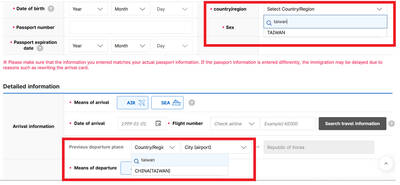
Jason Han says that the e-arrival card spat between South Korea and Taiwan shows that Seoul is signaling adherence to its “one-China” policy, while Taiwan’s response reflects a reciprocal approach. “Attempts to alter the diplomatic status quo often lead to tit-for-tat responses,” the analyst on international affairs tells the Taipei Times, adding that Taiwan may become more cautious in its dealings with South Korea going forward. Taipei has called on Seoul to correct its electronic entry system, which currently lists Taiwan as “China (Taiwan),” warning that reciprocal measures may follow if the wording is not changed before March 31. As of yesterday,
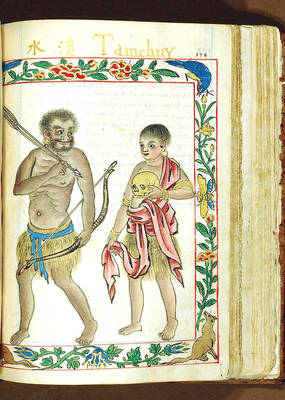
The Portuguese never established a presence on Taiwan, but they must have traded with the indigenous people because later traders reported that the locals referred to parts of deer using Portuguese words. What goods might the Portuguese have offered their indigenous trade partners? Among them must have been slaves, for the Portuguese dealt slaves across Asia. Though we often speak of “Portuguese” ships, imagining them as picturesque vessels manned by pointy-bearded Iberians, in Asia Portuguese shipping between local destinations was crewed by Asian seamen, with a handful of white or Eurasian officers. “Even the great carracks of 1,000-2,000 tons which plied

It’s only half the size of its more famous counterpart in Taipei, but the Botanical Garden of the National Museum of Nature Science (NMNS, 國立自然科學博物館植物園) is surely one of urban Taiwan’s most inviting green spaces. Covering 4.5 hectares immediately northeast of the government-run museum in Taichung’s North District (北區), the garden features more than 700 plant species, many of which are labeled in Chinese but not in English. Since its establishment in 1999, the site’s managers have done their best to replicate a number of native ecosystems, dividing the site into eight areas. The name of the Coral Atoll Zone might
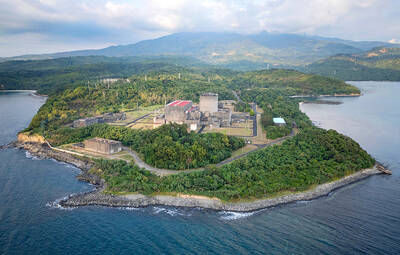
Nuclear power is getting a second look in Southeast Asia as countries prepare to meet surging energy demand as they vie for artificial intelligence-focused data centers. Several Southeast Asian nations are reviving mothballed nuclear plans and setting ambitious targets and nearly half of the region could, if they pursue those goals, have nuclear energy in the 2030s. Even countries without current plans have signaled their interest. Southeast Asia has never produced a single watt of nuclear energy, despite long-held atomic ambitions. But that may soon change as pressure mounts to reduce emissions that contribute to climate change, while meeting growing power needs. The


 RSS
RSS