


The Century Contemporary Dance Company (CCDC, 世紀當代舞團) brought together Taiwanese dancer/choreographer Chen Wei-ning (陳維寧) and Singaporean director/playwright Chong Tze Chien (張子健), director of The Finger Players (十指幫) with an interesting commission: create their own interpretations, in their own genres, of the Ming dynasty erotic novel The Golden Lotus (金瓶梅).
The idea was “one text, two explanations,” with the aim of giving a new, modern look to a literary classic. The resulting production, Lost in the Lust (慾土), opens tonight for a five-show run at Songshan Cultural and Creative Park’s Stage@Lab space.
Chen’s portion of the double bill is entitled “Paradise Denounce” (賤斥樂園). It examines the struggle of the female characters in a patriarchal society where the moral authority lay with men. Chong’s "Golden Lotus" (金瓶梅) examines the differing perspectives of the key characters.
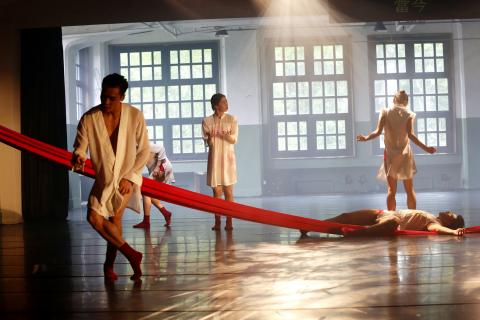
Photo Courtesy of Lin Sheng-fa
The five performers are Li Hui-wen (李蕙雯), Liu Jya-rui (劉家瑞), Chen Ya-ju (陳雅筑), Mo Tian-yun (莫天昀) and Lin Yi-zhen (林意真).
There will be post-show discussions tonight and tomorrow night.
■ Lost in the Lust (慾土), tonight, tomorrow and Sunday at 7:30pm, tomorrow and Sunday at 2:30pm at the Songshan Cultural and Creative Park East Building 2F(松山文創園區 — 東向製菸工廠2樓), 133, Guangfu S Rd, Taipei City (台北市光復南路133號)
■ Tickets are NT$800; available at NTCH box offices, online at www.artsticket.com.tw, Eslite ticket counters, convenience store ticketing kiosks and at the door. Tonight’s show is sold out.

For many people, Bilingual Nation 2030 begins and ends in the classroom. Since the policy was launched in 2018, the debate has centered on students, teachers and the pressure placed on schools. Yet the policy was never solely about English education. The government’s official plan also calls for bilingualization in Taiwan’s government services, laws and regulations, and living environment. The goal is to make Taiwan more inclusive and accessible to international enterprises and talent and better prepared for global economic and trade conditions. After eight years, that grand vision is due for a pulse check. RULES THAT CAN BE READ For Harper Chen (陳虹宇), an adviser

Traditionally, indigenous people in Taiwan’s mountains practice swidden cultivation, or “slash and burn” agriculture, a practice common in human history. According to a 2016 research article in the International Journal of Environmental Sustainability, among the Atayal people, this began with a search for suitable forested slopeland. The trees are burnt for fertilizer and the land cleared of stones. The stones and wood are then piled up to make fences, while both dead and standing trees are retained on the plot. The fences are used to grow climbing crops like squash and beans. The plot itself supports farming for three years.

The breakwater stretches out to sea from the sprawling Kaohsiung port in southern Taiwan. Normally, it’s crowded with massive tankers ferrying liquefied natural gas from Qatar to be stored in the bulbous white tanks that dot the shoreline. These are not normal times, though, and not a single shipment from Qatar has docked at the Yongan terminal since early March after the Strait of Hormuz was shuttered. The suspension has provided a realistic preview of a potential Chinese blockade, a move that would throttle an economy anchored by the world’s most advanced and power-hungry semiconductor industry. It is a stark reminder of

May 4 to May 10 It was once said that if you hadn’t performed at the Sapphire Grand Cabaret (藍寶石大歌廳), you couldn’t truly be considered a star. Taking the stage at the legendary Kaohsiung club was more than just a concert. Performers were expected to entertain in every sense, wearing outlandish or revealing costumes and staying quick on their feet as sharp-tongued, over-the-top hosts asked questions and delivered jokes that would be seen as vulgar, even offensive, by today’s standards. Opening in May 1967 during a period of strict political and social control, Sapphire offered a rare outlet for audiences in


 RSS
RSS