


For the vast majority of people in Europe, knowledge of the Taiwanese film scene extends no further than the work of director Ang Lee (李安) but a greater appreciation is being sparked by events such as the annual Taiwan Film Week at the Center of Taiwan Studies, part of the University of London’s School of Oriental and African Studies (SOAS).
Director of the Center of Taiwan Studies, Dafydd Fell, has found the medium of film a useful tool to address themes such as politics, modern history, society and economics.
“I teach in a political science department but being in the Taiwan studies community, I get exposed to a range of disciplines, including film. So I often use Taiwanese films in my teaching of Taiwanese politics.”
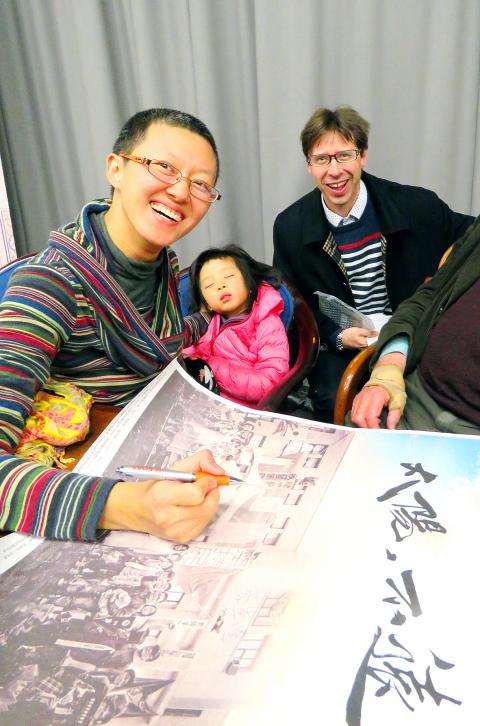
Photo: Jewel Lo
Fell, who presented the paper Portrayals of Democratic Politics in Taiwanese Film at last month’s European Association of Taiwan Studies Conference in Prague, responded to student interest in Taiwan’s social movements by screening the documentaries Civil Disobedience (公民不服從) and Sunflower Occupation at this year’s Taiwan Film Week in February. After the screenings, which respectively focus on the unrest generated by the visit to Taiwan of Association for Relations Across the Taiwan Strait Chairman Chen Yunlin (陳雲林) in 2008 and the events surrounding the occupation of the Legislative Yuan in 2014, the audience had the chance to take part in a question and answer session with director Chen Yu-ching (陳育青).
“The audiences tend to be quite diverse for the film screening events,” Fell says. “One group will be SOAS students taking our Taiwan courses but others will be non-students who are interested in Asian film, postgraduate students who have a film or Taiwan interest, [students at] other universities, members of the overseas Taiwanese community.”
“When we show social movement-related films then it is quite common for students who were activists in the past, but happen to be studying or working in the UK, to join screenings and they can bring something different to the discussion,” Fell says. “Social movement topics also tend to attract audience members from Hong Kong but also from China.”
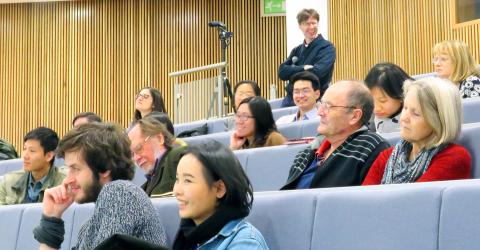
Photo: Tony Phillips
Sunflower Occupation is an omnibus featuring different films outlining the progress and aftermath of the Sunflower movement, arguably the most important protest movement in a generation. Some of these look at the movement in its historical and social context, for example, by featuring former leaders of the Wild Lily Movement of 1990 talking about more recent events.
“It is definitely easier to record footage of social movements today,” Fell says. “In fact, in Sunflower Occupation some parts were filmed using phone cameras, such as the Executive Yuan occupation. However, recently a number of documentaries are being released about earlier social movements from the 1980s and 90s. I sense there is a lot of interest in the continuity between these earlier and more recent protest movements.”
“Recently there had been a stereotype that young people in Taiwan were just not interested in politics, thus the ‘Strawberry Generation’ label,” Fell says. “Election rallies tended to be dominated by older audiences. Recent protest movements and election campaigns have undermined that stereotype.”
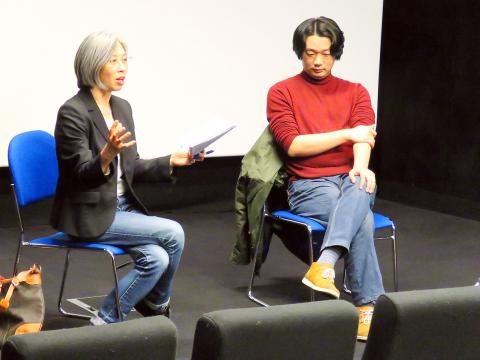
Photo: Tony Phillips
Also featured in this year’s Taiwan Film Week was the The Losers (廢物), a film about three interconnected characters in Meinong (美濃), a Hakka district in Kaohsiung City, where land is being bought up by developers and estate agents.
The film highlights social issues such as land development, migrant spouse families, challenges to agriculture and drug problems, as well as Hakka culture.
Director Lou Yi-an (樓一安) also traveled to London for the screening and Q&A session.
“The audience response and feedback has been very good over the last few years,” Fell says. “The visiting film directors also enjoy coming to SOAS as the post-screening Q&A and discussion tend to be very informed and lively.”
Londoners will not have to wait until the next Taiwan Film Week for their Taiwanese film fix as the documentaries Gongliao How are you? (貢寮,你好?) and Small Oyster Rock in Kezailiao are scheduled for screenings at SOAS this summer.
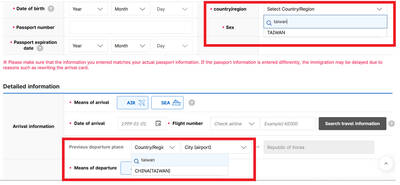
Jason Han says that the e-arrival card spat between South Korea and Taiwan shows that Seoul is signaling adherence to its “one-China” policy, while Taiwan’s response reflects a reciprocal approach. “Attempts to alter the diplomatic status quo often lead to tit-for-tat responses,” the analyst on international affairs tells the Taipei Times, adding that Taiwan may become more cautious in its dealings with South Korea going forward. Taipei has called on Seoul to correct its electronic entry system, which currently lists Taiwan as “China (Taiwan),” warning that reciprocal measures may follow if the wording is not changed before March 31. As of yesterday,

The Portuguese never established a presence on Taiwan, but they must have traded with the indigenous people because later traders reported that the locals referred to parts of deer using Portuguese words. What goods might the Portuguese have offered their indigenous trade partners? Among them must have been slaves, for the Portuguese dealt slaves across Asia. Though we often speak of “Portuguese” ships, imagining them as picturesque vessels manned by pointy-bearded Iberians, in Asia Portuguese shipping between local destinations was crewed by Asian seamen, with a handful of white or Eurasian officers. “Even the great carracks of 1,000-2,000 tons which plied
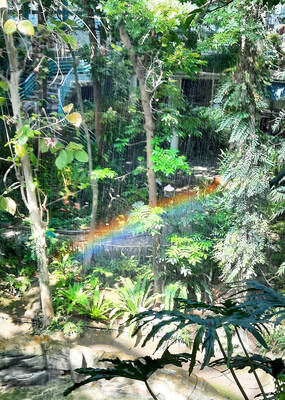
It’s only half the size of its more famous counterpart in Taipei, but the Botanical Garden of the National Museum of Nature Science (NMNS, 國立自然科學博物館植物園) is surely one of urban Taiwan’s most inviting green spaces. Covering 4.5 hectares immediately northeast of the government-run museum in Taichung’s North District (北區), the garden features more than 700 plant species, many of which are labeled in Chinese but not in English. Since its establishment in 1999, the site’s managers have done their best to replicate a number of native ecosystems, dividing the site into eight areas. The name of the Coral Atoll Zone might
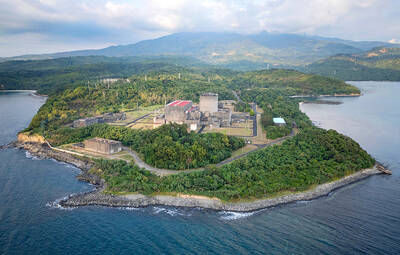
Nuclear power is getting a second look in Southeast Asia as countries prepare to meet surging energy demand as they vie for artificial intelligence-focused data centers. Several Southeast Asian nations are reviving mothballed nuclear plans and setting ambitious targets and nearly half of the region could, if they pursue those goals, have nuclear energy in the 2030s. Even countries without current plans have signaled their interest. Southeast Asia has never produced a single watt of nuclear energy, despite long-held atomic ambitions. But that may soon change as pressure mounts to reduce emissions that contribute to climate change, while meeting growing power needs. The


 RSS
RSS