


“Taiwanese media’s biggest problem isn’t that it’s crap, but that it has no power of imagination,” said Edd Jhong (鐘聖雄), one of the founders of Decode Magazine (眉角雜誌). “I want to see a magazine that explodes with pulp, makes you wet your pants. Something that has got balls the size of a bull, something that’s new and fun.”
Decode is certainly something new for Taiwan’s media market. At just its third issue, the Chinese-language publication has become Taiwan’s most highly sought after independent magazine. Its first issue, dedicated to the occupy protest movements gaining popularity around the globe, sold out its first print run of 3,500 in mere days, requiring a second printing of 700.
Its aim is to give readers the tools to ‘decode’ the complex events happening around them, and offers an in-depth and multi-angled approach as an answer to criticism of Taiwan’s poor quality news culture.
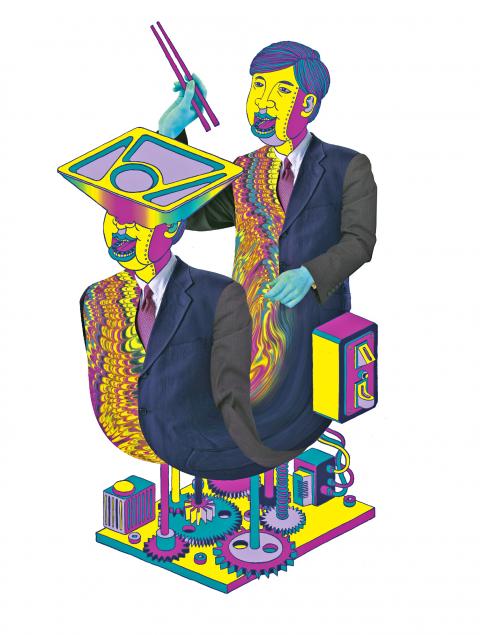
Photo courtesy of Godkidlla
But Taiwan’s most in-demand magazine can’t be found online. It’s only on sale at independent bookstores and coffee shops, and through a subscription purchased from a crowdfunding Web site.
This makes Decode hard to categorize. It is part of the new wave of online media news sites that have gained popularity after the Sunflower movement — the civil protest that broke out in March last year in opposition to the Chinese Nationalist Party (KMT)-dominated legislature’s ramming through a controversial cross-strait service trade agreement — but it is firmly entrenched in the world of the printed page, hoping to revive an era where eye-catching photography and design motivates readers to pluck out the cash to hold it in their own hands.
“Our biggest challenge is that people are already so used to free content. How many people are willing to buy and subscribe to newspapers and magazines since the dawn of Internet news?” said Liu Mei-yu (劉美妤), another Decode founder.
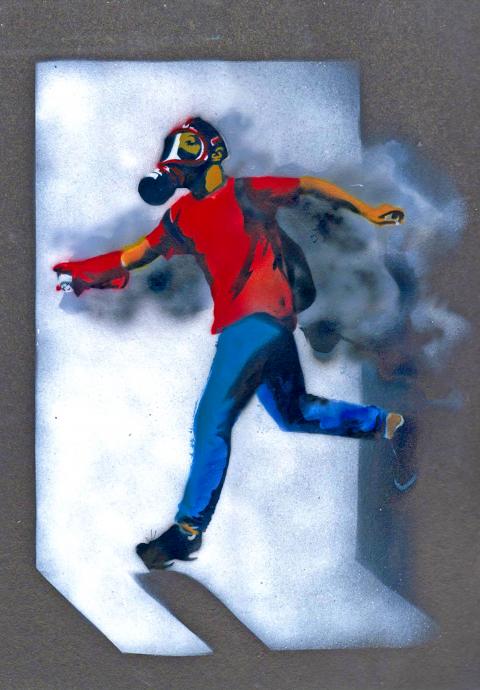
Photo courtesy of Godkidlla
Perhaps it’s still too early to write the obituary for Taiwan’s troubled printed news industry. Maybe all it needs is a new model to excite readers.
CONTENT IS KING
Staring intently into their computer screens, the magazine’s founders only look up as I begin to approach their table. We’ve arranged to meet at Sugarman Cafe, a coffee shop with posters of various social movements and protests past and present plastered all over the front door and bulletin board.
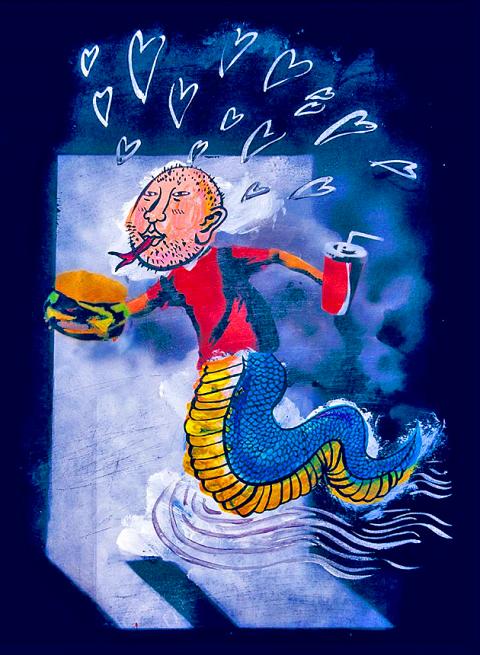
Photo courtesy of Godkidlla
Tucked into a booth in the far corner of the cafe, Jhong, Liu and Huang Yi-yuan (黃驛淵) are all busily working on the magazines’ next issue, about Taiwan’s “loser” culture.
“Our model for how we define a successful person is so narrow,” says Jhong. “We only see success as making a lot of money, and owning a house and car.”
Their choice to look at loser culture exemplifies its fun approach to delving into the deeper issues that affect Taiwanese society. What at first may seem like a vacuous theme to explore, later appears as a pithy and clever way to explain Taiwan’s obsession with consumerism and home ownership.
“If you’re single, make 30K a month, but you’re happy, nobody sees that as success. We see that person as a loser,” Liu says.
Decode can be seen as an answer to Taiwan’s schizophrenic news industry that offers a multitude of choice, but rarely provides meaningful analysis, or connects news events to larger trends occurring in Taiwan and around the globe.
“The problem with Taiwan’s media was so evident during the Sunflower movement,” said Jhong, an award-winning photo-journalist. “There were thousands of news stories about it, but no one had any idea what was really going on, or why the students were protesting.”
Jhong proposed the idea for Decode to Liu, a former New York Times reporter, and former United Daily News reporter Huang, who both liked the idea of an alternative news magazine in the vein of alternative ‘zines’ like Colors and Vice.
After covering the occupy movement and its link to Taiwan’s Sunflower movement in their first issue, they decided to carry out an “ethnography” of the Taiwanese dinner table, and looked at how cultural background, and the media’s perception of food safety and cuisine, affect our food choices. Both issues sold like hot cakes.
Decode’s popularity can be seen as part of the new and expanding media landscape that was formerly dominated by traditional media outlets the Apple Daily and the Liberty Times (the Taipei Times’ sister newspaper).
Online news Web sites like Taiwan’s Storm Media (風傳媒), Bacon Press (五花鹽), the Initium (端傳媒) and the highly anticipated news site The Reporter (報導者), by veteran writer and journalist Chang Tie-chi (張鐵志), have re-energized Taiwan’s media scene, providing more diversity and attracting thousands of new readers.
But Decode is very different from the explosion of new media Web sites in an important way. It has purposefully chosen to keep all of its content offline, hoping to engross its readers in content on the printed page, and away from the distractions of the smartphone screen.
A NON-LINE STRATEGY
As media outlets around the world clamber aboard the Internet as the great hope to survive shrinking circulation and boost advertisement sales, it may seem odd that Decode would choose a non-line strategy that focuses on the printed page.
News corporations like Next Media (壹傳媒) have been able to reap enormous profits through their aggressive online strategies, but it has come at the cost of over-dependence on tacky web ads that flood your screen and click-bait headlines with minimal content.
Decode’s creators see the media’s over-dependence on advertising to plug falling subscription numbers as part of the problem, not the solution.
“We’ve grown so used to advertisers footing the bill for our media, but that comes at a cost,” says Liu. “If you don’t want your editorial content to be taken hostage by advertisers, then you have to ask your readers to pay for good content.”
In order to have complete control of their content, and keep their magazine ad-free, they turned to local crowdsourcing platform SOSreader to raise the initial capital for the magazine.
Based on Jhong, Liu and Huang’s reputation within the independent journalism community, and the striking initial design layout sketches provided by lead designer Godkidlla (小子), Decode was able to raise an astounding NT$5 million for their first six-issue run.
Readers who subscribe to the magazine through a crowdfunding Web site receive the magazine by mail. It is available for purchase at independent bookshops and coffeeshops around Taiwan, but often sells out days of its announced sale date.
“A friend of mine told me that when Decode sold out in Taipei, he went all the way to Hualien to pick up the issue,” Jhong said.
Most important for Decode is to create a direct relationship with their readers, whereby they produce good content, readers pay the writers and editors directly for their work, and then are able to continue to make a good product.
“The attitude that people have in Taiwan is that news is free, so it becomes disposable. We want you to spend money on what we’ve produced, so you value it and enjoy it,” Huang says.
“If traditional media just shifts its old content to the Internet, the concept of new media doesn’t make any kind of breakthrough and is still stuck making vacuous content,” he adds.
Perhaps the greatest innovation in the rise of Taiwan’s new media isn’t digitalization, but giving readers a substantive and thoughtful way to think about their news.
For a full list of locations where Decode is sold, visit www.facebook.com/powertoimagination. The magazine’s third issue on “losers” is available now.
Jason Han says that the e-arrival card spat between South Korea and Taiwan shows that Seoul is signaling adherence to its “one-China” policy, while Taiwan’s response reflects a reciprocal approach. “Attempts to alter the diplomatic status quo often lead to tit-for-tat responses,” the analyst on international affairs tells the Taipei Times, adding that Taiwan may become more cautious in its dealings with South Korea going forward. Taipei has called on Seoul to correct its electronic entry system, which currently lists Taiwan as “China (Taiwan),” warning that reciprocal measures may follow if the wording is not changed before March 31. As of yesterday,

The Portuguese never established a presence on Taiwan, but they must have traded with the indigenous people because later traders reported that the locals referred to parts of deer using Portuguese words. What goods might the Portuguese have offered their indigenous trade partners? Among them must have been slaves, for the Portuguese dealt slaves across Asia. Though we often speak of “Portuguese” ships, imagining them as picturesque vessels manned by pointy-bearded Iberians, in Asia Portuguese shipping between local destinations was crewed by Asian seamen, with a handful of white or Eurasian officers. “Even the great carracks of 1,000-2,000 tons which plied
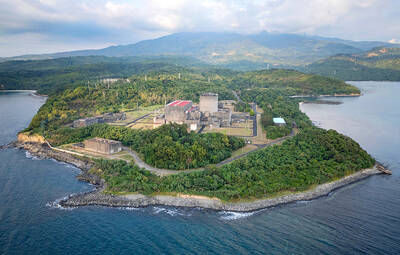
Nuclear power is getting a second look in Southeast Asia as countries prepare to meet surging energy demand as they vie for artificial intelligence-focused data centers. Several Southeast Asian nations are reviving mothballed nuclear plans and setting ambitious targets and nearly half of the region could, if they pursue those goals, have nuclear energy in the 2030s. Even countries without current plans have signaled their interest. Southeast Asia has never produced a single watt of nuclear energy, despite long-held atomic ambitions. But that may soon change as pressure mounts to reduce emissions that contribute to climate change, while meeting growing power needs. The

On Monday morning, in quick succession, the Chinese Communist Party (CCP) and the Chinese Nationalist Party (KMT) released statements announcing “that the Central Committee of the Communist Party of China and General Secretary Xi Jinping (習近平) have invited KMT Chairwoman Cheng Li-wun (鄭麗文) to lead a delegation on a visit to the mainland” as the KMT’s press release worded it. The KMT’s press release added “Chairwoman Cheng expressed her gratitude for the invitation and has gladly accepted it.” Beijing’s official Xinhua news release described Song Tao (宋濤), head of the Taiwan Work Office of the CCP Central Committee, as


 RSS
RSS