


While the Contemporary Legend Theater (當代傳奇劇場) has gained fame both at home and abroad for its adaptations of the works of William Shakespeare and Franz Kafka to Chinese operatic singing and movements, it remains at heart a classic Beijing opera troupe devoted to perpetuating the art form.
The 31-year-old company, founded by Wu Hsing-kuo (吳興國), is taking over the Fanqiao Theater and environs in New Taipei City’s Banciao District (板橋) this weekend and next to stage the fourth installment of its Legend Opera (傳奇風雅) program.
This year’s festival is subtitled Youth Vitality (青年戲曲節), since the focus is on the troupe’s younger performers, giving them both a chance to shine and the chance to reach out to contemporaries who might be more interested in Popu Lady or Jay Chou (周杰倫).
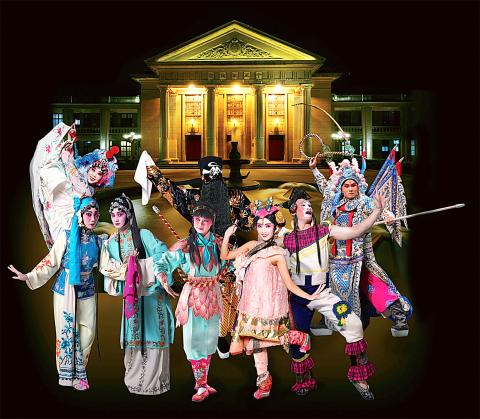
Photo courtesy of Contemporary Legend Theater
Altogether the company will be presenting 12 performances during the festival, beginning tonight. However, some of the shows have been reserved by private groups, while others are already sold out. As of press time, there are still seats available for all three shows on Sunday, the 2pm matinee on Dec. 19, and the two shows on Dec. 20.
A variety of works, or excerpts from full-length works, will be performed, both genre-bending and classics.
There are three chances to see Nezha (哪吒), which premiered at the company’s last festival in 2013, on Sunday at 11am, Dec. 19 at 2pm and Dec. 20 at 11am.
Nezha, whose main character is an eternal child who rides around on wheels of fire, was specifically created to appeal to a younger audience with its tale of bloody family infighting, betrayal and friendship. The title comes from the well-known Taoist deity who is also called the Third Prince
An earlier attempt by Wu to broaden his troupe’s appeal, A Play of Brother and Sister (兄妹串戲), which premiered in 2003, will be performed at the 2:30pm show on Sunday.
The show, the first of what Wu labeled “hip-hop comedy,” features a pair of feuding siblings who act out famous passages and standard numbers from folk and historical legends — in traditional singing style and martial arts moves — to a musical score that ranges from pop music — including two songs by Emil Chou (周華健) — to hip-hop.
The 4:30pm show on Sunday features excerpts from four operas, including Lin Chong’s Night Escape (林沖夜奔), The Matchmaker (紅娘) and Wu Song and the Tiger (武松打虎).
The 4:30pm show on Dec. 20 features excerpts from four productions, including Little Cowherd (小放牛) and Judge Bao and the Qin Xiang Lian Case (鍘美案).
However, the festival is more than just theater performances. Outside the theater in the 438 Art Zone, company members will also be offering instruction on traditional Chinese opera facial make-up, providing tips and technical instruction for those wanting to test their Beijing Opera skills and Beijing opera COSPLAY sessions.
For more information on the festival, visit: youth-vitality.blogspot.tw/ (only in Chinese).
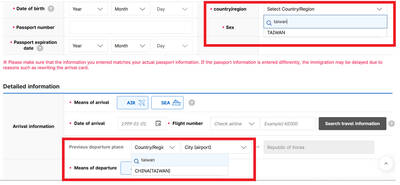
Jason Han says that the e-arrival card spat between South Korea and Taiwan shows that Seoul is signaling adherence to its “one-China” policy, while Taiwan’s response reflects a reciprocal approach. “Attempts to alter the diplomatic status quo often lead to tit-for-tat responses,” the analyst on international affairs tells the Taipei Times, adding that Taiwan may become more cautious in its dealings with South Korea going forward. Taipei has called on Seoul to correct its electronic entry system, which currently lists Taiwan as “China (Taiwan),” warning that reciprocal measures may follow if the wording is not changed before March 31. As of yesterday,
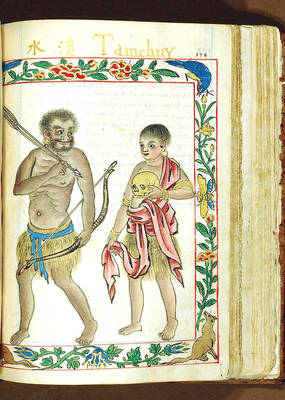
The Portuguese never established a presence on Taiwan, but they must have traded with the indigenous people because later traders reported that the locals referred to parts of deer using Portuguese words. What goods might the Portuguese have offered their indigenous trade partners? Among them must have been slaves, for the Portuguese dealt slaves across Asia. Though we often speak of “Portuguese” ships, imagining them as picturesque vessels manned by pointy-bearded Iberians, in Asia Portuguese shipping between local destinations was crewed by Asian seamen, with a handful of white or Eurasian officers. “Even the great carracks of 1,000-2,000 tons which plied
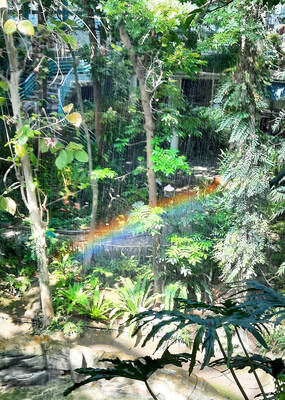
It’s only half the size of its more famous counterpart in Taipei, but the Botanical Garden of the National Museum of Nature Science (NMNS, 國立自然科學博物館植物園) is surely one of urban Taiwan’s most inviting green spaces. Covering 4.5 hectares immediately northeast of the government-run museum in Taichung’s North District (北區), the garden features more than 700 plant species, many of which are labeled in Chinese but not in English. Since its establishment in 1999, the site’s managers have done their best to replicate a number of native ecosystems, dividing the site into eight areas. The name of the Coral Atoll Zone might
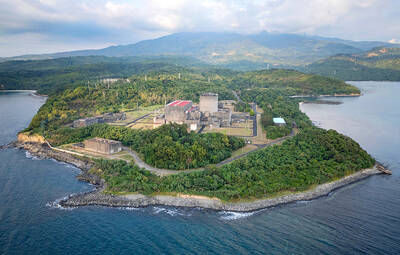
Nuclear power is getting a second look in Southeast Asia as countries prepare to meet surging energy demand as they vie for artificial intelligence-focused data centers. Several Southeast Asian nations are reviving mothballed nuclear plans and setting ambitious targets and nearly half of the region could, if they pursue those goals, have nuclear energy in the 2030s. Even countries without current plans have signaled their interest. Southeast Asia has never produced a single watt of nuclear energy, despite long-held atomic ambitions. But that may soon change as pressure mounts to reduce emissions that contribute to climate change, while meeting growing power needs. The


 RSS
RSS