


Following a determined explorer and his 16 proteges, driven by a dream deemed crazy by others, Dream Ocean (夢想海洋) is one of those documentaries made to appeal to a general audience. After all, what is there not to like about a group of individuals striving to achieve the impossible? The premise has the necessary elements for a story that promises plenty of drama and passion.
But what makes the documentary genuine and heartfelt is its protagonist Su Tar-zen (蘇達貞), a 63-year-old oceanographer devoted to promoting Taiwan’s ocean literacy, or the understanding of human influence on the ocean and vice versa.
The film opens with Su carefully examining the design of a canoe on his porch by the sea in Hualien. It is part of the grand plan the retired professor initiated last year, along with 16 selected young men and women from around the country. The goal: to voyage around the world in a canoe.
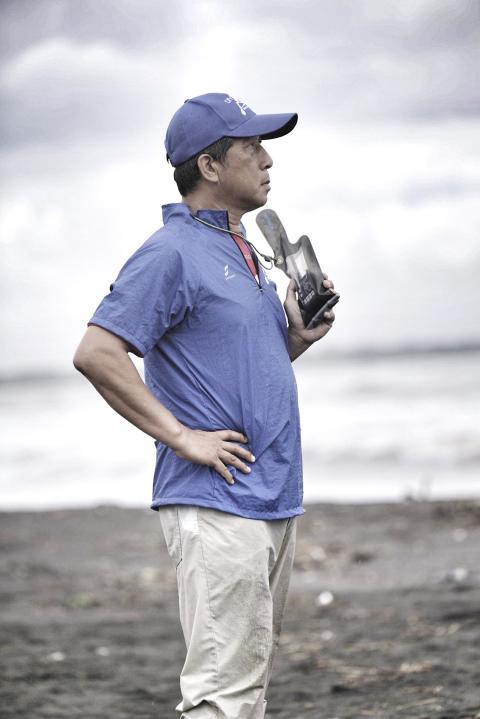
Photo courtesy of Hualien Media
The seafarers’ first mission will entail paddling from Hualien to Okinawa to Hawaii and finally, San Francisco.
For the next 90 minutes, the film follows the group of adventurers as they train in open water and learn to build their own vessels by hand. These “marine backpackers” can’t afford fancy stuff. They experiment, conserve and try to use as little resources as possible to make the canoe.
In the eyes of others, their endeavor is nothing short of dangerous. One sailcloth merchant, for example, stares at the young mariners in disbelief after realizing what they plan to do and says, “You’d better buy a lot of insurance. I have absolutely no faith in my products.”
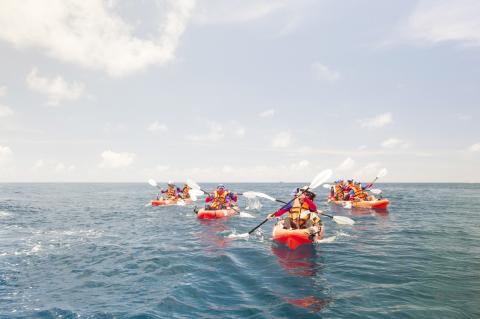
Photo courtesy of Hualien Media
For the most part, director Wang Wei-hsiang (王威翔) keeps the story buoyant and brisk, but social criticism occasionally seeps in. One such moment occurs when a crew member complains about how the water is “polluted and oily” after they paddle along the shore of Mailiao (麥寮) in Yunlin County, where the sixth naphtha cracker (六輕) plant looms.
The film hits its most poignant and emotional note when the audience discovers the reason why Su dedicates all his time, efforts and lifelong savings to found and manage the Jonathan Su Foundation (蘇帆海洋文化藝術基金會), which aims to cultivate a better understanding of the ocean and promote marine conservation, while encouraging ocean canoeing in particular.
In 2007, the oceanographer’s son, Jonathan, died in a diving accident. Before the accident, the father promised his son, also a marine enthusiast, that they would canoe around Taiwan together.
Su is keeping his promise.
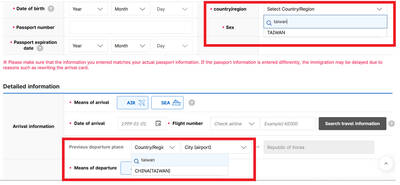
Jason Han says that the e-arrival card spat between South Korea and Taiwan shows that Seoul is signaling adherence to its “one-China” policy, while Taiwan’s response reflects a reciprocal approach. “Attempts to alter the diplomatic status quo often lead to tit-for-tat responses,” the analyst on international affairs tells the Taipei Times, adding that Taiwan may become more cautious in its dealings with South Korea going forward. Taipei has called on Seoul to correct its electronic entry system, which currently lists Taiwan as “China (Taiwan),” warning that reciprocal measures may follow if the wording is not changed before March 31. As of yesterday,

The Portuguese never established a presence on Taiwan, but they must have traded with the indigenous people because later traders reported that the locals referred to parts of deer using Portuguese words. What goods might the Portuguese have offered their indigenous trade partners? Among them must have been slaves, for the Portuguese dealt slaves across Asia. Though we often speak of “Portuguese” ships, imagining them as picturesque vessels manned by pointy-bearded Iberians, in Asia Portuguese shipping between local destinations was crewed by Asian seamen, with a handful of white or Eurasian officers. “Even the great carracks of 1,000-2,000 tons which plied
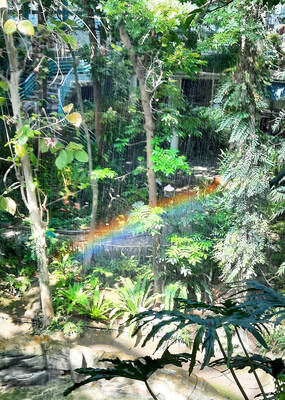
It’s only half the size of its more famous counterpart in Taipei, but the Botanical Garden of the National Museum of Nature Science (NMNS, 國立自然科學博物館植物園) is surely one of urban Taiwan’s most inviting green spaces. Covering 4.5 hectares immediately northeast of the government-run museum in Taichung’s North District (北區), the garden features more than 700 plant species, many of which are labeled in Chinese but not in English. Since its establishment in 1999, the site’s managers have done their best to replicate a number of native ecosystems, dividing the site into eight areas. The name of the Coral Atoll Zone might
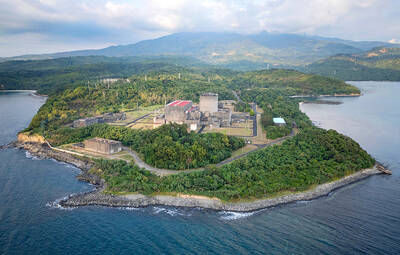
Nuclear power is getting a second look in Southeast Asia as countries prepare to meet surging energy demand as they vie for artificial intelligence-focused data centers. Several Southeast Asian nations are reviving mothballed nuclear plans and setting ambitious targets and nearly half of the region could, if they pursue those goals, have nuclear energy in the 2030s. Even countries without current plans have signaled their interest. Southeast Asia has never produced a single watt of nuclear energy, despite long-held atomic ambitions. But that may soon change as pressure mounts to reduce emissions that contribute to climate change, while meeting growing power needs. The


 RSS
RSS