


Adolescent love and the 1990s come under the microscope in Our Times (我的少女時代), an ambitious movie that could become a summer blockbuster.
Frankie Chen (陳玉珊), in her directorial debut, revises the “ordinary girl meets Prince Charming” tale, injecting a welcome dose of feminine perspective into the overused genre to touch upon the life experience of a girl becoming a woman in 1990s Taiwan. The comedy is supported by an appealing cast of novices, veterans and big-name stars.
It’s present-day Taipei, Truly Lin (Joe Chen, 陳喬恩) is in her thirties and stuck in a dead-end job. One night Lin suddenly recalls her first love, a high school romance that took place in 1994. The younger Lin, played by Vivian Sung (宋芸樺), is a plain, clumsy girl who spends her high-school days goofing around with friends and fawning over the most popular boy in school, Ouyang (Dino Lee, 李玉璽). An unfortunate incident leads Lin to become an errand girl for the school’s much-feared troublemaker Taiyu (Darren Wang, 王大陸).

Photo courtesy of Hualien Media International
It doesn’t take long, however, before Lin sees Taiyu for who he really is: a kind, smart young man. As their friendship evolves, they agree to help each other attract the people they are interested in and in the process Lin and Taiyu soon fall in love.
Meanwhile, Taiyu’s tough behavior results in a clash with school authorities and several street fights. Concerned, his parents send him to the US before he has a chance to say goodbye to Lin.
Fast forward two decades, Lin quits her job and breaks up with her boyfriend. Across town, a sold-out Andy Lau (劉德華) concert is set to take place at the Taipei Arena, where two surprises await our heroine.
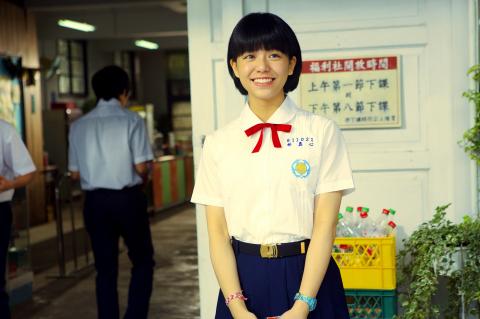
Photo courtesy of Hualien Media International
The light-hearted, briskly-paced film is a collaboration between Chen, a seasoned producer of soap operas and top-notch film producer Yeh Ju-fen (葉如芬). The experiences of these two veteran producers show in how well they can pick their cast, which, not to give the film away, include two Asian heartthrobs.
Another pleasant surprise is up-and-coming actress Sung, who captured the public’s attention with her performance the romantic comedy Cafe. Waiting. Love (等一個人咖啡) last year. Sung comes off as a lovable ugly duckling growing to become a strong, attractive girl, while playing well with the comic effect without caricaturing her role.
Chen and her crew have also done a fine job with their attention to detail of the era. Hairstyles, pop songs, sports drinks, tea houses, scary chain letters circulated in school and teenage obsessions with pop stars Lau and Aaron Kwok (郭富城) all create the right 1990s vibe. But the movie isn’t set in the 1990s simply for fun and decoration. It recalls a society that has just emerged from almost 40 years of martial law, an experience that makes the heroine who she is today.
With the screening time exceeding two hours, however, the movie could have used some pruning to keep its structure tighter and story snappier. Plotlines revolving around the two protagonists become repetitive at times, adding no new meaning to the narrative.
If one asks Taiwanese why house prices are so high or why the nation is so built up or why certain policies cannot be carried out, one common answer is that “Taiwan is too small.” This is actually true, though not in the way people think. The National Property Administration (NPA), responsible for tracking and managing the government’s real estate assets, maintains statistics on how much land the government owns. As of the end of last year, land for official use constituted 293,655 hectares, for public use 1,732,513 hectares, for non-public use 216,972 hectares and for state enterprises 34 hectares, yielding

The small platform at Duoliang Train Station in Taitung County’s Taimali Township (太麻里) served villagers from 1992 to 2006, but was eventually shut down due to lack of use. Just 10 years later, the abandoned train station had become widely known as the most beautiful station in Taiwan, and visitors were so frequent that the village had to start restricting traffic. Nowadays, Duoliang Village (多良) is known as a bit of a tourist trap, with a mandatory, albeit modest, admission fee of NT$10 giving access to a crowded lane of vendors with a mediocre view of the ocean and the trains

Traditionally, indigenous people in Taiwan’s mountains practice swidden cultivation, or “slash and burn” agriculture, a practice common in human history. According to a 2016 research article in the International Journal of Environmental Sustainability, among the Atayal people, this began with a search for suitable forested slopeland. The trees are burnt for fertilizer and the land cleared of stones. The stones and wood are then piled up to make fences, while both dead and standing trees are retained on the plot. The fences are used to grow climbing crops like squash and beans. The plot itself supports farming for three years.
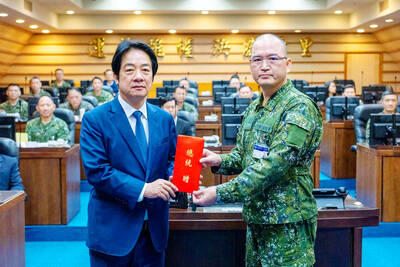
President William Lai (賴清德) on Nov. 25 last year announced in a Washington Post op-ed that “my government will introduce a historic US$40 billion supplementary defense budget, an investment that underscores our commitment to defending Taiwan’s democracy.” Lai promised “significant new arms acquisitions from the United States” and to “invest in cutting-edge technologies and expand Taiwan’s defense industrial base,” to “bolster deterrence by inserting greater costs and uncertainties into Beijing’s decision-making on the use of force.” Announcing it in the Washington Post was a strategic gamble, both geopolitically and domestically, with Taiwan’s international credibility at stake. But Lai’s message was exactly


 RSS
RSS