


Last weekend at Barcode, disco legend Bert Bevans dropped Donna Summer’s 1979 hit, Bad Girls, and the crowd nearly lost their collective mind. In the chorus, when the “toot-toot, beep-beep” part came on, people who didn’t know the song, people that are hardcore disco heads and random stragglers on Barcode’s dance floor were all looking at each other, grinning from ear to ear. Bevans gave Taiwan a memorable weekend of disco (with him even finding a way to play at The W’s Sunday pool party thanks to a little finagling by DJ Mr Uppity), and a reminder it doesn’t matter if it is New York City’s Studio 54 in the middle of the 1980s or an ultra chic Taipei lounge bar, good music is timeless.
THE NEW SOUND OF THE UNDERGROUND
Montrealer David Pimentel, better known to those in the music industry as Pomo, is a multi-instrumentalist and producer who has lately been climbing up the charts and out of the underground. Influenced by his father’s music collection growing up, which consisted of some all-time classics like Pink Floyd, Radiohead, David Bowie, The Beatles and Michael Jackson, Pomo is now making a splash on the scene by making his own “groove based, synthy, jazzy and dreamy electronic funk.”

Photo courtesy of Ultra Dance Society
In 2013, master of the underground, Kaytranada, added Pomo’s So Fine to his set list and the world started taking notice. Jazzy Jeff is a fan, shouting out his Sade remix online and Pomo has just worked with Mark Ronson, as well as releasing an official remix of Disclosure’s Holding On, one of the biggest songs of the summer. His focus for this year and beyond is to write more songs, produce tracks for more rappers and singers and bring his live set on tour.
Pomo says the future sound of music includes a little EDM, a little J Dilla and a little Prince.
“People can expect a groovy, eclectic set of a lot of my favorite artists and producers that make me dance and vibe to,” Pomo told the Taipei Times in an e-mail interview.
■ Ultra Dance Society presents Pomo with Diskokids, Bunjibeat and Not So Basic, tonight from 11:30pm to 5am at Korner, 200, Roosevelt Rd Sec 4, Taipei City (台北市羅斯福路四段200號B1). Admission is NT$1,000 at the door and includes one drink.
END OF AN ERA
At 4am on Saturday and Sunday, most venues are mopping the floors and trying to get their drunken revelers off the streets and into taxis so the neighbors don’t get pissed off. For Roxy 99, though, 4am has been the sweet spot because it stays open until 7am and people know that if they go there, they have one last chance at a one night stand.
When it was closer to National Taiwan Normal University, Roxy 99 was the anchor bar on the corner and lots of people would go there early and then head to Roxy Vibe for late night shenanigans. Two years ago, the Shidahood Self-help Association (師大三里里民自救會) ran owner Ling Wei (凌威) out of the area, and things have never been the same.
The new Roxy 99 was a lot like the old Roxy 99, but it never quite caught on. At the old one, people knew that when they went there, it would be rowdy until the sun came up. At the new one, the good times were few and far between. Now, the sun is setting on Roxy 99, and tomorrow night will be the final chance to do an uncountable number of cheap shots of tequila, listen to the DJ play Daft Punk’s One More Time in its entirety, and do the walk of shame up those stairs into the sunlight with a random stranger.
■ Roxy 99 farewell party is tomorrow night from 11pm to 7am at Roxy 99, B2, 27, Fushing Rd Sec 2, Taipei City (台北市大安區復興南路二段27號B2). Admission is NT$500 and includes with two drinks.

Taiwan’s English education system is being pulled apart by three opposing forces. Bilingual Nation 2030 pulls students toward English and global communication. Artificial Intelligence (AI) readiness pulls them toward digital judgment, verification and AI-mediated work. But Taiwan’s old exam culture pulls them back toward memorization, grammar drills, timed reading and correct answers. If the education system keeps using old exams to define success, it risks producing graduates who are neither genuinely bilingual nor genuinely AI-ready, but trained for tasks machines can already perform. The first force is Bilingual Nation 2030. Launched in 2018, the policy aimed to “help Taiwan’s workforce connect

It seems every few days one bumps into one of those “real man” comments in which Taiwan is urged to “face reality” or similar, and “make a deal,” with the speaker implying that soon it will be too late. “Deal” advocates always present themselves as having a superior grip on reality, and the manly ability to make the “hard choice.” Their testosterone-laden language often echoes that of Taiwan sellout advocates. Note that such commentary always specifies a process (“make a deal, work with, make progress”), never the end state of what occupation by a violent authoritarian colonialist state will entail. In

“Taiwan’s Opposition Leader Comes to US With a Message Straight Out of Beijing” read a May 31 headline in the Wall Street Journal. Top US administration officials and members of Congress almost certainly read the WSJ, and if there was a bullet point takeaway that people in Washington should absorb ahead of Chinese Nationalist Party (KMT) Chair Cheng Li-wun’s (鄭麗文) arrival in DC on June 9, that headline is it. The last few columns have discussed this very topic, and the timing is not coincidental. While those top officials likely do not read the Taipei Times, judging by the number
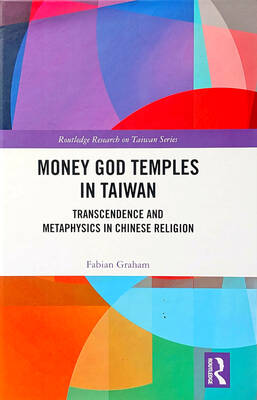
As someone who normally steers clear of books with “transcendence” or “metaphysics” in their subtitles, this reviewer — a casual observer of local belief systems since the 1990s — found Fabian Graham’s Money God Temples in Taiwan a challenging read. Those who’ve only dipped their toes into temple culture will likely need to parse several sections with special care if they’re to keep up with the author, a British ethnographic researcher whose previous books have investigated religious practices among ethnic Chinese in Southeast Asia. This scholarly volume examines a facet of Taiwan’s religious landscape that didn’t exist a century ago, and


 RSS
RSS