


You’ve seen the movie Black Swan, but what about White Swan? Or Avengers Grimm? Or Darker Shades of Grey? Or Attack of the Lederhosen Zombies?
You won’t catch these features at your local movie theater, but they and other B and C-grade flicks are doing booming business in the Cannes market, running in parallel with the film festival.
Sales to television and video-on-demand companies are strong, with China emerging as a key customer for the trashy niche, producers and distributors dealing with such films told AFP.
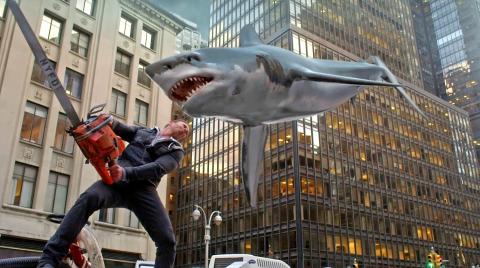
Photo: AP
Those in the sector are frank about what they’re selling.
“I think there’s really good independent movies that deserve to be seen. And outside that there’s a bunch of crap,” said Lawrence Silverstein, vice-president for sales and marketing at an Los Angeles-based outfit called Osiris Entertainment.
Silverstein pointed to a poster of House of Bad on his stand (plotline: three fugitive sisters with a suitcase of stolen heroin hide out in their childhood home, haunted by their parents) and said, “It’s not a great horror movie, but it’s not bad.” (Reviews on the Internet disagree.)
But he also showed a teaser of a crowdfunded indie horror-comedy called Clinger, in which an accidentally decapitated teen returns to stalk his unrequited love. It looked well-paced and entertaining.
MOCKBUSTERS
Other posters around the Cannes market, including one showing a Thor-like superhero wearing a red cap and brandishing a hammer over the title God of Thunder, underlined a whole category in the niche known as “mockbusters.”
These knockoffs, made to resemble small-budget versions of Hollywood blockbusters, ride the marketing slipstream of the originals to tempt people looking for something to watch at home, not at the cinema.
“We find a similar genre and hint at it in the title,” said David Rimawi, a producer and seller at The Asylum, one of the bigger LA outfits in the sector.
Naturally, the big US studios aren’t happy, especially with piracy also squeezing revenues. But the B-grade merchants are careful to stay just on the right side of the line of what constitutes a copy and what is sufficiently different.
“Their feeling, which we don’t necessarily agree with, is that it can cannibalize their market. But we would completely disagree, because what would cannibalize their market is a pirated movie of their movie,” said Rimawi.
“We’ve all settled in an area where we’re not too egregious. It’s clearly a different movie but there’ll be some word or term that’s similar to the other ones.”
The Asylum has a catalog of 200 films and makes around 15 a year, each with a budget of US$500,000 to US$2 million and done mostly in-house, with hired directors.
Apart from mockbusters such as Age of Tomorrow and Mad Max-inspired Road Wars, it also makes its own zany horror movies, of which Sharknado (killer sharks swept inland by a tornado) is probably the most famous.
ASIAN DEMAND
Other fare, driven by client demand — often Japanese — includes 3-Headed Shark Attack and Mom, Tommy Made a Dinosaur. A zombie series, Z-Nation, is showing on the US cable channel SyFy.
Films made for TV and video-on-demand (VOD) are the main outlets for this fare, though occasionally distributors in small territories such as Romania pick them up for theatrical release.
The massive, recent shift away from DVD sales to VOD has fragmented the market, but the players are seeing signs of strong buyer interest from Asian nations, especially China.
“There’s a big VOD market in China,” said Douglas Price, CEO and producer at D3 Telefilm, which is looking to get around Chinese quotas on foreign film imports by co-producing with Chinese companies.
“They have to understand that you have to bring more American/European actors into the movies — they can’t just be all purely Chinese,” he said.
Although the Chinese co-producers demand all distribution rights in China, that “is no big problem for me,” he said.
“They will give you the rights for around the world, which to me I think is a good deal.”
Certainly, the appetite in Asia and the Middle East for B-grade movies is buoying the market. So much so, that — as the tagline for the snowbound Austrian flick Attack of the Lederhosen Zombies says — “it’s all downhill from here.”
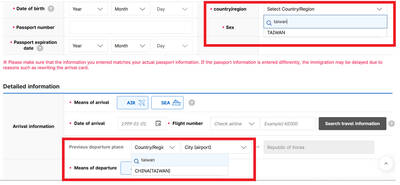
Jason Han says that the e-arrival card spat between South Korea and Taiwan shows that Seoul is signaling adherence to its “one-China” policy, while Taiwan’s response reflects a reciprocal approach. “Attempts to alter the diplomatic status quo often lead to tit-for-tat responses,” the analyst on international affairs tells the Taipei Times, adding that Taiwan may become more cautious in its dealings with South Korea going forward. Taipei has called on Seoul to correct its electronic entry system, which currently lists Taiwan as “China (Taiwan),” warning that reciprocal measures may follow if the wording is not changed before March 31. As of yesterday,
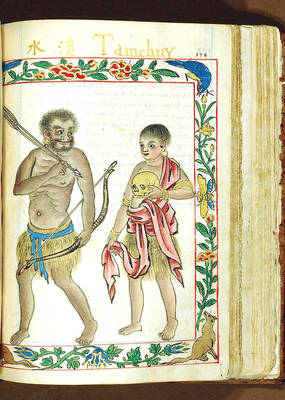
The Portuguese never established a presence on Taiwan, but they must have traded with the indigenous people because later traders reported that the locals referred to parts of deer using Portuguese words. What goods might the Portuguese have offered their indigenous trade partners? Among them must have been slaves, for the Portuguese dealt slaves across Asia. Though we often speak of “Portuguese” ships, imagining them as picturesque vessels manned by pointy-bearded Iberians, in Asia Portuguese shipping between local destinations was crewed by Asian seamen, with a handful of white or Eurasian officers. “Even the great carracks of 1,000-2,000 tons which plied
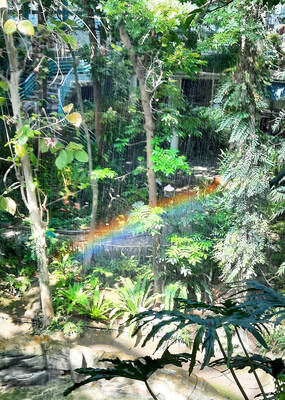
It’s only half the size of its more famous counterpart in Taipei, but the Botanical Garden of the National Museum of Nature Science (NMNS, 國立自然科學博物館植物園) is surely one of urban Taiwan’s most inviting green spaces. Covering 4.5 hectares immediately northeast of the government-run museum in Taichung’s North District (北區), the garden features more than 700 plant species, many of which are labeled in Chinese but not in English. Since its establishment in 1999, the site’s managers have done their best to replicate a number of native ecosystems, dividing the site into eight areas. The name of the Coral Atoll Zone might
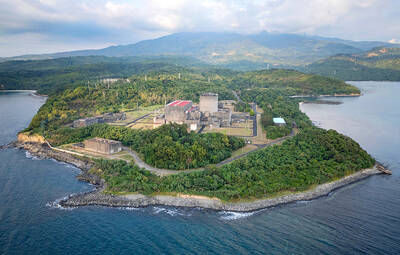
Nuclear power is getting a second look in Southeast Asia as countries prepare to meet surging energy demand as they vie for artificial intelligence-focused data centers. Several Southeast Asian nations are reviving mothballed nuclear plans and setting ambitious targets and nearly half of the region could, if they pursue those goals, have nuclear energy in the 2030s. Even countries without current plans have signaled their interest. Southeast Asia has never produced a single watt of nuclear energy, despite long-held atomic ambitions. But that may soon change as pressure mounts to reduce emissions that contribute to climate change, while meeting growing power needs. The


 RSS
RSS