


Tatsuo Aoki’s low-key Tokyo bar, Popeye, has become a destination for beer fanatics from around the country. They make the pilgrimage to sample Hokkaido ales and Shizuoka stouts, or for an impromptu lecture from Aoki on hops and yeast.
He’s part of an uprising in Japan against the staggering blandness of local beer. Four beverage behemoths dominate the market, all promoting pilsner-style lagers that account for more than 95 percent of the suds sold. It’s a bit like sidling up to a bar in 1980s Milwaukee: Miller or Budweiser?
Tastes are changing though. Craft beer is gaining popularity in Japan through the efforts of people such as Aoki, much like it has in the US and Europe. The four giants — Asahi Group Holdings, Kirin Holdings, Suntory Holdings and Sapporo Holdings — are experimenting with alternative brews too as they face a slide in consumption. The competition is changing the market and beginning to produce beer drawing acclaim around the world.
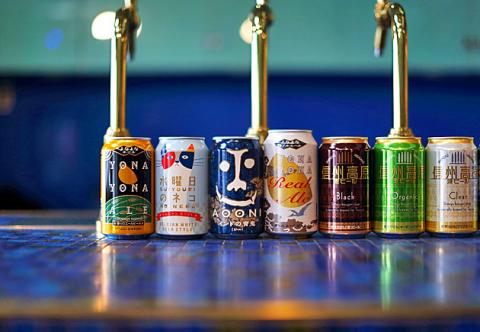
Photo: Bloomberg/ Tomohiro Ohsumi
“There are dozens of brewers in Japan making fabulous, highly rated beers,” said Matt Simpson, owner of the Marietta, Georgia-based consulting firm The Beer Sommelier. “They’re not exposed yet.”
Japan has been the land of lager for reasons of politics and taste. The country’s regulations long blocked smaller breweries from competing, including by imposing minimum beer production volumes until 1994. Lagers from the likes of Asahi and Kirin were also considered preeminent in their field.
Business culture reinforced the breweries’ success, with bosses routinely leading salary-men out for hours of drinking.
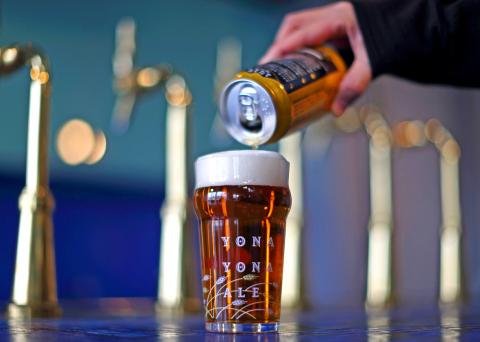
Photo: Bloomberg/ Tomohiro Ohsumi
“Everyone imagined that the more you drink, the more successful you’d be,” said Akira Hashida, curator at the Sapporo museum in Tokyo. “These days, young people don’t see the purpose.”
WHISKY, WINE
Japan’s beer consumption has slumped since 2001 as people turned to alternatives such as whisky and wine. In addition, the country’s number of inhabitants is projected to fall by a quarter to 97 million by 2050, according to the Washington-based Population Reference Bureau.
Craft beer is the exception. Sales volumes rose 7 percent in the first eight months of last year, the most recent data available at Euromonitor International, on top of a 15 percent increase during the same period the previous year. There are now almost 80 brewpubs serving their own small-batch beers in Tokyo, up from just four of them five years ago, according to Euromonitor.
“People who like booze around me are all into craft beers now,” said Aya Yamaguchi, a 34-year-old Tokyo office worker.
MALT, HOPS
Aoki’s bar in eastern Tokyo has specialized in beer for two decades and was the first to serve ji biru, or locally made beer, on tap. His bar now serves 80 independent labels, including Baird Brewing Company’s Shimaguni Stout and ales from Coedo Brewery.
Bakusyu Club Popeye, as it’s formally known, is a few steps up in a yellow-brick building in the Ryogoku neighborhood. Inside, the staff explains the nuances of different ales and suggests the best beer pairings with various dishes.
Aoki, 62, is on a mission to change people’s perceptions of beer. He rattles off the names of six local brewers he thinks are best positioned to break out, including Otaru Beer and Echigo Beer. He started a brewery called Strange Brewing in his hometown of Niigata, and serves the beer at his pub. He’s also chairman of the Japan Craft Beer Support Group, which holds seminars on the latest trends.
“The craft beer boom is happening,” he said on a recent Friday as his bar filled with customers.
JAPAN REGULATIONS
Aoki thinks regulations remain an issue and wants the Japanese government to ease them further. He points out many rules are still a burden for small breweries, including taxes and outdated laws like a ban on home brewing from the Meiji era a century ago.
“Everything is disadvantageous for micro-brewers in Japan,” said Aoki, whose bar is BeerAdvocate.com’s most- reviewed Japanese watering hole.
Japan’s giants are trying to adapt. They’re investing in craft brewers, rolling out richer “premium” brands and even starting their own brewpubs.
Asahi recently released a dark porter and a pale ale under its Craftsmanship brand. Sapporo said in March it would soon start selling a pricier craft label, to help “get rid of the fixed image of the Sapporo beer brand.”
“We beer makers were caught in our own trap,” Kirin President Senji Miyake said in February. “We’ve been engaged in just making pilsner-type beers while getting locked into a price-cutting war, and as a result, beer has become like a commodity.”
BORING BEER
Kirin in September bought a minority stake in Japan’s largest craft label, Yo-Ho Brewing. In March, the company opened Spring Valley Brewery — a 176-seat brewpub attached to its Yokohama factory — and opened a similar venue last month in Tokyo.
“What’s most problematic in Japan is that beer is considered very boring as opposed to wine, sake or whiskey,” Toru Wada, head of Kirin’s Spring Valley unit, said at the Yokohama pub’s opening. “We want to make beer more fun and cool.”
Today, it’s anything but. Craft beer accounted for less than 1 percent of sales in Japan in 2013, while 96 percent of the sales were lagers, according to Euromonitor.
Japan, with its culture of craftsmanship and perfectionism, has shown it can compete globally in other fields. Last year, Suntory’s Yamazaki whisky was declared the best in the world by Jim Murray’s Whisky Bible, beating out Scottish rivals.
Aoki said Japan has the opportunity to make the same kind of impact in beer. He is convinced the corporate giants can help popularize craft beers, but they won’t be able to make the kind of exceptional brews that small players can.
“I appreciate their entrance in a way that that will make the market more vibrant, but I doubt major beer makers can make real ones,” he said. “They can’t create the same taste as micro-brewers do.”
Warning: Excessive consumption of alcohol can damage your health.

The Portuguese never established a presence on Taiwan, but they must have traded with the indigenous people because later traders reported that the locals referred to parts of deer using Portuguese words. What goods might the Portuguese have offered their indigenous trade partners? Among them must have been slaves, for the Portuguese dealt slaves across Asia. Though we often speak of “Portuguese” ships, imagining them as picturesque vessels manned by pointy-bearded Iberians, in Asia Portuguese shipping between local destinations was crewed by Asian seamen, with a handful of white or Eurasian officers. “Even the great carracks of 1,000-2,000 tons which plied
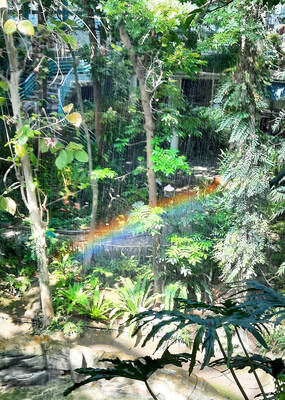
It’s only half the size of its more famous counterpart in Taipei, but the Botanical Garden of the National Museum of Nature Science (NMNS, 國立自然科學博物館植物園) is surely one of urban Taiwan’s most inviting green spaces. Covering 4.5 hectares immediately northeast of the government-run museum in Taichung’s North District (北區), the garden features more than 700 plant species, many of which are labeled in Chinese but not in English. Since its establishment in 1999, the site’s managers have done their best to replicate a number of native ecosystems, dividing the site into eight areas. The name of the Coral Atoll Zone might

On Monday morning, in quick succession, the Chinese Communist Party (CCP) and the Chinese Nationalist Party (KMT) released statements announcing “that the Central Committee of the Communist Party of China and General Secretary Xi Jinping (習近平) have invited KMT Chairwoman Cheng Li-wun (鄭麗文) to lead a delegation on a visit to the mainland” as the KMT’s press release worded it. The KMT’s press release added “Chairwoman Cheng expressed her gratitude for the invitation and has gladly accepted it.” Beijing’s official Xinhua news release described Song Tao (宋濤), head of the Taiwan Work Office of the CCP Central Committee, as
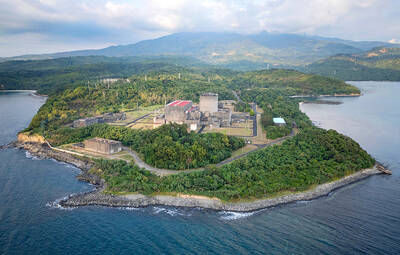
Nuclear power is getting a second look in Southeast Asia as countries prepare to meet surging energy demand as they vie for artificial intelligence-focused data centers. Several Southeast Asian nations are reviving mothballed nuclear plans and setting ambitious targets and nearly half of the region could, if they pursue those goals, have nuclear energy in the 2030s. Even countries without current plans have signaled their interest. Southeast Asia has never produced a single watt of nuclear energy, despite long-held atomic ambitions. But that may soon change as pressure mounts to reduce emissions that contribute to climate change, while meeting growing power needs. The


 RSS
RSS