


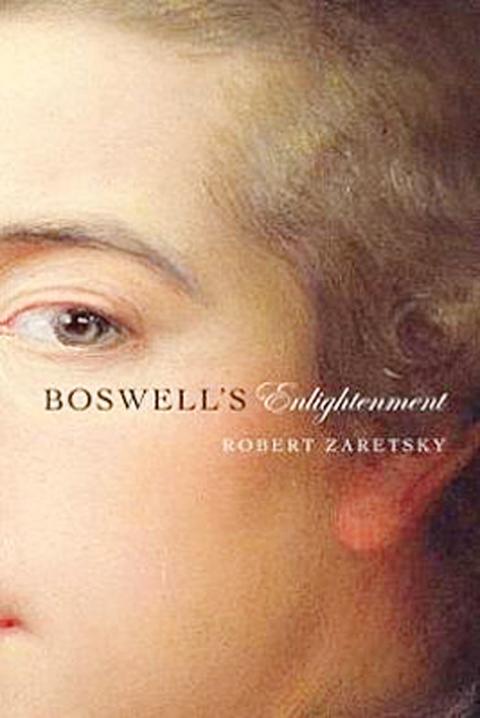
James Boswell’s The Life of Samuel Johnson is routinely cited as the greatest biography in English. But there’s a paradox here, because Boswell is never listed as among the language’s greatest writers. In fact he’s often called mediocre, superficial, garrulous and uncritical. So is the celebrity of his great book due only to the undoubted fascination of its subject?
When I saw the title Boswell’s Enlightenment, I immediately thought that its gameplan would be to establish Boswell as a major Enlightenment figure, someone from whom a masterly biography could rightly be expected. The Enlightenment, the European movement to promote reason, knowledge and a love of liberty in the minds of ordinary people, may not have been as strong a force in Britain as it was on the continent, but there were David Hume and Edward Gibbon, two celebrated Enlightenment authors, and perhaps Boswell could be added to their number.
It turns out, however, that this program is not what Zaretsky has in mind. Instead, he’s written a readable, and even popular, account of the young Scot, following him from Edinburgh down to London (where he was to meet Johnson in 1763), and then off on a tour of Europe which lasted from 1763 to 1765. This continental tour occupies the bulk of Zaretsky’s book.
One of the main characteristics of Enlightenment thinkers was their skepticism over the claims of Christianity. Many were near-atheists, while others were what the 18th century called “deists,” believers in a divine creator but nothing much after that. Boswell, by contrast, retained elements of the Scots Presbyterianism in which he’d been brought up, and was even surprisingly sympathetic to Catholicism, both in his youth and when traveling in Italy. Above all, he was terrified of the possibility of there being no afterlife, and wrestled with this problem throughout his days.
But none of this stopped him wanting to meet the celebrities of his age, atheists or not. Johnson, the most highly-esteemed English author at the time, was his first great catch. When they met, Boswell was 22 and Johnson 53, but Johnson’s enthusiasm for the precocious young Scot was every bit the equal to Boswell’s delight in making the acquaintance of the famous editor, critic and poet.
Johnson’s attitude to religion was highly traditional. For him, belief in revelation and redemption were the cornerstones of his mindset, and the Enlightenment figures were pernicious at best. But Boswell wanted to know the famous, and during his European tour met writers Rousseau, Voltaire, Horace Walpole and David Hume (whom he’d known earlier in Edinburgh), the political agitator John Wilkes, the German classicist Johann Joachim Winckelmann and the Corsican rebel leader Pasquale Paoli. These weren’t just casual meetings. He spent six days with Paoli in his mountain retreat (Paoli called him his “English ambassador”), had five long sessions with Rousseau, several with Voltaire — though Boswell’s eight-page account of these has been lost — and accompanied Wilkes for weeks touring Rome and Naples (they climbed Vesuvius together).
Nor was this all. When Boswell arrived back in England he did so in the company of Rousseau’s common law wife, Therese Levasseur, who he promptly made love with. “I allow that you are a hardy and vigorous lover,” she said to him afterwards, “but you have no art.” Boswell duly recorded the remark in his journal. His candor about his sexual life — he contracted gonorrhea 19 times — is one of his most notable virtues; his London journal, not published until 1950, is our major source for information about sex in this era. Wilkes was similarly open, and told Boswell that he wrote best while in bed with women.
Rousseau was in England on the run from various authorities, and established himself in rooms above a greengrocer’s shop in the London borough of Chiswick. Paoli and Wilkes showed up in London too, and Boswell introduced them both to Johnson — with difficulty in the case of Wilkes who the Tory Johnson considered a scoundrel.
What it’s important to understand is that skepticism about the claims of Christianity was far more common in the mid-18th century that it was to be 100 years later, at least in England. Wilkes told Boswell not to worry about immortality or the soul, two things for which there was little evidence. When Boswell visited him on his deathbed, Hume joked about his soon ceasing to exist. And both Rousseau and Voltaire were sufficiently skeptical about religion for the authorities to be repeatedly concerned over the influence of their works.
The problem with this new book is that it’s not clear who its intended audience is. Fellow academics (the author is a professor of French history at the University of Houston) won’t find anything fresh here — there are, for instance, no newly-discovered documents cited. The author makes no novel claim for Boswell, contrary to my expectations. And the general public will, I think, be sorry not to find Boswell’s story concluded — we have his youth, for example, then the continental tour in detail, but nothing about the writing of The Life of Johnson (1791). This was the crowning achievement of Boswell’s life, and 30 pages about it would not only have given the book some symmetry but would have completed the story of his life and achievement for the ordinary reader for whom this book seems mostly designed.
For the rest, I did detect one doubtful claim. Zaretsky twice refers to Boswell traveling from Scotland to London in four days. But the time it took for commercial coaches in the mid-18th century to get from Glasgow or Edinburgh to London was 12 days in summer and a full two weeks in winter. Maybe a determined traveler riding alone could have shaved a day or two off this, but four days seems to me improbable.
All in all, however, the greatest mystery of Boswell’s life remains what it’s always been, how so volatile a man, and one so full of paradoxes — tentative Christian, close friend of atheists, opponent of the abolition of slavery, and enthusiast for attending public executions — could have ended up penning the greatest literary biography in the language. We should have been told more about how he managed to do it.

For many people, Bilingual Nation 2030 begins and ends in the classroom. Since the policy was launched in 2018, the debate has centered on students, teachers and the pressure placed on schools. Yet the policy was never solely about English education. The government’s official plan also calls for bilingualization in Taiwan’s government services, laws and regulations, and living environment. The goal is to make Taiwan more inclusive and accessible to international enterprises and talent and better prepared for global economic and trade conditions. After eight years, that grand vision is due for a pulse check. RULES THAT CAN BE READ For Harper Chen (陳虹宇), an adviser
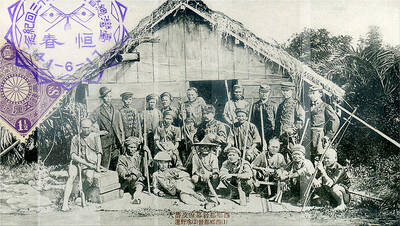
Traditionally, indigenous people in Taiwan’s mountains practice swidden cultivation, or “slash and burn” agriculture, a practice common in human history. According to a 2016 research article in the International Journal of Environmental Sustainability, among the Atayal people, this began with a search for suitable forested slopeland. The trees are burnt for fertilizer and the land cleared of stones. The stones and wood are then piled up to make fences, while both dead and standing trees are retained on the plot. The fences are used to grow climbing crops like squash and beans. The plot itself supports farming for three years.

The breakwater stretches out to sea from the sprawling Kaohsiung port in southern Taiwan. Normally, it’s crowded with massive tankers ferrying liquefied natural gas from Qatar to be stored in the bulbous white tanks that dot the shoreline. These are not normal times, though, and not a single shipment from Qatar has docked at the Yongan terminal since early March after the Strait of Hormuz was shuttered. The suspension has provided a realistic preview of a potential Chinese blockade, a move that would throttle an economy anchored by the world’s most advanced and power-hungry semiconductor industry. It is a stark reminder of

May 4 to May 10 It was once said that if you hadn’t performed at the Sapphire Grand Cabaret (藍寶石大歌廳), you couldn’t truly be considered a star. Taking the stage at the legendary Kaohsiung club was more than just a concert. Performers were expected to entertain in every sense, wearing outlandish or revealing costumes and staying quick on their feet as sharp-tongued, over-the-top hosts asked questions and delivered jokes that would be seen as vulgar, even offensive, by today’s standards. Opening in May 1967 during a period of strict political and social control, Sapphire offered a rare outlet for audiences in


 RSS
RSS