


Outside of the hotel minibar, few places for business travelers have had more unhealthy fare than airports, home of the stale, pre-wrapped sandwich and fast food burger. But that is starting to change.
The farm-to-table movement has come to airports across the country, bringing fresh, local produce, meat and other goods to restaurants led by well-known chefs and shops with local culinary specialties.
“It’s the same kind of renaissance that we’re seeing streetside,” said Frank Sickelsmith, vice president for adult beverage and restaurant development for HMSHost, which runs concessions at more than a hunrdred airports. “Airports want iconic brands from the local market. More often now, that’s farm-to-table.”
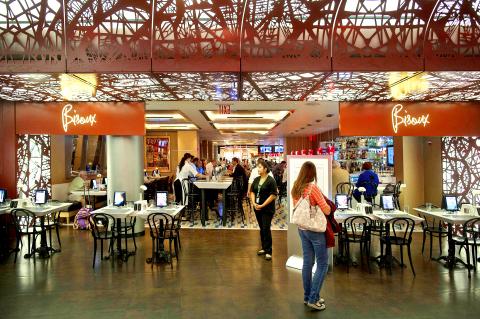
Photo: Bloomberg/Victor Blue
NO MORE GREASY AIRPORT FOOD
Newark Liberty International Airport is bringing in several leading chefs, including Benoit’s Alain Ducasse, to revamp Terminal C. As at other airport restaurants run by OTG Management, which is based in Manhattan, chefs at Newark will be required to shop at green markets three times weekly from spring to fall.
JetBlue opened a shop, New York Minute, that sells New York produce, honey and other local products in the renovated Terminal 5, and the airline is considering growing potatoes or other crops at John F. Kennedy International Airport. That would follow the lead of Chicago’s O’Hare International Airport, where an aeroponic garden supplies herbs and vegetables to restaurants.
The push toward healthier, more interesting airport dining has been welcomed by travelers. David Danto, a technology consultant who travels up to six times a month, once would have resorted to a McDonald’s chicken sandwich.
“Now you can even go into an airport bar and pick up a salad or healthy sandwich,” said Danto, from Milburn, New Jersey, adding that he prefers not to have heavy or greasy food before flying. “You get one meal that doesn’t agree with you and it shuts you down for the whole trip.”
Harriet Baskas, an author who runs the blog Stuck at the Airport, said it was important for travelers to have a choice.
“I’m old enough to remember when your choice was a hot dog rotating on a spit,” she said.
In its annual survey of food at the busiest US airports, the Physicians Committee for Responsible Medicine in November found that 75 percent offered healthful plant-based meals. Baltimore-Washington International Airport topped the 23-airport list, while Newark, La Guardia and Kennedy all made the top 11.
CONNECTING FARMS WITH AIRPORTS
Travelers at Denver International Airport can now skip tired options in favor of, for example, a Colorado lamb burger at Root Down, a branch of a popular Denver farm-to-table eatery. The airport location, which opened in 2013, has brought its share of challenges for Justin Cucci, the chef and owner.
Between security, logistics and the airport’s location — about 32km east of downtown Denver — getting arugula and grass-fed beef to the airport has been difficult, Cucci said. “We have over 40 purveyors, and getting all those purveyors out there has been a challenge,” he said. “There are just some farmers that will not come out there, so we need to find the next best thing.”
Greg Gunthorp, a pig farmer in LaGrange, Indiana, experienced that challenge himself.
Gunthorp’s family has supplied celebrity chef Rick Bayless with pork and poultry for at least 14 years. But when Bayless opened his Tortas Frontera at O’Hare four years ago, Gunthorp could not find a way to get his pork the 274km to the airport in time for the brief nightly window when food deliveries are allowed.
With the help of FarmLogix, an intermediary that connects farmers with large businesses and institutions, Gunthorp and other small-scale farmers have found a lucrative new market in airports. Gunthorp, who now provides bacon and chorizo to Tortas Frontera, has had to add employees and farmland to keep up with the O’Hare demand.
“They’re our biggest bacon customer by far,” he said. “At times it’s been hard to keep up, to be honest. It’s been rough, but it’s been fun.”
REVITALIZING DINING EXPERIENCE
With the farm-to-table movement breaching previously untouched frontiers like airports, chefs and farmers say that it can only benefit small producers, who have not had much in the way of good news in recent decades. The Department of Agriculture has predicted a 25 percent decline in farm income this year.
“We’re just starting to see how this farm-to-table movement can revitalize rural America,” Gunthorp said.
Early evidence shows that the farm-to-table concept has at least revitalized airport dining. In Chicago, Bayless’ airport outpost has proved so successful that he has developed an app that allows travelers to order food from Tortas Frontera before they arrive at O’Hare.
One lesson Bayless said he had learned from Tortas Frontera was that the old restaurant management theories do not work in an airport. Restaurants can provide fresh, local ingredients in airports, he said, but their survival will be difficult unless the agricultural system changes.
“There’s the boutique farm-to-table idea, and it’s very romantic,” Bayless said. “But the only way it really makes sense is to grow farms that are a bit bigger, and then we have to develop these middlemen like FarmLogix.”
Even with the new options, not all travelers are convinced of how much demand there will ultimately be. Joe Brancatelli, an airport regular who runs the business-travel site Joe Sent Me, says time spent in airports is a business traveler’s worst enemy, making dining there less important.
“We want better dining options, clearly, and we’ll spend more money than the leisure traveler, but the fact that there’s more farm-to-table options won’t change anything for us,” said Brancatelli, a Cold Spring, New York, resident. “My goal in life as a business traveler is not to sample Rick Bayless at O’Hare. I’d much rather eat in town at his real place.”
If one asks Taiwanese why house prices are so high or why the nation is so built up or why certain policies cannot be carried out, one common answer is that “Taiwan is too small.” This is actually true, though not in the way people think. The National Property Administration (NPA), responsible for tracking and managing the government’s real estate assets, maintains statistics on how much land the government owns. As of the end of last year, land for official use constituted 293,655 hectares, for public use 1,732,513 hectares, for non-public use 216,972 hectares and for state enterprises 34 hectares, yielding

The small platform at Duoliang Train Station in Taitung County’s Taimali Township (太麻里) served villagers from 1992 to 2006, but was eventually shut down due to lack of use. Just 10 years later, the abandoned train station had become widely known as the most beautiful station in Taiwan, and visitors were so frequent that the village had to start restricting traffic. Nowadays, Duoliang Village (多良) is known as a bit of a tourist trap, with a mandatory, albeit modest, admission fee of NT$10 giving access to a crowded lane of vendors with a mediocre view of the ocean and the trains

The March/April volume of Foreign Affairs, long a purveyor of pro-China pablum, offered up another irksome Beijing-speak on the issues and solutions for the problems vexing the People’s Republic of China (PRC) and the US: “America and China at the Edge of Ruin: A Last Chance to Step Back From the Brink” rang the provocative title, by David M. Lampton and Wang Jisi (王緝思). If one ever wants to describe what went wrong with US-PRC relations, the career of Wang Jisi is a good place to start. Wang has extensive experience in the US and the West. He was a visiting
One of the challenges with the sheer availability of food in today’s world is that lots of us end up spending many of our waking hours eating. Whether it’s full meals, snacks or desserts, scientists have found that it’s not uncommon for us to be mindlessly grazing at some point during all of our 16 or so waking hours. The problem? As soon as this food hits the bloodstream in the form of glucose, it initiates the release of the hormone insulin. This in turn activates a switch present in every one of our cells, which is responsible for driving cell


 RSS
RSS