


Everything Will Be Alright in the End
Weezer
Republic

Weezer and its songwriter and frontman, Rivers Cuomo, have always wrapped worries and vulnerabilities in brash, succinct rock tunes: power pop with the distortion cranked up. On Everything Will Be Alright in the End, Weezer’s ninth studio album, the melodies are as strong as the misgivings. And vice versa.
Twenty years after the release of Weezer’s self-titled 1994 debut album, Cuomo stares down a situation that most long-running acts try to ignore: a band’s midcareer — possibly late-career — crisis as youth fades, radio styles change, fans prefer nostalgia and cynical self-consciousness sets in. It’s not the first time; Hurley, Weezer’s 2010 album, started with Memories and ended with Time Flies, both well aware of aging. On the first single from the new album, a two-chord hard-rock stomp called Back to the Shack, Cuomo sets out his current plan: “Kick in the door, more hardcore/Rockin’ out like it’s ‘94.”
Cuomo’s songwriting has a sarcastic streak that parallels his confessional moments, but for the now he seems sincere. Two more songs ponder what it takes for a rocker to persevere. Eulogy for a Rock Band is a fan’s farewell: “Goodbye heroes, you had a good run/15 years of ruling the planet.” Back in the first person, I’ve Had It Up to Here is a full-fledged manifesto: “Don’t wanna compromise my art/for universal appeal,” Cuomo sings. “Don’t wanna be mass consumed/I’m not a Happy Meal.”

That doesn’t mean Weezer has turned primitive or unpolished. After gimmicky attempts to update — a hip-hop collaboration, programmed sounds — on its 2009 album, Raditude, Weezer has reclaimed what it does best. Reunited with Ric Ocasek of the Cars as producer, who also worked on Weezer’s first and third albums, the band savors the three-minute, guitar-driven, verse-chorus-bridge rock song. But it also heaps on the overdubs — particularly Brian Bell’s lead guitar, which rivals the orchestral edifices that Brian May built for Queen and takes over the album’s grandiose and manic finale, The Futurescope Trilogy.
The rest of the album often returns to the wellspring of power pop: girl trouble, usually as faced by a clueless guy (though not clueless about verse-chorus-bridge). “I’m lonely, so homely/Can’t you relate?” is the singer’s approach to a Lonely Girl, as vocal harmonies surge in. Applying grunge guitar to the basic doo-wop chord progression, Cuomo and Bethany Cosentino of Best Coast share a duet in Go Away: He’s contrite, she’s bitter.
Even in matters of the heart, some new songs face the ravages of time. In Cleopatra, the singer taunts, “You’re older and colder.” (For a craftsman’s touch, when Cuomo sings, “You can’t control me no more,” the music adds an extra beat to one measure — out of 4/4 control — and he then adds a syllable to sing, “Cle-o-pat-a-ra.”) The girl trouble in Foolish Father is an adult’s predicament: a daughter who hates him. Minor-key verses move into major-key choruses until, eventually, the daughter replies, singing, “Everything will be all right in the end.” In Weezer’s songs, music brings hope.
— Jon Pareles, NY Times News Service
Birdman Presents Rich Gang: Tha Tour Part 1
Rich Gang
stunnalife.com
There’s been no more ornery hip-hop hit this year than Lifestyle, the leather-soft, swaying-slow catalog of pleasure by Rich Gang, the supergroup/side project consisting of rising Atlanta stars Young Thug and Rich Homie Quan along with Birdman, the Cash Money Records paterfamilias. It’s soothing and agitating at once, finding common ground between Rich Homie Quan, the street-corner preacher prone to moan his needs, and Young Thug, the irascible rapscallion with no filter. (Birdman’s mainly around to chaperone.)
The new Rich Gang mixtape fully heralds the arrival of its brand of yacht rap, brimming with luxurious production that’s almost comically gentle in tone and approach. It’s a complete 180 from the Lex Luger era of just a few years ago, in which beats approximated animated thunderstorms. Now they’re mere suggestions, soft beds on which to recline.
What’s most gratifying to hear is the ease and intimacy of the interactions between Young Thug and Rich Homie Quan. In places, they’re weaving lines in and out like some futurist, freakazoid version of EPMD. Rich Homie Quan is the grounded one, as usual, especially on affectingly tender tracks like Milk Marie, but it’s thrilling to hear Young Thug pipe up. He’s a born disrupter, pound for pound the most curious and least linear rapper working, incorporating little tics into his lyrics — like repeatedly revising himself mid-verse on I Got — that end up extremely sticky.
As for Birdman, he sounds invigorated surrounded by young, hungry talent, but he’s best on the opening track Givenchy, where he delivers one of his signature rambling monologues — his true medium — boasting about “marble floors, gold toilets and chandeliers,” so relaxed he doesn’t even need a beat.
— Jon Caramanica, NY Times News Service
Lily-O
Sam Amidon
Nonesuch
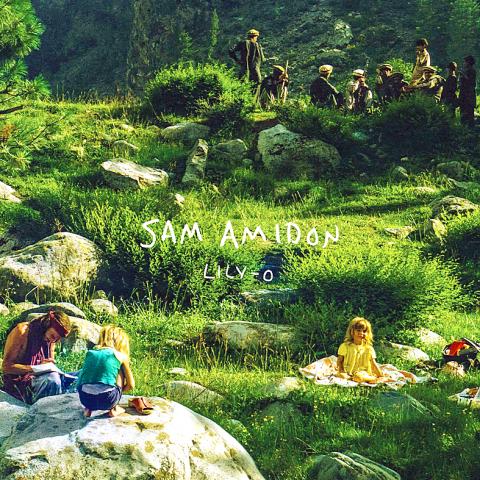
The final track on Lily-O, a hauntingly beautiful new album by the folk singer Sam Amidon, begins in resonant quiet, with the droning overtones of what sounds like a Tibetan singing bowl. Soon you’re aware of an electric guitar blended into the mix, followed by a more clearly articulated acoustic guitar part, in lilting cadence.
Amidon’s calm, self-contained voice arrives a minute into the song — Devotion, an Appalachian shape-note hymn composed in 1818, based on poetry written in England a century earlier. The lyrics welcome death as a doorway, turning in earnest toward eternity, and Amidon sings them evenly, building each new phrase upon the last.
Lily-O is the second of Amidon’s albums released by Nonesuch, and like its predecessor Bright Sunny South, it consists mainly of reframed traditional songs. Amidon again plays banjo, fiddle and guitar, all with plain-spoken grace; his rhythm partners are the bassist Shahzad Ismaily and the drummer Chris Vatalaro. Amidon’s sithatnging is unforced but sturdy, and possibly playing with your notions of guilelessness.
Whatever has happened to bring American folk song back into style, it rests on some ideal of rough-hewed authenticity. So it’s a meaningful subversion that Amidon works with the producer Valgeir Sigurdsson, who recorded the album in his studio in Iceland, and the guitarist Bill Frisell, whose vision of Americana runs heartfelt but not hidebound.
The album could easily have been credited as an Amidon-Frisell collaboration, rather than a solo album, for all of its silvery sheen and echoing filigree. But Amidon owns the liberties taken with these songs: the title track, which begins a cappella and ends in a semi-abstract swirl; Blue Mountains, with its brittle rhythm programming; Walkin’ Boss, with its clatter-boom beat and pedal delay. His version of Groundhog, a frisky tune associated with Doc Watson, turns ruminative, almost sinister.
But another song from the Watson repertory, the elegy Your Long Journey, brings out the album’s most moving performance. Amidon sings in a muted voice, trusting the lyrics to make their own impression. The song arrives near the album’s close, just before Devotion, so its heavenward glance doubles as a seamless transition.
— Nate Chinen, NY Times News Service

Jason Han says that the e-arrival card spat between South Korea and Taiwan shows that Seoul is signaling adherence to its “one-China” policy, while Taiwan’s response reflects a reciprocal approach. “Attempts to alter the diplomatic status quo often lead to tit-for-tat responses,” the analyst on international affairs tells the Taipei Times, adding that Taiwan may become more cautious in its dealings with South Korea going forward. Taipei has called on Seoul to correct its electronic entry system, which currently lists Taiwan as “China (Taiwan),” warning that reciprocal measures may follow if the wording is not changed before March 31. As of yesterday,

The Portuguese never established a presence on Taiwan, but they must have traded with the indigenous people because later traders reported that the locals referred to parts of deer using Portuguese words. What goods might the Portuguese have offered their indigenous trade partners? Among them must have been slaves, for the Portuguese dealt slaves across Asia. Though we often speak of “Portuguese” ships, imagining them as picturesque vessels manned by pointy-bearded Iberians, in Asia Portuguese shipping between local destinations was crewed by Asian seamen, with a handful of white or Eurasian officers. “Even the great carracks of 1,000-2,000 tons which plied

It’s only half the size of its more famous counterpart in Taipei, but the Botanical Garden of the National Museum of Nature Science (NMNS, 國立自然科學博物館植物園) is surely one of urban Taiwan’s most inviting green spaces. Covering 4.5 hectares immediately northeast of the government-run museum in Taichung’s North District (北區), the garden features more than 700 plant species, many of which are labeled in Chinese but not in English. Since its establishment in 1999, the site’s managers have done their best to replicate a number of native ecosystems, dividing the site into eight areas. The name of the Coral Atoll Zone might

Nuclear power is getting a second look in Southeast Asia as countries prepare to meet surging energy demand as they vie for artificial intelligence-focused data centers. Several Southeast Asian nations are reviving mothballed nuclear plans and setting ambitious targets and nearly half of the region could, if they pursue those goals, have nuclear energy in the 2030s. Even countries without current plans have signaled their interest. Southeast Asia has never produced a single watt of nuclear energy, despite long-held atomic ambitions. But that may soon change as pressure mounts to reduce emissions that contribute to climate change, while meeting growing power needs. The


 RSS
RSS