


Chi Chia-wei’s (祁家威) eyes light up as he recounts his life as Taiwan’s pioneering gay activist. But underlying his buoyant remembrance lays a palpable sense of fear, as though he’s expecting the police to show up and kick down the door.
During the Martial Law era, when any kind of dissent was muzzled or crushed, Chi came out publicly and started a one-man gay rights campaign. In 1986, the then 28-year-old filed a petition with the Legislative Yuan demanding equal marriage rights for same-sex couples.
He was immediately arrested.
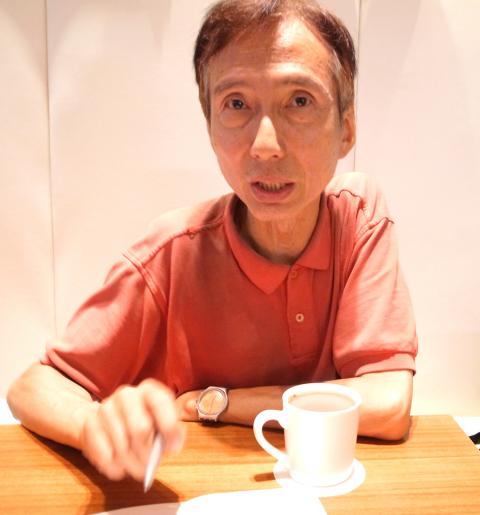
Photo: Ho Yi, Taipei Times
“I was locked up in the same jail as [former president] Chen Shui-bian (陳水扁) and [democracy pioneer] Deng Nan-jung (鄭南榕) … I served five months; they served seven,” the 58-year old activist recalls.
After his release, Chi devoted himself to HIV/AIDS prevention and care. He volunteered to work with medical professionals and hit the streets to canvas for donations. He bought hundreds of thousands of condoms a year, handed them out in areas across Taipei and gave them to the city’s licensed sex workers. He set up a free HIV testing service to hundreds of people annually, while running a small hospice for patients with the virus.
Chi says the nation’s intelligence agency continues to keep close tabs on him because, whether authoritarian or democratic, the state cannot tolerate “those who organize and assemble.”
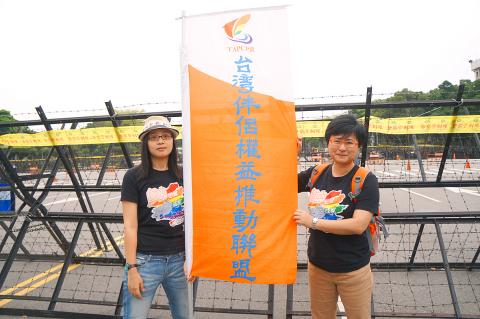
Photo: Victoria Hsu and Ho Yi, Taipei Times
“I always tell people to be careful if they want to report about me,” the gaunt Chi warned as we concluded our interview.
Twenty-seven years after the lifting of martial law, Taiwan’s turbulent past is still clearly present in Chi’s mind, even as the country has become one of the most gay-friendly in Asia. The government no longer rounds up gay activists, and recent polls indicate that more than half of respondents support legal recognition of same-sex unions. Indeed, recent proposed amendments to Article 972 of the Civil Code that would make same-sex unions possible have been forwarded to the Legislative Yuan for review.
Unlike the past, the government no longer suppresses gay rights. Today, challenges to gay rights comes from elsewhere.
Anti-gay Demonstrations
On Nov. 30 last year, tens of thousands of people rallied on Ketagalan Boulevard in front of the Presidential Office, voicing their opposition to legalizing same-sex marriage. The main force behind the demonstration was the Alliance of Religious Groups for the Love of Families Taiwan (台灣宗教團體愛護家庭大聯盟), a movement composed of Christian organizations, Buddhist sects, the Chinese Regional Bishops’ Conference (天主教會台灣地區主教團) and I-Kuan Tao (一貫道) — a religious movement that combines Confucianism, Taoism and Chinese Buddhism, and recognizes non-Chinese religious traditions such as Christianity and Islam.
It was one of the largest mobilizations of Taiwan’s religious groups in recent years. There were reportedly hundreds of security staff. Those gay advocates who showed up were subjected to abuse and driven away. In the weeks leading up to the protest, ministers preached homophobic sermons, asking their congregation to support the alliance-initiated signature drive against same-sex marriage and join the demonstration, says Chen Hsiao-en (陳小恩), secretary of the Tong-Kwang Light House Presbyterian Church (同光同志長老教會), whose members and clergy consist mainly of gay men and lesbians.
“Our church was packed to capacity during those weeks,” Chen Hsiao-en says, highlighting fears felt by the gay community leading up to the demonstrations.
“Newcomers would burst out crying, saying that they couldn’t take it anymore... One gay Christian thought his church would unconditionally love and accept him, but as soon as he came out to the pastor, he was rejected. Many [gay people] left their churches, heartbroken, after the demonstration on Nov. 30.”
For members of the religious alliance, however, the demonstration was a triumph — one that successfully pressured the legislature to halt the amendment to Article 972.
“Public opinion has to change, so we stepped forward. Now lawmakers and the media know our religious groups are against [same-sex marriage]. City councilors, mayors or the president — no matter what their elected office, they follow the voters. We are great in number, so let’s see who they will listen to,” says Paul Chang (張全鋒), vice president of the Unification Church Taiwan and one the alliance’s spokesmen.
‘Moral Taliban’
Religious opposition to same-sex unions is, in fact, shepherded by those who represent a small minority of the country’s population. Chen Chih-hung (陳志宏), a Taiwan Lutheran Church (基督教台灣信義會) bishop who also serves as the alliance’s spokesman, says that Christian churches are the driving force behind the crusade.
“To a certain extent, Christian groups take the lead on this issue since Asian religions haven’t traditionally seen homosexuality as a big deal. Churches in the US and Europe have confronted the impact of gay marriage directly… Since only a small percentage of Taiwanese are Christians, we share what we know with other religions so that they understand the seriousness of the situation,” Chen Chih-hung says.
According to statistics compiled by the Ministry of the Interior last year, Taiwan, a country composed of predominantly Buddhist and Taoist worshippers, has nearly 580,000 Protestants and Catholics. So the crusade against same-sex marriage is something of a foreign transplant.
“Christian churches in Taiwan are informed by churches abroad about what gay activists have been doing here… We lack experience. They have told us how serious the issue is and what strategies [gay rights advocates] deploy,” Chen Chih-hung says.
The clergyman says a large amount of information about how to combat gay rights issues comes from a global network of organizations, including The Society for Truth and Light (明光社), a conservative Christian pressure group based in Hong Kong and dubbed the “moral Taliban” by its detractors.
Focus on the Family, headquartered in the US city of Colorado Springs, is another institute promoting a conservative Christian agenda internationally. It has an office in South Africa, considered part of the American Christian operations whose role in the recent anti-gay legislation in Africa has been widely reported. Focus on the Family has a branch in Taipei called Loving Family (愛家基金會).
Dubious logic
For this global network of Christian organizations, society is built on the institution of marriage, which can only be between a man and a woman. All forms of sexual activity outside the heterosexual institution are considered dangerous and sinful.
“Same-sex unions cannot lead to marriage. They are a form of promiscuity like adultery, rape and prostitution… Since promiscuity is a sin, demanding human rights [for gay people] doesn’t make sense,” Chang says.
“The biggest problem is that homosexuals can’t produce offspring. But that’s what human society is built on,” Chang adds.
It is a sentiment echoed by Chen Chih-hung.
“Following the logic of gay marriage, where any two persons who are in love can get married, we quickly run into a very practical problem: incest. Brothers can marry sisters, so too can fathers marry daughters, mothers marry sons,” Chen says.
The fear-mongering is put into local context in an observation made by Democratic Progressive Party (DPP) Legislator Yu Mei-nu (尤美女), who helped to forward to the legislature the amendments to Article 972 of the Civil Code drafted by the Taiwan Alliance to Promote Civil Partnership Rights (台灣伴侶權益推動聯盟).
‘Dictatorship of Lechery’
The Taiwan Alliance to Promote Civil Partnership Rights has also put forth two other bills that recognize partnership rights for all couples, irrespective of gender, and allow diverse forms of family to include members not related by blood. Their advocacy, together with the continuous effort by women’s groups such as the Awakening Foundation (婦女新知基金會) to decriminalize adultery — a criminal offense punishable by a jail sentence of up to 12 months — has caused panic among religious conservatives, Yu says.
“They connect all these things together and come up with a conspiracy theory, believing that the calls for decriminalization of adultery, together with same-sex unions and diverse forms of family, are intended to ultimately destroy families and society,” says Yu, a veteran woman’s rights advocate and supporter of lesbian, gay, bisexual and transgender (LGBT) rights.
In a completely different tone, both Chang and Chen Chih-hung speak of a dark, hidden agenda of the LGBT movement in Taiwan. The most active elements of the movement, they say, are not gay rights activists but libertines, with LGBT equality only part of their mission. The ultimate goal is to replace the institution of marriage and family with a culture of sexual promiscuity.
Their views are reflected in a short video widely circulated on the internet prior to the Nov. 30 protest. Titled Sexual liberation is storming Taiwan (性解放風暴即將襲台), the video is designed to ignite anxiety and fear by stigmatizing gay people and their supporters as proponents of promiscuity, group sex and bestiality.
“Taiwan is the first place in Asia they [the libertines] want to gain control of,” the two spokesmen say in separate interviews.
By focusing on LGBT advocates as sexual deviants, rather than preaching that homosexuality as a sin, which would find little resonance in Taiwanese society, the Christian minority generates a much greater response from worried parents and other concerned citizens. And that is exactly the strategy adopted for last year’s anti-gay marriage law rally, which was disguised under the banner “Think of the Children.”
In light of what they believe a successful mobilization to show off their political strength, the anti-LGBT alliance regards political lobbying through all levels of government as one of their main tasks. Chang says that they will continue to oppose the enactment of laws allowing same-sex unions as well as the passage of anti-discrimination laws aimed at curtailing discrimination against members of LGBT communities.
“If denouncing homosexuality counts as a form of discrimination, then what will happen to school teachers, clergy, priests and monks? Are they going to lose their jobs or go to jail for criticizing gays and lesbians? This is an abuse of the law, a violation of religious freedom. This is what I call the dictatorship of lechery,” Chang says.
The second part of this feature will appear in tomorrow’s edition.

Taiwan’s renewable shortfall is a problem of execution, not resources. Japan’s long-cycle, joined-up energy planning is the model worth studying — but what Taiwan can borrow is the institutional machinery, not the politics. When Nvidia CEO Jensen Huang (黃仁勳) used his visit to Taipei last month to warn that the country needs far more electricity, he was naming a constraint its own planners already know well: Taiwan Power Co (Taipower, 台電) expects demand from the semiconductor and artificial intelligence (AI) sector alone to exceed 5 gigawatts (GW) by 2030. The harder question is not whether to build more capacity but which
In a projection room, visitors at the Re: Battle City exhibition at Kaohsiung’s Neiwei Arts Center are invited to sit and watch a 20-minute animated movie. Artist Chang Li-ren (張立人) created the movie with dolls he made by molding paper into crude, painted figurines. The dolls interact in a detailed and realistic Taiwanese cityscape. Outside the projection room, visitors can wander around a massive model of the city. A sizeable crowd happily takes pictures of what looks like the best dollhouse in Taiwan: the same props that were used to tell the story of the country’s descent into techno-dictatorship in the movie. The
The last time Taiwan’s foreign correspondents were invited to a special briefing with a sitting president was in 2015. That was two presidents ago under Ma Ying-jeou (馬英九). But Thursday morning, President William Lai (賴清德) welcomed the nation’s international press corps warmly, speaking specifically to the theme of press freedom. Lai addressed Taiwan’s foreign press corps saying, “You live, work and report in Taiwan.” “Thank you for your professionalism and upholding the spirit of press freedom,” he continued. “As you engage in your work of journalism, you let the world see Taiwan.” The timing of this event, hosted by the Taiwan Foreign

Chinese Nationalist Party (KMT) Chairwoman Cheng Li-wun’s (鄭麗文) recent trip to the US highlighted her party’s anti-Taiwan defense policies. Disapproval of their policies was strong among those who met with her. Republican Senator Dan Sullivan, said that the KMT was “playing with fire.” Democratic Representative Tom Suozzi reportedly said that Cheng’s party was “weakening deterrence.” Foreign policy maven David Sacks observed in Asia Nikkei that “many Americans struggle to see the logic behind the KMT’s refusal to fund the portion of the special defense budget pertaining to indigenous defense production.” The logic of the KMT’s decision to purchase only US


 RSS
RSS