


As Taiwanese students in New York prepared posters and distributed sunflowers for the March 30 rally at Times Square, encouraging words from peers participating in the Sunflower Movement back home were trickling in through various social media and instant messaging apps.
“We all belong to the same social circle, so we know things about the movement that even the media hasn’t picked up on,” says Wang Yu-hsiu (王郁秀), a sociology graduate student at Columbia University, referring to the Legislative Yuan protests in Taipei against the cross-strait service trade agreement with China.
TOUGH SKIN
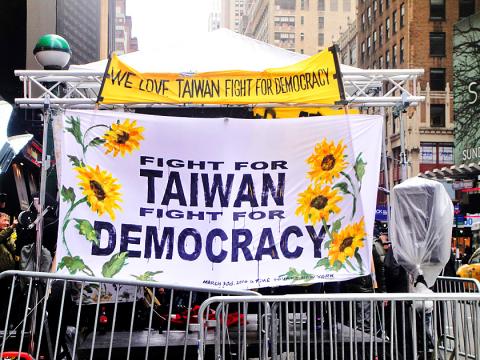
Photo: Dana Ter
On the surface, the protests might seem like another example of young people rebelling against authority. Wang’s friend Liu Yen-ting (劉彥廷), a Columbia graduate student studying statistics said that there’s a misperception that people from their generation are irresponsible, unable to withstand societal pressure and “easily bruised” — hence the term “strawberry generation” (草莓族) ascribed to them. But the Sunflower Movement shows how “strawberries” are stepping up to wrest control of their future, which they believe the trade agreement will negatively impact.
Wang says that protesters in Taipei are an educated group of young adults who are concerned about their job prospects. Hanes Wu (吳政翰), a young entrepreneur, is a good example of someone who fits this demographic. He was on Facebook video call while finalizing the design of his new app which would allow one iPad user to simultaneously see what another user is drawing on their iPad. Dissatisfied with fixing computer bugs only to be told each time that the entire system was going to be overhauled, Wu quit his job and started his own tech company with a friend.
With plans to expand to the US market, Wu says it’s hard work but there’s a sense of entitlement which comes from being your own boss. He added that his parent’s generation were used to keeping quiet despite the hardships they endured due to fear of repercussions under Martial Law. Therefore, the strawberry generation is being judged by a set of outdated values and expectations stemming from a very different historical and political context, he said.
Yao Hsuan-hung (姚璇亨), another young protester who works for a design and advertising agency in Taipei, added that the so-called strawberry generation grew up in a society that was more stable, prosperous and democratic. As a result, they are not afraid to voice their opinions.
Yao had just returned from the Legislative Yuan late at night as he posted these messages on Facebook, when another protestor, a graduate student and indie musician who preferred to remain anonymous was signing out from Facebook to head to the protests, where he intended to stay until daybreak.
“Have you ever heard of more than 1,000 people gathering at a place, leaving no garbage behind and even remembering to recycle?” the musician asked.
Chou Hanwen (周漢文), a recent graduate who works in investment said that in addition to being clean and orderly, the Sunflower Movement has been “peaceful and rational.”
STRAWBERRIES CONCERNED FOR TAIWAN’S DEMOCRACY
The “sunflowers” believe that if passed, the trade agreement would allow China to exercise more control over some of Taiwan’s vital industries, including the media. This would not only impact their job prospects, but also challenge their way of thinking.
When Liu told a Chinese friend at Columbia University that the police in Taiwan had “suppressed” protestors at the Executive Yuan, his friend thought the police had “evicted” them. These contrasting perceptions can be explained by the different socio-political settings in which young adults from both sides of the Taiwan Strait grew up in. Wang added that although she harbors no antagonism towards China and its people, she was simply not accustomed to thinking in a “Chinese way.”
The strawberries’ active participation in the Sunflower Movement from Taipei to New York shows how concerned they are about their future. Wang hopes to find employment in the US, but Liu hopes to return to Taiwan, although he acknowledges that finding a good job might be tough. He said that his writer friends are worried that China’s entry into Taiwan’s publishing sector might, in the long run, adversely affect the publication of books on taboo topics such as gay rights.
What is unsettling, the indie musician added, is not competition from China, since his livelihood, along with that of Wu, Chou and many others, partly depends on that country’s market. Rather, the problem is a lack of democratic process in the handling of the trade agreement, and the dangerous precedent it sets in Taiwan.
Concerned about Taiwan’s democracy heading on the same track as Hong Kong, the indie musician said:
“Hong Kong was a gem in Asia, but its shine faded away after 1997. I hope a similar story will never happen in Taiwan.”

Taiwan’s English education system is being pulled apart by three opposing forces. Bilingual Nation 2030 pulls students toward English and global communication. Artificial Intelligence (AI) readiness pulls them toward digital judgment, verification and AI-mediated work. But Taiwan’s old exam culture pulls them back toward memorization, grammar drills, timed reading and correct answers. If the education system keeps using old exams to define success, it risks producing graduates who are neither genuinely bilingual nor genuinely AI-ready, but trained for tasks machines can already perform. The first force is Bilingual Nation 2030. Launched in 2018, the policy aimed to “help Taiwan’s workforce connect
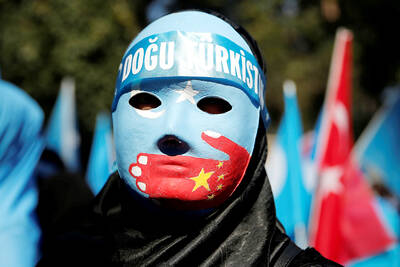
It seems every few days one bumps into one of those “real man” comments in which Taiwan is urged to “face reality” or similar, and “make a deal,” with the speaker implying that soon it will be too late. “Deal” advocates always present themselves as having a superior grip on reality, and the manly ability to make the “hard choice.” Their testosterone-laden language often echoes that of Taiwan sellout advocates. Note that such commentary always specifies a process (“make a deal, work with, make progress”), never the end state of what occupation by a violent authoritarian colonialist state will entail. In

“Taiwan’s Opposition Leader Comes to US With a Message Straight Out of Beijing” read a May 31 headline in the Wall Street Journal. Top US administration officials and members of Congress almost certainly read the WSJ, and if there was a bullet point takeaway that people in Washington should absorb ahead of Chinese Nationalist Party (KMT) Chair Cheng Li-wun’s (鄭麗文) arrival in DC on June 9, that headline is it. The last few columns have discussed this very topic, and the timing is not coincidental. While those top officials likely do not read the Taipei Times, judging by the number
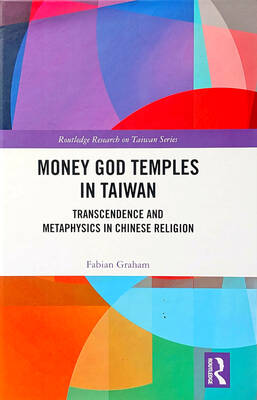
As someone who normally steers clear of books with “transcendence” or “metaphysics” in their subtitles, this reviewer — a casual observer of local belief systems since the 1990s — found Fabian Graham’s Money God Temples in Taiwan a challenging read. Those who’ve only dipped their toes into temple culture will likely need to parse several sections with special care if they’re to keep up with the author, a British ethnographic researcher whose previous books have investigated religious practices among ethnic Chinese in Southeast Asia. This scholarly volume examines a facet of Taiwan’s religious landscape that didn’t exist a century ago, and


 RSS
RSS