


By the side of a crowded Delhi highway with buses thundering by and hawkers touting their wares lies a small, walled cemetery.
It holds the graves of hundreds of British citizens and other foreigners who, for better or worse, played roles in India’s colonial past. Soldiers, missionaries, traders and officials rest here, the cracked tombstones giving only hints of their lives.
Despite the peaceful air, the Nicholson Christian Cemetery near the Kashmere Gate is also testimony to a history of violence. It was founded after the Indian Mutiny in 1857 and many of its inhabitants died in that conflict, now seen by some as India’s first war for independence.
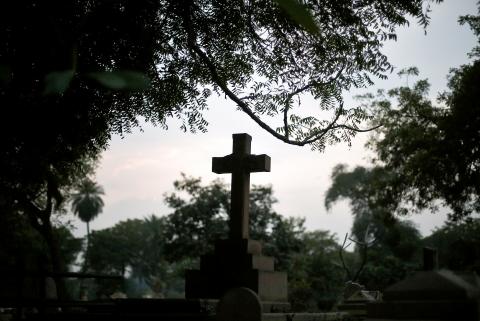
Photo: Reuters
The cemetery is named after Brigadier General John Nicholson, who was mortally wounded at the age of 36 leading the assault to relieve the siege of Delhi during the insurrection.
His grave is surrounded by a railing fence and features a white marble slab. His ghost is reputed to haunt the cemetery.
Nicholson was a controversial character in life and in death. An Ulsterman who fought in Afghanistan and Punjab before meeting his fate in Delhi, he was disliked for his haughty manner by fellow officers but revered by many of his Indian troops who elevated him to a cult-like status.
But he detested Indians and Afghans and dealt with them ruthlessly, reputedly displaying the severed head of one of his adversaries on his desk.
To a fellow officer, he proposed “the flaying alive, impalement or burning of the murderers of (British) women and children. The idea of simply hanging the perpetrators of such atrocities is maddening”.
Historian William Dalrymple, in his book The Last Moghul, calls Nicholson an “imperial psychopath” with a “merciless capacity for extreme aggression and brutality”.
Still, his grave is designated a national monument by the Archaeological Survey of India’s antiquities department.
“We don’t bear any grudges,” said Father Jesuario Rebello, head of the Delhi Cemeteries Commission.
Other soldiers buried among the bougainvillea and tamarind trees include Alexander William Murray of the 42nd Bengal Regiment. According to his gravestone, Murray “fell while encouraging his men to follow his example on the 18th of September 1857 during the siege of Delhi”.
Plenty of civilians are buried here too. James Cumming was a telegraph master killed by lightning on July 28, 1874, “leaving a widow and infant daughter to bewail his loss.” James Daof “died of heatstroke” in August 1907 at the age of 29.
Elizabeth Badley Read, daughter of the Reverend B.H. Badley of the American Methodist Mission Society, was born in Los Angeles in 1885 and died in Delhi in 1935.
“She loved India,” her tombstone says.
There are also the graves of many infants and children for whom the rigours of life in India were too much.
NO VACANCIES
Father Rebello’s problems are with the present, not the past.
“The cemetery is closed now. There’s no space anymore,” he told Reuters at New Delhi’s Sacred Heart Cathedral.
Only “second burials” are allowed - when relatives move the deceased’s cremated remains to a niche and use the vacated lot for a new body.
In fact, five of Delhi’s 11 old Christian cemeteries are full. The government had allocated land for a new cemetery but that is getting crammed too, said Rebello, a Roman Catholic priest from the former Portuguese colony of Goa.
“We’re fighting. The government does not give easily. We are a minority,” he said.
The small staff of gravetenders often have to chase away drug addicts, who climb over the wall to seek peace and seclusion to indulge their habit, he said.
Funds are also a problem. The graveyard charges a small fee from relatives to clean the graves and clear away the weeds which sprout relentlessly.
So modern India has encroached on the graveyard. One way to raise money has been to rent it to Bollywood movie productions as a set.
But after the plot of one movie involved an assassination attempt on a politician by a bishop, the committee now vets scripts to make sure they are appropriate. Anything too racy - no doubt with the silent approval of the Victorians lying there - will not be allowed.
“We don’t permit any semi-nudity and things like that here,” Rebello said.
If one asks Taiwanese why house prices are so high or why the nation is so built up or why certain policies cannot be carried out, one common answer is that “Taiwan is too small.” This is actually true, though not in the way people think. The National Property Administration (NPA), responsible for tracking and managing the government’s real estate assets, maintains statistics on how much land the government owns. As of the end of last year, land for official use constituted 293,655 hectares, for public use 1,732,513 hectares, for non-public use 216,972 hectares and for state enterprises 34 hectares, yielding

The small platform at Duoliang Train Station in Taitung County’s Taimali Township (太麻里) served villagers from 1992 to 2006, but was eventually shut down due to lack of use. Just 10 years later, the abandoned train station had become widely known as the most beautiful station in Taiwan, and visitors were so frequent that the village had to start restricting traffic. Nowadays, Duoliang Village (多良) is known as a bit of a tourist trap, with a mandatory, albeit modest, admission fee of NT$10 giving access to a crowded lane of vendors with a mediocre view of the ocean and the trains

The March/April volume of Foreign Affairs, long a purveyor of pro-China pablum, offered up another irksome Beijing-speak on the issues and solutions for the problems vexing the People’s Republic of China (PRC) and the US: “America and China at the Edge of Ruin: A Last Chance to Step Back From the Brink” rang the provocative title, by David M. Lampton and Wang Jisi (王緝思). If one ever wants to describe what went wrong with US-PRC relations, the career of Wang Jisi is a good place to start. Wang has extensive experience in the US and the West. He was a visiting

One of the challenges with the sheer availability of food in today’s world is that lots of us end up spending many of our waking hours eating. Whether it’s full meals, snacks or desserts, scientists have found that it’s not uncommon for us to be mindlessly grazing at some point during all of our 16 or so waking hours. The problem? As soon as this food hits the bloodstream in the form of glucose, it initiates the release of the hormone insulin. This in turn activates a switch present in every one of our cells, which is responsible for driving cell


 RSS
RSS