


After his feature debut Night Market Hero (雞排英雄), which grossed NT$140 million in 2011, blockbuster maker Yeh Tien-lun (葉天倫) returns with Twa Tiu Tiann (大稻埕), a film that aims to be grander and much larger in scope. The movie mixes fantasy and history to tell the story of a young man travelling back in time to 1920s Taiwan which was then under Japanese colonial rule. It is a melodramatic comedy punctuated with big emotions, and through its well-rendered time-travel conceit, the film delivers a rare portrait of Taipei as a city with a long history, affording its residents time travel into the past when one could bump into Chiang Wei-shui (蔣渭水), an important figure in Taiwan’s resistance to Japanese colonial rule, while walking down a Dadaocheng (大稻埕) street.
The film opens in present-day Taipei, where college student Jack, played by television show host-turned-actor Chris Wang (宥勝), whiles away his days chasing girls and hanging out with friends. To the gang of young lads, the history lessons taught by Professor P (Chu Ko Liang, 豬哥亮) couldn’t be more different from their easygoing lifestyle.
One day, during a field trip to a museum in western Taipei’s Dadaocheng area, Jack notices a painting on display. It is Festival on South Street (南街殷賑), a painting of iconic Dihua Street (迪化街)) by Kuo Hsueh-hu (郭雪湖), a pioneer of modern art in Taiwan. Encouraged by Professor P, Jack takes a photograph of the work. Suddenly, everything in the painting comes to life, and Jack finds himself transported back to 1920s Dadaocheng, which at the time was a major trading hub for tea, textiles, herbal medicines and many other goods.

Photo Courtesy of Swallow Wings
Bewildered, Jack is taken in by Ginger (Sonia Sui, 隋棠), a sassy Manchu woman who fled to Taiwan after the Qing Dynasty crumbled and has since run a textile shop in the area. To his surprise, Jack finds among Ginger’s helpers his history professor, who discovered the painting’s portal back in time and has been returning to the past constantly to court Ginger.
Jack’s eagerness to return to the 21st century dissipates when he meets young Taiwanese geisha Rose (Jian Man-shu, 簡嫚書). While love blossoms between Jack and Rose, they befriend Chiang Wei-shui (Lee Li-jen, 李李仁) and are drawn into the campaign for democracy led by Chiang and other Taiwanese civil rights activists. Soon Jack, Professor P and their friends become involved in Chiang’s effort to petition the colonial government for the creation of an elected representative body in front of the Japanese Crown Prince Hirohito, who visited Taiwan in 1923.
Over the two-hour screening time, Yeh delicately weaves Taiwanese history into a work of holiday entertainment packed with romance and humor. The plot involving the lead character coming to terms with the present through his reconciliation with the past serves as an eloquent metaphor and is passably carried out by rising actor Wang. The star of the show, however, is Taiwanese comedian Chu Ko Liang, who appears genuinely funny with his offbeat humor and makes a surprisingly lively pair with model-turned-actress Sui.
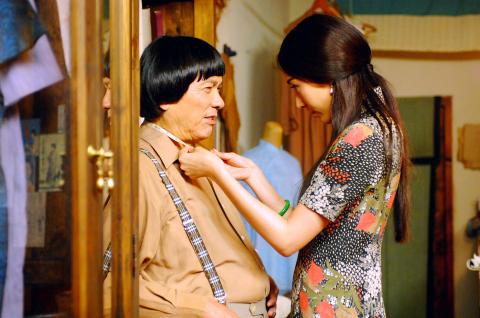
Photo Courtesy of Swallow Wings
Unfortunately, the movie is largely let down by sloppy and lazy scriptwriting. Sufficient details, motivation and narrative coherence are often absent. Embarrassingly cliched characters abound; a speech by Chiang is lifeless in its excessive sentimentality. The absence of a film studio in Taiwan, along with the needed infrastructure and talent to produce period films, is also apparent in this movie as portraits of historical grandeur are sometimes reduced to the scale of a television drama.
An aspect of Twa Tiu Tiann worth mentioning is the playful rendition Moving Forward (向前行). Though the uplifting mood of the song, recorded in 1990, is hardly in tune with the sentiments of present-day Taiwan, it makes a fitting accompaniment to the movie’s sanguine, if not overly saccharine, vision.
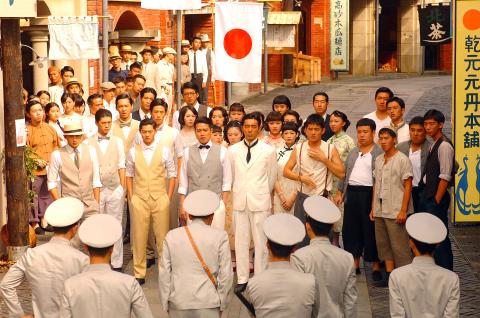
Photo Courtesy of Swallow Wings

If one asks Taiwanese why house prices are so high or why the nation is so built up or why certain policies cannot be carried out, one common answer is that “Taiwan is too small.” This is actually true, though not in the way people think. The National Property Administration (NPA), responsible for tracking and managing the government’s real estate assets, maintains statistics on how much land the government owns. As of the end of last year, land for official use constituted 293,655 hectares, for public use 1,732,513 hectares, for non-public use 216,972 hectares and for state enterprises 34 hectares, yielding

The small platform at Duoliang Train Station in Taitung County’s Taimali Township (太麻里) served villagers from 1992 to 2006, but was eventually shut down due to lack of use. Just 10 years later, the abandoned train station had become widely known as the most beautiful station in Taiwan, and visitors were so frequent that the village had to start restricting traffic. Nowadays, Duoliang Village (多良) is known as a bit of a tourist trap, with a mandatory, albeit modest, admission fee of NT$10 giving access to a crowded lane of vendors with a mediocre view of the ocean and the trains

For many people, Bilingual Nation 2030 begins and ends in the classroom. Since the policy was launched in 2018, the debate has centered on students, teachers and the pressure placed on schools. Yet the policy was never solely about English education. The government’s official plan also calls for bilingualization in Taiwan’s government services, laws and regulations, and living environment. The goal is to make Taiwan more inclusive and accessible to international enterprises and talent and better prepared for global economic and trade conditions. After eight years, that grand vision is due for a pulse check. RULES THAT CAN BE READ For Harper Chen (陳虹宇), an adviser

Traditionally, indigenous people in Taiwan’s mountains practice swidden cultivation, or “slash and burn” agriculture, a practice common in human history. According to a 2016 research article in the International Journal of Environmental Sustainability, among the Atayal people, this began with a search for suitable forested slopeland. The trees are burnt for fertilizer and the land cleared of stones. The stones and wood are then piled up to make fences, while both dead and standing trees are retained on the plot. The fences are used to grow climbing crops like squash and beans. The plot itself supports farming for three years.


 RSS
RSS