


Fireweeds 野草居食屋
Address: 1, Lane 28, Tongan Rd, Taipei City (台北市同安街28巷1號)
Telephone: (02) 2366-0618
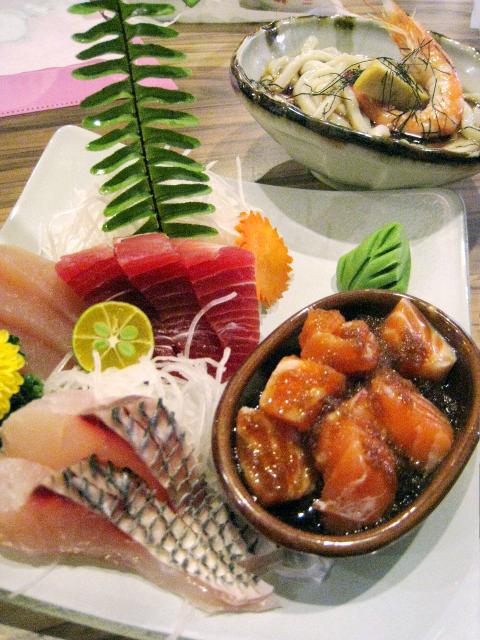
Photo: Ian Bartholomew, Taipei Times
Open: 5pm to 12am daily
Average meal: From NT$600
Details: Chinese menu; credit cards accepted
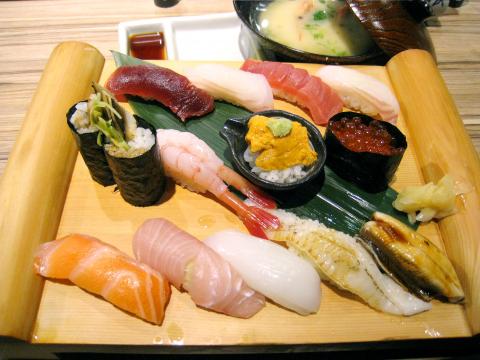
Photo: Ian Bartholomew, Taipei Times
On the Net: www.fireweeds.tw
Old-style wooden Japanese houses have had a rough time over the last few decades, many left to moulder away, neglected or abandoned, if they have not been utterly demolished to make way for soulless modern apartments. The Japanese restaurant Fireweeds (野草居食屋), which opened in June just off Tongan Street in Taipei’s Zhongzheng District (中正區), is a splendid example of what can be achieved when the restoration project is approached with the right balance of ambition and humility.
With its emphasis on strongly flavored foods that go well with alcoholic beverages, Fireweeds resembles an izakaya, a traditional Japanese style drinking shop, except that it offers a wider range of food.
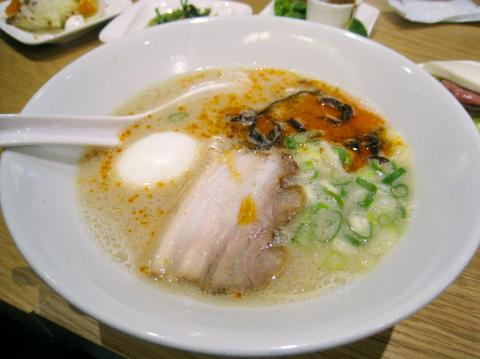
Photo: Ian Bartholomew, Taipei Times
The menu is elegant both in design and content, with the usual standards mixed in with some unexpected items to tempt the tastebuds. A mixed sashimi platter (綜合生魚片, NT$350) came with a bowl of marinated salmon that put a totally new spin on this rather weary standard. It was notable particularly due to the careful balancing of the marinade, that was quite spicy, but which did not overwhelm the flavor of the fish. Fireweeds has a good selection of high quality sakes, bottled Kirin beer (NT$150 for 630ml) and draft Asahi beer (NT$100 for 340ml). These are ideally suited to washing down the vast array of good things that come from the semi open kitchen located behind a dining counter.
Addiction Aquatic Development 上引水產
Address: 18, Alley 2, Lane 410, Minzhu E Rd, Taipei City (台北市民族東路410巷2弄18號)
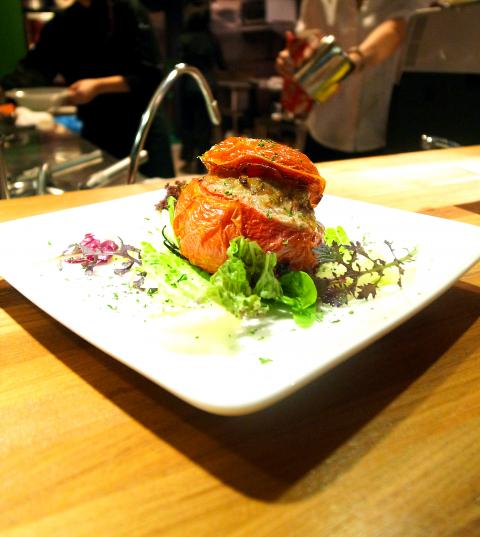
Photo: Ho YI, Taipei Times
Telephone: (02) 2508-1268
Open: 10am to 5pm
Average meal: NT$600 and up
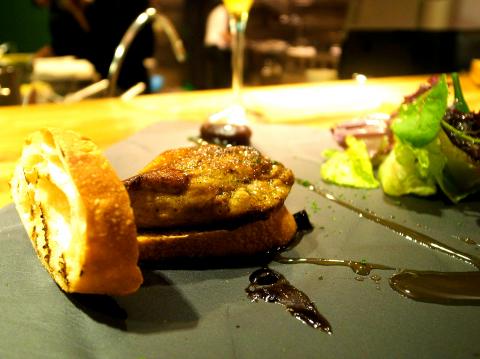
Photo: Ho YI, Taipei Times
Details: cash only; Chinese menu
The fish market located on Minzhu East Road (民族東路) close to the intersection with Jianguo North Road (建國北路) has long been popular with foodies seeking quality ocean produce. A cooked food section was attached to the market, but it was a rather grubby, haphazard affair that did not particularly recommend itself for either the quality of either the cooking or the ambiance. This has change since it was taken over by the Mitsui Food and Beverage Enterprise Group (三井餐飲事業集團), which operates a number of top Japanese restaurants around town. They have recently established Addiction Aquatic Development, a sophisticated sushi, grill and hotpot restaurant at this venerable venue that mixes up high-end stylings with an edgy marketplace atmosphere.
In a section offering sushi, and another specializing in crustaceans, there is not much seating, and the standing area up at the bar where customers can watch the chefs work are the most coveted spots.
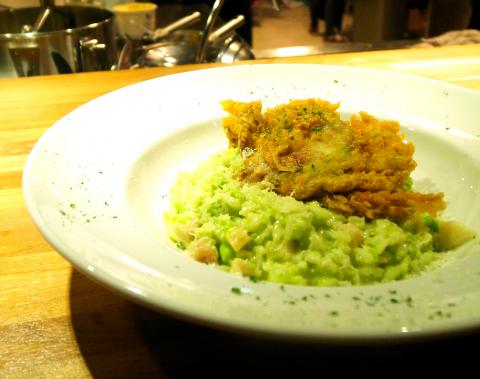
Photo: Ho YI, Taipei Times
For anyone not familiar with the arcana of raw fish cuisine or with a good working knowledge of the Taiwanese fishery industry, the selection of fish available could easily feel overwhelming. If ordering your own nigiri (raw fish on rice) platter is too much of an ordeal, the special nigiri selection (特選握壽司, NT$600) is highly recommended, providing a selection of around 14 pieces that is a perfect introduction to what Addiction Aquatic Development has to offer on any particular day. It is also a perfect springboard for subsequent a la carte orders.
Although the service can be a little haphazard, the quality of the food on offer mostly overrides this nagging dissatisfaction, and overall the price-to-quality ratio is admirable.
Ippudo TW 一風堂
Address: 85 Zhongshan N Rd Sec 1, Taipei City (台北市中山北路一段85號)
Telephone: (02) 2562-9222
Open: 11:30am to midnight
Average meal: NT$400
Details: English, Japanese and Chinese photo menu; no credit cards; no reservations
Ippudo has earned cult status as the restaurant that brought Japanese Kyushu-style ramen into the mainstream after founder Shigemi Kawahara was crowned “ramen king” after three consecutive victories in a popular Japanese TV ramen competition and admitted to the Ramen Hall of Fame. From a restaurant seating just 10 in Kawahara’s native Fukuoka, Ippudo has become an international operation with outlets in New York, Hong Kong and Singapore (as well as over 50 outlets across Japan). It opened its first Taiwan branch in May.
The interior is carefully designed to present an impression of modern style and a degree of chic, but without providing any comforts beyond what is strictly necessary. Like the decor, the food is deceptively simple. Apart from side dishes, there are only three options for the main course, all of them ramen, each with slightly different flavorings.
That said, these bowls of ramen are no simple proposition. Many restaurant critics here and abroad have already raved about the complexity of the broth, which uses whole pig heads, among other ingredients, simmered over many hours to achieve a luscious texture and multi-layered flavor. The effect is not easy to describe, and this reviewer found himself taking spoonful after spoonful, trying to get his brain around the broth’s outstanding qualities, and its sophisticated inter-relationship with the noodles and condiments.
The three types of ramen on offer are shiromaru classic (NT$200), akamaru modern (NT$230) and Ippudo karaka (NT$230). It is a symbol of Ippudo’s influence in the world of ramen that the designations of “shiromaru” and “akamaru” (white broth and red broth respectively), initiated by Kawahara, have been adopted by ramen restaurants across Japan.
A Poet
Address: 9, Ln 295, Dunhua S Rd Sec 1, Taipei City (台北市敦化南路一段295巷9號)
Telephone: (02) 2709-0068
Average meal: From NT$1,000
Open: Tuesday to Sunday from 11:30am to 4:30pm and 5:30pm to 10:30pm
There is nothing not to like about this tastefully decorated restaurant serving Mediterranean-influenced food in a central but quiet location near Renai Circle (仁愛圓環). We arrived on a Sunday at noon and for a split second forgot we were in Taipei. Sunlight streams through a skylight into the front part of the dining room, where shrubs and flowers flourish in a small indoor garden.
Dining at A Poet feels like living in a page of an interior design magazine. The interior seamlessly fuses a vintage European feel with an eclectic design ethos expressed through robust wood tables, exposed cement walls, antique iron chairs of bright colors and industrial lamps.
The same thought went into the menu, with the youthful chefs paying particular attention to how their dishes are presented. Health-conscious patrons will be glad to know that the restaurant uses simple seasonings, with plenty of herbs, and shuns artificial flavorings.
Appetizers include the marinated chorizo and chickpeas with bread (NT$200) and shrimp rolled in Parma ham (NT$220). The selection of main courses features items such as squid risotto (NT$500), roasted rib-eye steak (NT$880) and stewed pork with apple and herbs (NT$500).
Your Kitchen 宅食法式廚房
Address: 8, Ln 53, Zhongshan N Rd Sec 1, Taipei City (台北市中山北路一段53巷8號)
Telephone: (02) 2567-2633
Average meal: NT$1,180 plus 10 percent service charge
Open: Tuesday to Sunday from 12pm to 3pm and 6:30pm to 10pm
The French restaurant wins accolades with its cozy ambiance, professional and amicable service and a set menu that exhibits a fine level of thoughtfulness.
Tucked away in a quiet alley between Zhongshan North Road and Tianjin Street (天津街) in Taipei, the spacious restaurant is stylish — a chic palette of black, white and gray is gently offset by the warmth of wood and soft lighting — and comfortable.
The sometimes curt manner often associated with French restaurants is nowhere to be found at Your Kitchen. Instead, the atmosphere is a mix of neighborliness and charm. Next to the entrance, several young cooks in the spotless open kitchen work on a six-course set menu (NT$1,180 plus 10 percent service charge per person) that changes on a monthly basis.
The focus was on seafood during the month I visited. My favorite course of the evening was the pan-roasted fish with clam and saffron sauce. The visually inviting and colorful dish features bites of finely textured deep-sea grouper served with red bell pepper and a creamy clam sauce that owes much of its delightful flavor to the addition of saffron.
Because the restaurant has a limited number of seats, making a reservation on the weekend is a necessity. Your Kitchen’s menu can be found on the restaurant’s Web site: www.yourkitchen.com.tw.
Le Bouchon Aux Vins 塞子小酒館
Address: 129, Jiaxing St, Taipei City (台北市嘉興街129號)
Telephone: (02) 2732-9987
Average meal: NT$1,000
Open: Wednesdays to Sundays from 11:30am to 2pm and 5:30pm to 10:30pm; Tuesdays from 5:30pm to 10:30pm
Opened in July in a quiet alley off the busy, congested Keelung Road (基隆路), Le Bouchon Aux Vins has deservedly enjoyed a base of clientele attracted to its short but gratifying menu of French country cooking that is also reasonably priced.
As in most of the city’s tinier dining establishments, the seating area is small and can be crowded when the restaurant is full. Diners who opt for space to maneuver can sit at the L-shaped bar around the open kitchen where the chef and his assistants serve hearty, rustic dishes said to come from France’s culinary regions such as Lyon and Normandy.
Items on the starter menu include tomate farcis (NT$150), or stuffed tomato with ground pork, and French Gillardeau oysters (NT$400 for two or NT$220 each). The restaurant’s risotto served with soft-shell crab (NT$480) is among the best risotto I have had in Taipei. Lusciously thick and creamy, the risotto showed off a rich mixture of flavors and textures, with diced cubes of zucchini and baby corn a worthy accompaniment to the fried shellfish. The rice was also cooked to al dente perfection.
Though the food is rustic and the ambiance casual, Le Bouchon takes the idea of service seriously. Our plates were promptly whisked away when emptied, and we never waited more than a few minutes before the next dish arrived.

For many people, Bilingual Nation 2030 begins and ends in the classroom. Since the policy was launched in 2018, the debate has centered on students, teachers and the pressure placed on schools. Yet the policy was never solely about English education. The government’s official plan also calls for bilingualization in Taiwan’s government services, laws and regulations, and living environment. The goal is to make Taiwan more inclusive and accessible to international enterprises and talent and better prepared for global economic and trade conditions. After eight years, that grand vision is due for a pulse check. RULES THAT CAN BE READ For Harper Chen (陳虹宇), an adviser

Traditionally, indigenous people in Taiwan’s mountains practice swidden cultivation, or “slash and burn” agriculture, a practice common in human history. According to a 2016 research article in the International Journal of Environmental Sustainability, among the Atayal people, this began with a search for suitable forested slopeland. The trees are burnt for fertilizer and the land cleared of stones. The stones and wood are then piled up to make fences, while both dead and standing trees are retained on the plot. The fences are used to grow climbing crops like squash and beans. The plot itself supports farming for three years.

The breakwater stretches out to sea from the sprawling Kaohsiung port in southern Taiwan. Normally, it’s crowded with massive tankers ferrying liquefied natural gas from Qatar to be stored in the bulbous white tanks that dot the shoreline. These are not normal times, though, and not a single shipment from Qatar has docked at the Yongan terminal since early March after the Strait of Hormuz was shuttered. The suspension has provided a realistic preview of a potential Chinese blockade, a move that would throttle an economy anchored by the world’s most advanced and power-hungry semiconductor industry. It is a stark reminder of

May 4 to May 10 It was once said that if you hadn’t performed at the Sapphire Grand Cabaret (藍寶石大歌廳), you couldn’t truly be considered a star. Taking the stage at the legendary Kaohsiung club was more than just a concert. Performers were expected to entertain in every sense, wearing outlandish or revealing costumes and staying quick on their feet as sharp-tongued, over-the-top hosts asked questions and delivered jokes that would be seen as vulgar, even offensive, by today’s standards. Opening in May 1967 during a period of strict political and social control, Sapphire offered a rare outlet for audiences in


 RSS
RSS