


For P. Kerim Friedman and his wife Shashwati Talukdar, making a documentary about the plight of a small and often marginalized ethnic group in India was a six-year odyssey that took them from Taiwan to India to New York. The feature-length film, Please Don’t Beat Me, Sir!, recently had its premiere in Goa, India.
The movie, in English with Chinese subtitles, will be screened tomorrow at National Tsing Hua University in Hsinchu starting at 6:30pm. Friedman, who teaches at National Dong Hwa University in Hualien, will attend and host a discussion afterwards.
“CRIMINAL TRIBE”

Graphic courtesy of P. Kerim Friedman
The movie examines the Chhara, a formerly nomadic community who were labeled as a “criminal tribe” by the British under the 1871 Criminal Tribes Act. They remain an outcast group in India.
“Even after the British left India, the Chhara still continue to be treated as ‘born criminals’ by the police,” Friedman said.
The roots of the movie began in 2005 when the couple made a short film, Acting Like a Thief, to raise awareness about the arrest of an Indian theater director, who had been jailed on false charges in 2003, Friedman said.

Photo courtesy of Carol Kitman and P. Kerim Friedman
“It was while making that film that we got the idea of making a feature-length documentary about the same community. We simply loved being in Chharanagar, and were so impressed with the young actors of Budhan Theater that we decided we had to come back to do something bigger.”
Friedman said that while there are no groups like the Chhara in Taiwan, the documentary can still speak to viewers here. He said, for example, that colonial Japanese policies toward Taiwan’s indigenous population share some parallels with what happened to the Chhara under British colonialism.
“In particular, rule of the mountain areas and the east coast of Taiwan was largely left to the Japanese-administered police forces. Early ethnographic accounts of Taiwanese Aborigines were also conducted by the local police in those days. And today’s Aborigines still suffer from discrimination on the basis of their ethnicity,” Friedman said.
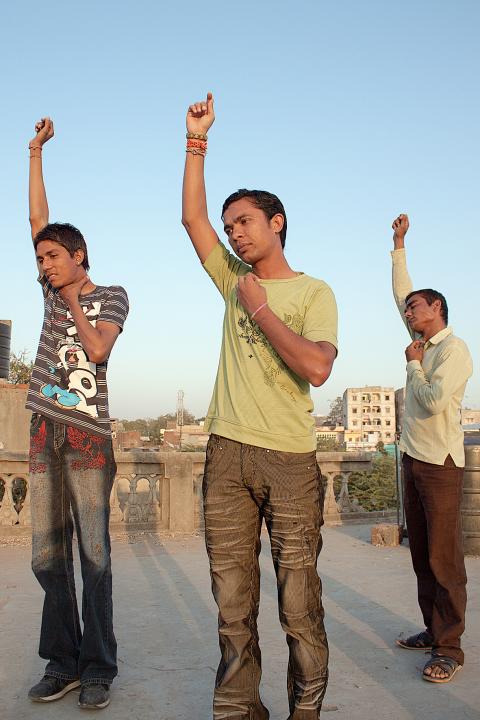
Photo courtesy of Carol Kitman and P. Kerim Friedman
Friedman said his mostly Aboriginal students are sympathetic to the plight of the Chhara, and have even performed plays by Budhan Theatre in Chinese.
“My dream is to take some of my Aborigine students to India to visit Budhan Theatre,” he said.
ETHICS OF DOCUMENTARY FILMMAKING
Friedman, 42, who teaches Indigenous Studies at Dong Hwa University where he also offers a course on India, was recently on a committee that produced a set of guidelines for ethical documentary filmmaking in Taiwan.
“These guidelines were produced after a series of meetings with representatives from indigenous communities, filmmakers and anthropologists held around the country,” he said.
Friedman is a busy man. In addition to teaching a course on ethnographic filmmaking, he is on the planning committee for Taiwan’s International Ethnographic Film Festival, which was founded by Taiwan’s leading ethnographic filmmaker, Hu Tai-li (胡台麗), and conducts research on the nation’s Hoklo (also known as Taiwanese) language policies and indigenous language revitalization.
COLLABORATIVE EFFORT
Friedman’s approach to documentary filmmaking involves significant feedback from his subjects.
“One reason it took so long is that we worked collaboratively with the community. After making a rough-cut we would return to the community and screen it for them. In the film itself you can see some of the discussions we had with them about earlier cuts of the film and how that changed the making of the film. This approach was necessitated by the particular dangers threatening the community, but also comes from the ethical commitments of contemporary anthropology,” he said.
For their efforts, the couple recently received the Society for Visual anthropology’s Jean Rouch Award for Collaborative Filmmaking.
Funding is always a problem for producers of independent documentaries. Friedman said that funding for Please Don’t Beat Me, Sir! came from academic sales of Acting Like a Thief, online fundraising and grants from funding agencies such as The New York State Council for the Arts and the Asia Network for Documentary at the Busan International Film Festival.
GLOBAL FILMMAKING TEAM
Friedman, a native of New Jersey where he was raised in a Jewish family, and Talukdar, an Indian who grew up in New Delhi steeped in Hindu traditions, have put their own roots in the background and now work as an international movie-making team with global audiences in mind. He spends most of the year in Taiwan, usually only leaving the country for a few weeks of the year.
“Shashwati earlier was working quite a bit in New York and traveling back and forth to New York a lot, but lately she’s been doing more work in India and has two new projects based in her hometown. The first is about 17th and 18th century mural paintings and the second is a fiction piece that is still in development.”
WHITE TERROR
Talukdar, 45, is also producing a movie about Taiwanese democracy, she told the Taipei Times.
“This project grew out of Kerim’s friendship with two men who were imprisoned during the White Terror period,” she said. “They spent 10 years in prison just for reading the wrong books. I would like to make an experimental documentary inspired by their stories, but it is too early in the process to say much more about the project.”
Don’t Beat Me, Sir! had its world premiere at the 2011 Busan International Film Festival and it also recently received a “special mention” at the 2012 Zanzibar International Film Festival. But since the couple shot the film in India, the International Film Festival of India in Goa was especially important for them, Talukdar said.
“Not only was it the Indian premiere of our film, but it was an opportunity to raise awareness about the plight of the group in the film,” she said. “The Goa screening was a big success, with many people staying long afterwards for intense but friendly discussions.”
Friedman said they are currently working on a DVD version of the film and volunteers have already provided translations in Chinese, Spanish, French, Arabic, Swedish, Bulgarian and German. With the movie in the can and now screening on several continents, Friedman and Talukdar hope to use the film to raise awareness and funds.
“Budhan Theatre is not just a theater troupe, they’re re also an important community organization,” Friedman said. “We founded a nonprofit, called Vimukta, to help support their community development and education programs. We are now trying to raise money to support their children’s theater program.”

For many people, Bilingual Nation 2030 begins and ends in the classroom. Since the policy was launched in 2018, the debate has centered on students, teachers and the pressure placed on schools. Yet the policy was never solely about English education. The government’s official plan also calls for bilingualization in Taiwan’s government services, laws and regulations, and living environment. The goal is to make Taiwan more inclusive and accessible to international enterprises and talent and better prepared for global economic and trade conditions. After eight years, that grand vision is due for a pulse check. RULES THAT CAN BE READ For Harper Chen (陳虹宇), an adviser
Traditionally, indigenous people in Taiwan’s mountains practice swidden cultivation, or “slash and burn” agriculture, a practice common in human history. According to a 2016 research article in the International Journal of Environmental Sustainability, among the Atayal people, this began with a search for suitable forested slopeland. The trees are burnt for fertilizer and the land cleared of stones. The stones and wood are then piled up to make fences, while both dead and standing trees are retained on the plot. The fences are used to grow climbing crops like squash and beans. The plot itself supports farming for three years.

The breakwater stretches out to sea from the sprawling Kaohsiung port in southern Taiwan. Normally, it’s crowded with massive tankers ferrying liquefied natural gas from Qatar to be stored in the bulbous white tanks that dot the shoreline. These are not normal times, though, and not a single shipment from Qatar has docked at the Yongan terminal since early March after the Strait of Hormuz was shuttered. The suspension has provided a realistic preview of a potential Chinese blockade, a move that would throttle an economy anchored by the world’s most advanced and power-hungry semiconductor industry. It is a stark reminder of

May 4 to May 10 It was once said that if you hadn’t performed at the Sapphire Grand Cabaret (藍寶石大歌廳), you couldn’t truly be considered a star. Taking the stage at the legendary Kaohsiung club was more than just a concert. Performers were expected to entertain in every sense, wearing outlandish or revealing costumes and staying quick on their feet as sharp-tongued, over-the-top hosts asked questions and delivered jokes that would be seen as vulgar, even offensive, by today’s standards. Opening in May 1967 during a period of strict political and social control, Sapphire offered a rare outlet for audiences in


 RSS
RSS