


When Sigur Ros took to the stage last Wednesday night at the National Taiwan University Stadium, it was to a room of people sitting in folding chairs. Promoters probably expected that the ambient band would put people to sleep with their celestial sounding songs. But instead, the Icelandic ensemble delivered an unforgettable and mind-blowing exhibition of sheer talent that left fans quite literally scrambling over their seats just to get a closer look at the band.
Maybe it was because this was Sigur Ros’ first performance in Taiwan and people didn’t know what to expect of a band categorized as minimalist and post-rock, but the show started slow. Perhaps the crowd needed a minute to fully absorb how the hypnotic coos coming from lead singer Jonsi Birgisson made them feel. But in the blink of an eye, life charged through some very serious listeners and most of the audience rose to their feet, some even stood on their chairs. And that’s when the concert really began.
As the show went on, emotional intensity continued to build up as brooding melodies carried over into tremendous build-ups that when released, even sparked some soft head banging from the crowd. But for the most part, it seemed concertgoers stood enraptured with their mouths agape.
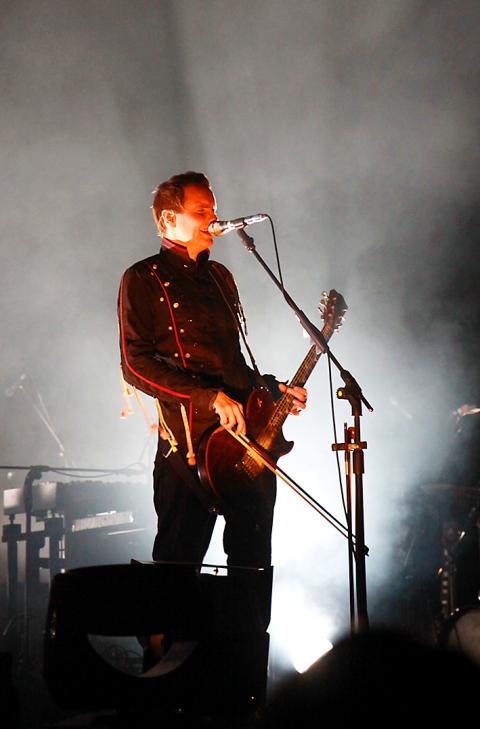
Photo: Olivia Wycech, Taipei Times
This is probably because they couldn’t sing along, since the band sang mostly in Icelandic or Hopelandic, a made-up language that the band says is supposed to evoke a unique experience in every listener. But, despite very few distinguishable characteristics between songs, fans seemed to know every song from the very first chord and responded with roaring cheers and applause.
It didn’t matter that no one could understand Birgisson because his falsetto voice was an ethereal instrument to enjoy all on its own. He hit and held, quite literally, every note so well that he seemed to impress even himself. Birgisson’s exquisite projection of sonic sublime resonated in breathtaking moments where people simply stood mesmerized, with their eyes closed.
Although Birgisson was joined on stage by his core band and a small orchestra of six, it was still he who, after every apex, continued to enthrall fans by theatrically playing his electric guitar with a bow. Later, he would sing with the microphone pressed against his forehead. This is all part of the idiosyncratic nature that has defined the band since they formed in 1994.
At one point, the band paused dramatically mid-song and motion, which clearly confused the crowd as bouts of awkward cheers kept erupting sporadically. While many people didn’t know what to do with the silence, the people that understood what was happening quickly shushed them and savored every second of the silence bestowed upon them by Sigur Ros.
The encore was thunderous and immediately after the show, one fan on the group’s Web site even compared it to an out-of-body experience. It seemed that Sigur Ros far exceeded expectations and won the hearts of many new fans along the way.

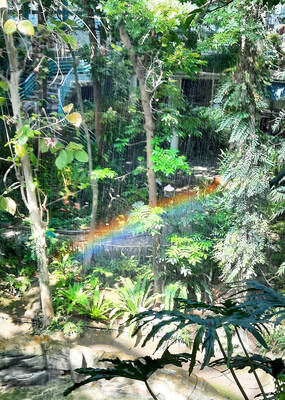
It’s only half the size of its more famous counterpart in Taipei, but the Botanical Garden of the National Museum of Nature Science (NMNS, 國立自然科學博物館植物園) is surely one of urban Taiwan’s most inviting green spaces. Covering 4.5 hectares immediately northeast of the government-run museum in Taichung’s North District (北區), the garden features more than 700 plant species, many of which are labeled in Chinese but not in English. Since its establishment in 1999, the site’s managers have done their best to replicate a number of native ecosystems, dividing the site into eight areas. The name of the Coral Atoll Zone might
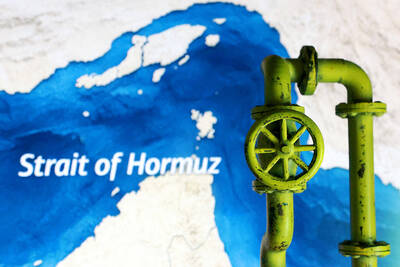
The US war on Iran has illuminated the deep interdependence of Asia on flows of oil and related items as raw materials that become the basis of modern human civilization. Australians and New Zealanders had a wake up call. The crisis also emphasizes how the Philippines is a swatch of islands linked by jet fuel. These revelations have deep implications for an invasion of Taiwan. Much of the commentary on the Taiwan scenario has looked at the disruptions to world trade, which will be in the trillions. However, the Iran war offers additional specific lessons for a Taiwan scenario. An insightful

On Monday morning, in quick succession, the Chinese Communist Party (CCP) and the Chinese Nationalist Party (KMT) released statements announcing “that the Central Committee of the Communist Party of China and General Secretary Xi Jinping (習近平) have invited KMT Chairwoman Cheng Li-wun (鄭麗文) to lead a delegation on a visit to the mainland” as the KMT’s press release worded it. The KMT’s press release added “Chairwoman Cheng expressed her gratitude for the invitation and has gladly accepted it.” Beijing’s official Xinhua news release described Song Tao (宋濤), head of the Taiwan Work Office of the CCP Central Committee, as

Polling data often confirms what we expect, but sometimes it throws up surprises. When examined over time, some patterns appear that speak to something bigger going on. In this column, whenever possible, Formosa’s polls are used. Despite the sometimes cringeworthy antics of Formosa’s Chairman, Wu Tzu-Chia (吳子嘉), the data produced includes detailed breakdowns crucial for analysis. It has also been conducted monthly 11-12 times a year for many years with many of the same questions, allowing for analysis over time. When big shifts do occur between one month and the next it is usually in response to some event in


 RSS
RSS