


US Senator Deb Fischer on Thursday urged her colleagues in the US Congress to deepen Washington’s cooperation with Taiwan and other Indo-Pacific partners to contain the global security threat from China.
Fischer and other lawmakers recently returned from an official trip to the Indo-Pacific region, where they toured US military bases in Hawaii and Guam, and visited leaders, including President William Lai (賴清德).
The trip underscored the reality that the world is undergoing turmoil, and maintaining a free and open Indo-Pacific region is crucial to the security interests of the US and its partners, she said.
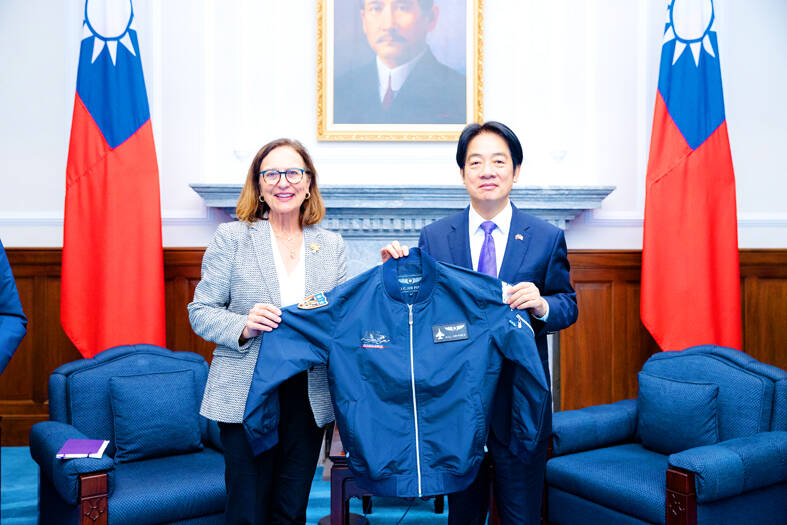
Photo courtesy of the Presidential Office
Her visit to Taiwan demonstrated ways the US could enhance its posture and deepen cooperation with partners in the region, she said.
“Taiwan has made remarkable progress in bolstering its self-defense in recent years. We should seize every opportunity to build on that momentum,” Fischer said.
The US must also recognize the challenges posed by the Chinese Communist Party, which continues to increase its campaign to threaten, pressure and isolate Taiwan, she said.
Beijing’s actions are unacceptable, as Taiwanese have “earned their place” as a respected and indispensable component of the global economy, Fischer said.
“The world is more dangerous today than at any point since World War II,” she added.
“Taiwan is the test case for US credibility in upholding a free and open rules-based order,” Fischer said. “If Taiwan were to fall under coercion, the consequences would reverberate far beyond the Taiwan Strait — shaking the confidence of our allies and emboldening adversaries worldwide.”
Taiwan’s defense is not its problem alone, as any conflict in the region would jeopardize the advanced semiconductor production on which the world’s economy depends, including US electronics, automotive and healthcare sectors, she said.
War in the Taiwan Strait would disrupt global trade routes, and could spark a worldwide crisis, escalate regional military tensions and trigger a broader conflict, she added.
A powerful US presence in the region is required to reduce the odds of conflict, and reassure its allies that they would not face the threat of war alone, she said.
The US Senate Armed Services Committee is committed to ensuring Washington and Taipei make the necessary investments needed to bolster deterrence networks and combat readiness, Fischer said.
In related news, a US official on Thursday said that US and Taiwanese defense officials held talks in Alaska last week.
Jed Royal, the top Indo-Pacific official at the US Department of Defense, met a senior Taiwanese national security official in Anchorage, the official said.
The Financial Times reported that the Taiwanese official was former National Security Council deputy secretary-general Hsu Szu-chien (徐斯儉), who earlier this week became an advisory committee member on the council.
Meanwhile, the Mainland Affairs Council (MAC) yesterday confirmed that council Minister Chiu Chui-cheng (邱垂正) is to visit the US from today to Sept. 14 and deliver a speech on cross-strait relations at the Heritage Foundation in Washington.
Chiu is to deliver a speech on Friday next week titled “Maintaining the peaceful and stable status quo across the Taiwan Strait is in line with the shared interests of Taiwan and the United States,” the council said in a statement.
The speech would outline Taipei’s assessment of the situation in the Taiwan Strait and the government’s cross-strait policy, it said.
Chiu would discuss with foundation senior research fellow Steve Yates “how a free, secure and prosperous Taiwan not only contributes to regional stability, but also makes America’s position stronger on the world stage,” the foundation said, adding that Chiu would also meet with US officials from the executive and legislative branches, as well as experts at think tanks and members of Taiwanese communities in the US.
The meetings would serve to “explain the government’s cross-strait policy and encourage broader attention to Taiwan Strait issues,” it added.
Additional reporting by Reuters
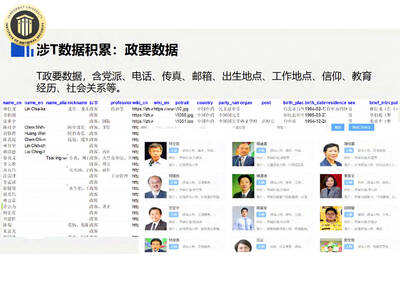
NETWORK-MAPPING PROJECT: The database contains 170 detailed files of Taiwanese politicians and about 23 million records of household registration data in Taiwan China has developed a network-mapping project targeting political figures and parties in Taiwan to monitor public opinion during elections and to craft tailored influence campaigns aimed at dividing Taiwanese society, according to documents leaked by Chinese technology firm GoLaxy (中科天璣). The documents, collected by Taipei-based Doublethink Lab, showed a database was specifically created to gather detailed information on Taiwanese political figures, including their political affiliations, job histories, birthplaces, residences, education, religion and a brief biography about them. Several notable Taiwanese politicians are in the database, including President William Lai (賴清德), former president Tsai Ing-wen (蔡英文), Minister of Foreign Affairs Lin Chia-lung (林佳龍),
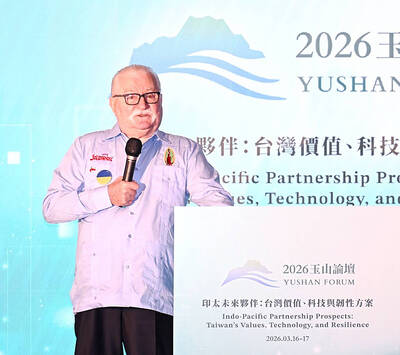
RECOGNITION: Former Fijian prime minister Mahendra Chaudhry said that Taiwan’s New Southbound Policy serves as a stabilizing force in the Indo-Pacific region Taiwan can lead the unification of the Chinese people, Nobel Peace Prize laureate and former Polish president Lech Walesa said in Taipei yesterday, adding that as the world order is changing, peaceful discussion would find good solutions, and that the use of force and coercion would always fail. Walesa made the remarks during his keynote address at a luncheon of the Yushan Forum in Taipei, titled “Indo-Pacific Partnership Prospects: Taiwan’s Values, Technology and Resilience,” organized by the Taiwan-Asia Exchange Foundation with the Ministry of Foreign Affairs. Walesa said that he had been at the forefront of a big peaceful revolution and “if
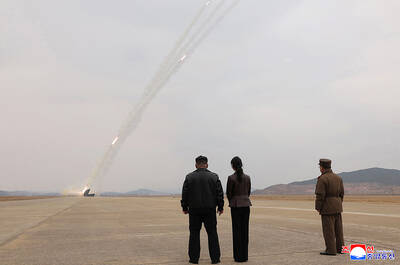
North Korea tested nuclear-capable rocket launchers, state media reported yesterday, a day after Seoul detected the launch of about 10 ballistic missiles. The test comes after South Korean and US forces launched their springtime military drills, due to run until Thursday. North Korean leader Kim Jong-un on Saturday oversaw the testing of the multiple rocket launcher system (MRLS), the Korean Central News Agency (KCNA) said. The test involved 12 600mm-caliber ultra-precision multiple rocket launchers and two artillery companies, it said. Kim said the drill gave Pyongyang’s enemies, within the 420km striking range, a sense of “uneasiness” and “a deep understanding
UPGRADED MISSILE: The Chungshan Institute of Science and Technology is reportedly to conduct a live-fire test of the Hsiung Feng III anti-ship missile on Thursday next week The US Army is planning to build new facilities to boost explosives production and strengthen its supply chain, a move aimed at addressing munitions shortages and supporting obligations to partners including Taiwan, Ukraine and Israel, Defense News reported. The army has issued a sources sought notice for a proposed Center of Excellence at the Blue Grass Army Depot in Kentucky, the report said. The facility would serve as a hub within the US industrial base for the production of key military explosives, including research department explosives (RDX) and high melting explosives (HMX), while also supporting research and development of next-generation materials. The proposed


 RSS
RSS