


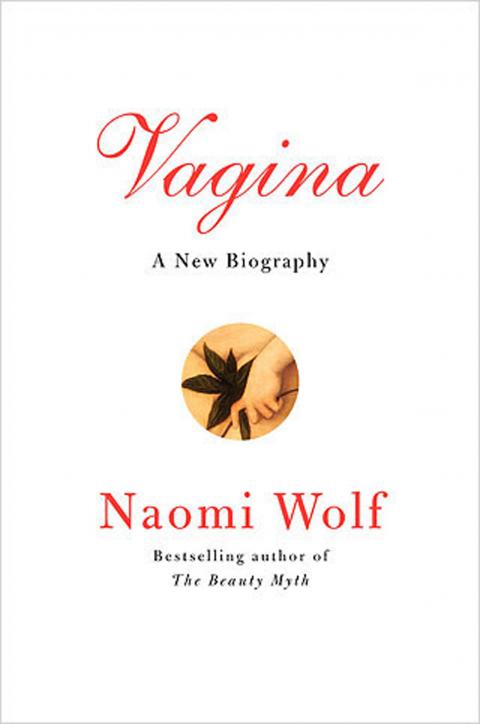
For the feminist writer Naomi Wolf, the spring of 2009 was beautiful. She was “emotionally and sexually happy, intellectually excited, and newly in love.” Her boyfriend of two years was more than able to provide for her physical and emotional needs and they had, it seems, a fabulous sex life. But then — uh, oh — trouble in paradise. One morning, as she looked out of the window at her “little cottage upstate” (Wolf is based in New York), it occurred to her that something was up with the quality of her orgasms. Where once achieving an orgasm had led her to see “colors as if they were brighter,” and even to make “the connections between things” seem more distinct, now she no longer experienced sex in a “poetic dimension ... instead, things seemed discrete and unrelated to me.” As she pondered the tree tops — presumably now a uniform sage, as opposed to the iridescent jade, olive and emerald of old — she thought: What is happening to me?
In the same boat, most women would leap out of bed and proceed with their day, pushing their anxiety to the back of their minds, like old yogurt to the back of the fridge. They would count their blessings (oh, to be newly in love at 46) and, perhaps, load the washing machine with extra fierceness. At most, they might confide in a friend. Not Wolf, though. Off she hopped, first to her gynecologist, and thence to New York’s “top nerve man,” who told her that she had a mild form of spina bifida, as a result of which her wonky spinal column was compressing the branch of her pelvic nerve that ends in the vaginal canal. Soon after, her doctor performed successful surgery on Wolf’s vertebrae, fusing them in order to release pressure on the nerve. And soon after that she was back to her orgasmic best: “I began again, after lovemaking, to experience the sense of heightened interconnectedness, which Romantic poets and painters called ‘the Sublime.’”
This experience transformed Wolf’s life in more ways than one, for out of it came Vagina: A New Biography (a title, I admit, that has made me think a Kindle might, after all, have its uses). Her nerve man had told her that impulses from the pelvic nerve travel up to the “female brain;” that because all women are built differently, one’s ability to experience an orgasm — be it the decorous, old-fashioned clitoral kind, or the zingy, modern vaginal orgasm — is not, as many feminists believe, down to conditioning and culture but merely neural wiring. What news! “I almost fell off the edge of the exam table in my astonishment,” Wolf writes. “This was a much less mysterious and value-laden message about female sexuality: it presented the obvious suggestion that anyone could learn about her own particular neural variant and simply master the patterns of the special way it worked.”
On the surface, I’m inclined to agree with Wolf on this score. I’m not going to write about my own orgasms, be they sepia or Technicolor, but nothing makes me angrier than the suggestion that my migraine is psychosomatic. It’s not: it’s chemical, or neurological, or whatever word you want to use. But science can be abused, too, and regularly is, by drug companies and ideologues alike. In Vagina, Wolf uses her scientific discoveries — her book teems with randy lab rats — to provide ballast for some pretty conservative ideas. Rather like a darts player I once interviewed, she believes that women who don’t get good sex regularly, who are denied the soothing benefits of dopamine and oxytocin, both stimulated by orgasm, will inevitably be “emotionally irritable.” Men who don’t indulge in serious and lengthy foreplay, employing what she calls the “Goddess array” to turn their partners on, should ask themselves: “Do I want to be married to a Goddess or a bitch?” (Wolf’s favored terms for the vagina are “Goddess” and “yoni.”) She believes that, having come to understand neural wiring, “we should respect the potential for enslavement to sexual love in women”.
On the other hand, she is content to abandon science altogether when it suits. At the Chalk Farm studio of an irresistibly charismatic (at least he is to her) Tantric healer called Mike Lousada, who helps women with sexual problems by massaging their yonis, her rationality departs the room faster than you can say “vibrator.” She tells us almost nothing of Lousada’s qualifications for this work, nor does she question his ethics, batting not an eyelid when he reveals that he doesn’t have full intercourse with his clients “unless it is extremely therapeutic.” She reports, with no hint of a smile, that he once saw the Virgin Mary in a vagina. Did Lousada massage Wolf’s yoni? No. Although she came to think of him as her “resident adviser” on all things yoni, the “nice monogamous Jewish girl” in her would allow him only to trace the meridian lines in her body (result: oceanic bliss). I was struck, as perhaps you will be, by Wolf’s use of “nice” in this context.
Of course, it’s easy to laugh at Wolf, and plenty of people will. The story of what happened when a friend threw a party for her (he served vagina-shaped pasta which he feebly referred to as “cuntini,” with the result that Wolf had writer’s block for the next six months) has already been sent up mercilessly on the Internet. The final section of the book, in which she turns self-help guru and starts insisting that women have a physiological need to take delivery of flowers, to sleep only with powerful men, and to receive large amounts of semen, reads as if Barbara Taylor Bradford had taken it upon herself to rewrite The Joy of Sex. But applied to the right target, her sincerity is disarming, too. She sees vajazzling as celebratory. Her account of the use of rape in war is acute and angry; her cultural history of the vagina luridly fascinating. She is particularly good on the Victorian obsession with the dangers of female masturbation — a fixation that, in 1858, saw the clitoridectomy introduced to England. (It goes without saying that this brutality changed nothing: doctors were often required to remove rogue objects from vaginas, among them boxes of pomade and hairbrushes.) You can’t fault her energy, either. And she is nothing if not provocative.

The Portuguese never established a presence on Taiwan, but they must have traded with the indigenous people because later traders reported that the locals referred to parts of deer using Portuguese words. What goods might the Portuguese have offered their indigenous trade partners? Among them must have been slaves, for the Portuguese dealt slaves across Asia. Though we often speak of “Portuguese” ships, imagining them as picturesque vessels manned by pointy-bearded Iberians, in Asia Portuguese shipping between local destinations was crewed by Asian seamen, with a handful of white or Eurasian officers. “Even the great carracks of 1,000-2,000 tons which plied
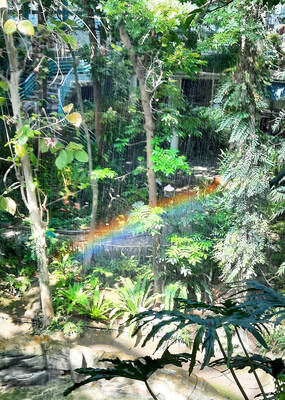
It’s only half the size of its more famous counterpart in Taipei, but the Botanical Garden of the National Museum of Nature Science (NMNS, 國立自然科學博物館植物園) is surely one of urban Taiwan’s most inviting green spaces. Covering 4.5 hectares immediately northeast of the government-run museum in Taichung’s North District (北區), the garden features more than 700 plant species, many of which are labeled in Chinese but not in English. Since its establishment in 1999, the site’s managers have done their best to replicate a number of native ecosystems, dividing the site into eight areas. The name of the Coral Atoll Zone might

On Monday morning, in quick succession, the Chinese Communist Party (CCP) and the Chinese Nationalist Party (KMT) released statements announcing “that the Central Committee of the Communist Party of China and General Secretary Xi Jinping (習近平) have invited KMT Chairwoman Cheng Li-wun (鄭麗文) to lead a delegation on a visit to the mainland” as the KMT’s press release worded it. The KMT’s press release added “Chairwoman Cheng expressed her gratitude for the invitation and has gladly accepted it.” Beijing’s official Xinhua news release described Song Tao (宋濤), head of the Taiwan Work Office of the CCP Central Committee, as
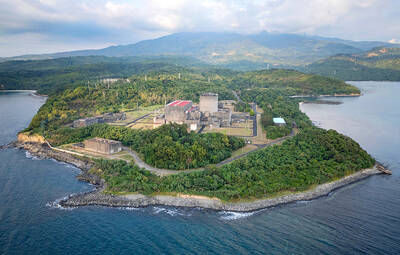
Nuclear power is getting a second look in Southeast Asia as countries prepare to meet surging energy demand as they vie for artificial intelligence-focused data centers. Several Southeast Asian nations are reviving mothballed nuclear plans and setting ambitious targets and nearly half of the region could, if they pursue those goals, have nuclear energy in the 2030s. Even countries without current plans have signaled their interest. Southeast Asia has never produced a single watt of nuclear energy, despite long-held atomic ambitions. But that may soon change as pressure mounts to reduce emissions that contribute to climate change, while meeting growing power needs. The


 RSS
RSS