


Last weekend in Naeba, Japan at the Fuji Rock Festival, I ran into the head of The Wall Music, Orbis Fu (傅鉛文) during Radiohead’s Sunday night set. He hinted that the Formoz Festival (野台開唱) may be making a comeback in 2013, which would definitely be good news. Japan now has about 30 summer music festivals, with both Fuji Rock and Summer Sonic acting as the twin Meccas for Asian rock fans. Korea also has two big festivals in Pentaport and the Jisan Valley Rock Festival that get Fuji Rock headliners and dwarf anything in Taiwan.
The closest we’ve got is Ho-Hai-Yan, which rock fans are starting to avoid because it is mainly a giant night market, and TWinkle Rock Festival, which kicks off next weekend with performances by Smashing Pumpkins (Aug. 10, tickets NT$2,500 to NT$3,500), Nelly Furtado with Bassment Jaxx and Go Chic (Aug. 11, tickets NT$2,000) and the post-grunge band Garbage (Aug. 15, tickets NT$2,500 to NT$3,500). Then six weeks from now it’s Noel Gallagher and the High Flying Birds (Sep. 27, tickets NT$2,500 to NT$3,500), which is basically like Oasis-lite, as Noel wrote most of the Oasis songs and has continued to perform them since the band broke up three years ago. (Noel Gallagher played Fuji Rock last weekend to mixed reviews, which is not to say he was terrible. He just wasn’t Oasis.)
In truth, TWinkle Rock really isn’t a festival at all. It’s just a concert series of headliner-type acts. Tickets for all the events are all sold separately, and there are none of the normal music festival benefits, like dozens or hundreds of bands to check out or anything that can be construed as a festival vibe.
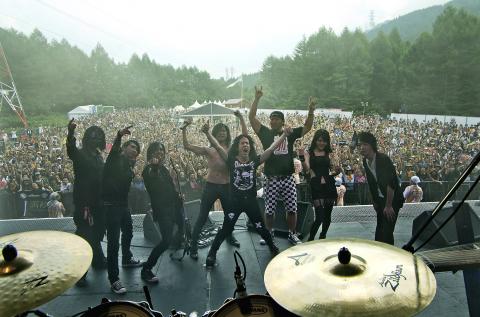
Photo courtesy of Chthonic
The promoter, Very Aspect (有像音樂), is one of two corporate-style concert promoters in Taiwan. In recent years they’ve been behind Justin Beiber, Massive Attack, the Pet Shop Boys and Bob Dylan. Now that the market is moving more into indie rock, so are they.
A few months ago, the Marilyn Manson show Very Aspect organized at Taipei Show Hall II (台北世貿展演二館) was unforgivably bad. There was no opening band, fans were still lining up to get into the venue when Manson started, the performance was terrible (not completely their fault), and they used a stupid system of putting a fence through the middle of the venue, so people who paid more were in the front of the room and people who paid less were in the back, like cattle. All the TWinkle Rock shows will be in the same room, and most will be using the same dumb system of separating the crowd. The line-up is not bad, but to be honest, your money would be better spent flying to Tokyo for Summer Sonic (Aug. 18 to 19, www.summersonic.com).
■ TWinkle Rock: www.twinklerockfestival.com
More Fuji Rock news, briefly. The Taiwanese bands Chthonic (閃靈) and Deserts Chang (張懸) were the only non-Japanese Asian bands to play the festival. (Take that, Korea!) Chang’s set at a smallish, hippie-themed stage called Gypsy Avalon included shout-outs to Spring Scream and an announcement that she has an album coming out in Japan next month. Chthonic’s set was on Fuji Rock’s second largest stage and surprised a lot of people with its heavyweight guests. These included one of Japan’s most famous kickboxers, Musashi, and former-Megadeth guitarist Marty Friedman, who performed one song with the band.
“Since we’ve performed several times in Japan during the last few years, we thought we should do something special for Fuji Rock,” says Freddy Lim (林昶佐), contacted by email after the festival. So Chthonic asked the Japanese metal label Howling Bull to contact Friedman, one of the band’s long-time idols. It turns out that Friedman was a big fan of a Chthonic concert DVD and happy to do the gig. The pro-fighter Musashi meanwhile had been known to the band since he surprisingly showed up at the afterparty of a Tokyo show a few years ago. “After that, we gradually became friends with him. This time he said he hoped he could come on stage and sing the song Takao with us. But the refrain is in Taiwanese, he had to specially practice,” said Lim.
After Fuji Rock, Chthonic flew to Germany to play Europe’s biggest headbanger’s ball, Wacken Open Air, while Megadeth, sans Freedman, is on their way to Taipei.
That’s right, Megadeth! Stretch out your necks! This is the only of metal’s “big four” to ever play Taiwan, having last visited in 2001 for the Formoz Festival. That gig was delayed by a menacing typhoon, and the band ended up taking the stage at a dilapidated warehouse at Huashan sometime after 3am on a Sunday night.
Typhoon Saola should be well gone by this Sunday, so expect a less jet-lagged performance this time around. Megadeth has been thrashing for 30 years and only one original member — lead singer Dave Mustaine — remains. They may not be the Megadeth of old, but reviews of the band’s ongoing Pacific-rim tour — so far Manila (during a typhoon), Bangkok and a Beijing show that was cancelled for the usual vague reasons — have been pretty good, and the sets have been concert-length. Masquerader, a thrash metal act, will open. If all goes well, this should be brutal.
■ Megadeth, Sun, Aug. 5, 7pm at ATT Showbox, 12 Songshou Rd, Taipei (台北市信義區松壽路12號). Tickets are NT$1,800 to NT$3,600 through WalkieTicket.com.
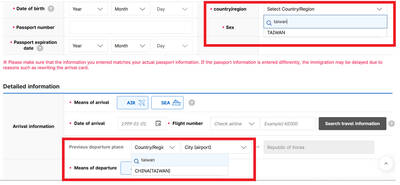
Jason Han says that the e-arrival card spat between South Korea and Taiwan shows that Seoul is signaling adherence to its “one-China” policy, while Taiwan’s response reflects a reciprocal approach. “Attempts to alter the diplomatic status quo often lead to tit-for-tat responses,” the analyst on international affairs tells the Taipei Times, adding that Taiwan may become more cautious in its dealings with South Korea going forward. Taipei has called on Seoul to correct its electronic entry system, which currently lists Taiwan as “China (Taiwan),” warning that reciprocal measures may follow if the wording is not changed before March 31. As of yesterday,
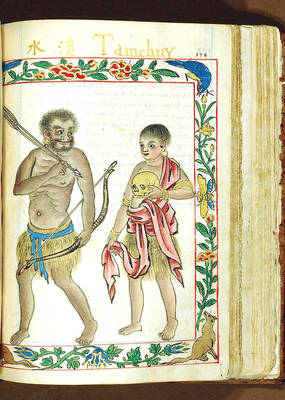
The Portuguese never established a presence on Taiwan, but they must have traded with the indigenous people because later traders reported that the locals referred to parts of deer using Portuguese words. What goods might the Portuguese have offered their indigenous trade partners? Among them must have been slaves, for the Portuguese dealt slaves across Asia. Though we often speak of “Portuguese” ships, imagining them as picturesque vessels manned by pointy-bearded Iberians, in Asia Portuguese shipping between local destinations was crewed by Asian seamen, with a handful of white or Eurasian officers. “Even the great carracks of 1,000-2,000 tons which plied
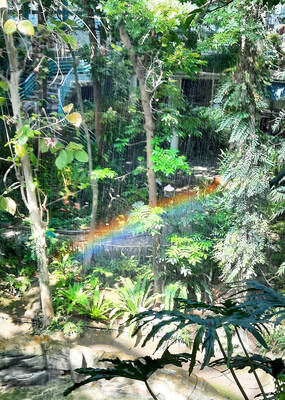
It’s only half the size of its more famous counterpart in Taipei, but the Botanical Garden of the National Museum of Nature Science (NMNS, 國立自然科學博物館植物園) is surely one of urban Taiwan’s most inviting green spaces. Covering 4.5 hectares immediately northeast of the government-run museum in Taichung’s North District (北區), the garden features more than 700 plant species, many of which are labeled in Chinese but not in English. Since its establishment in 1999, the site’s managers have done their best to replicate a number of native ecosystems, dividing the site into eight areas. The name of the Coral Atoll Zone might
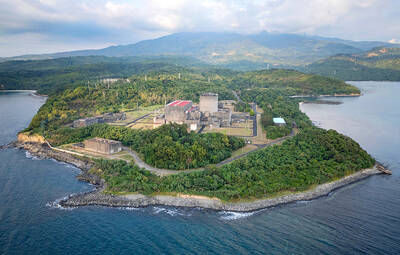
Nuclear power is getting a second look in Southeast Asia as countries prepare to meet surging energy demand as they vie for artificial intelligence-focused data centers. Several Southeast Asian nations are reviving mothballed nuclear plans and setting ambitious targets and nearly half of the region could, if they pursue those goals, have nuclear energy in the 2030s. Even countries without current plans have signaled their interest. Southeast Asia has never produced a single watt of nuclear energy, despite long-held atomic ambitions. But that may soon change as pressure mounts to reduce emissions that contribute to climate change, while meeting growing power needs. The


 RSS
RSS