


The BlackBerry Bold 9900, which came out in Taiwan earlier this year, checks off all of the important qualities in a smartphone. It’s fast, easy to use and many popular apps are available — there’s Facebook, Dropbox, Whatsapp and Angry Birds. The phone is well-built and sports a sleek look.
When I tested this latest version of the Blackberry Bold last month, my initial reaction was, yes, this is the smartphone I’ve always wanted! But not so fast. Problems remain for Research In Motion, the Canadian company that produces BlackBerry devices. Since the iPhone came out five years ago, RIM, which once set the benchmark for smartphones, has been perpetually stuck playing catch-up with Apple and Google, who now dominate the market.
Before I got an iPhone, I was a BlackBerry user. In 2008, I had the very first version of the BlackBerry Bold, the 9000, and I liked it very much. It was great for email, thanks to RIM’s instantly-gratifying push mail system, and a well-designed keyboard made it easy to type properly-spelled and properly-punctuated messages.
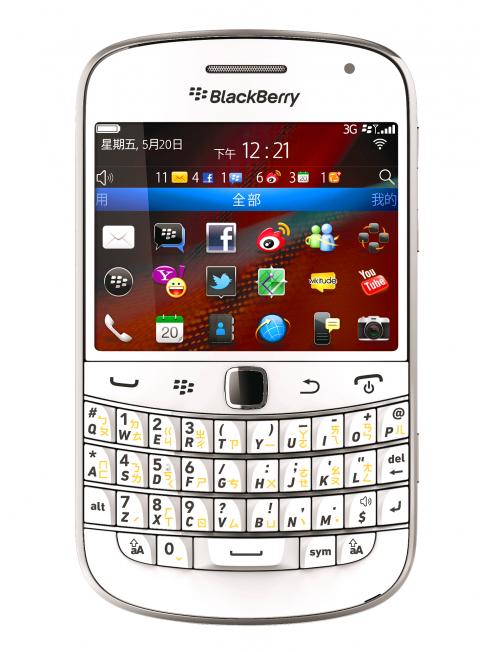
Photo Courtesy of Research in Motion
But the BlackBerry 9000’s quirks eventually grew tiring. It tended to crash a lot. Navigating the phone got to be laborious, especially since you had to move the cursor with a trackball that would get stuck from time to time. Good apps were hard to find and when you did find one, it was a hassle to download (the “App Store” was still a new idea then). The Web browser was sluggish.
By the time my phone contract was up, the iPhone looked more attractive than ever. I gave up the convenience of that clickety-smooth keyboard and BlackBerry’s renowned system for handling emails, and never looked back.
Most of these complaints have been addressed with the 9900, albeit a little late. The phone could be considered the best BlackBerry ever made, but is it likable enough to lure one away from iPhone or the latest and greatest Android handset?
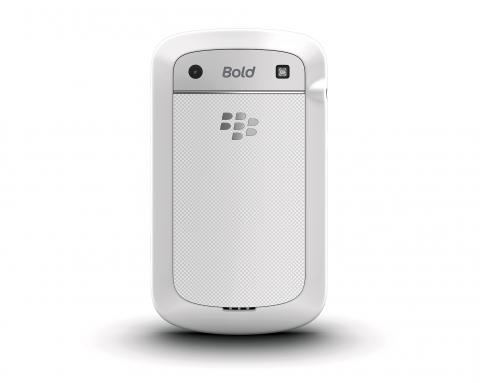
Photo Courtesy of Research in Motion
A straightforward answer doesn’t come easily, but there is plenty to like about the 9900.
The new Bold is impressive for how it combines the best of both worlds when it comes to smartphones. Typing is a breeze, thanks to that ever-so familiar and fantastic QWERTY keyboard, still the best around for mobile devices. But the 9900 is also up-to-date as a modern device, with a smooth and responsive touchscreen that is on par with any iPhone or Android device.
During the week and a half that I used the 9900, it never crashed and was quick in handling most apps, thanks to beefed-up hardware that includes a 1.2GHZ processor and 768MB of RAM.
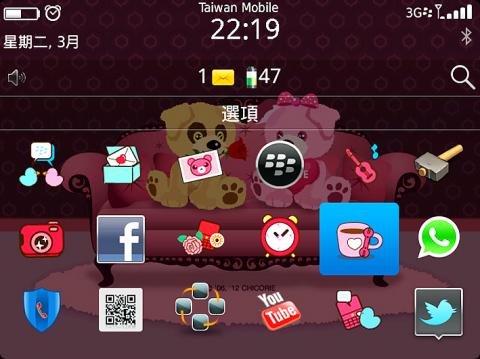
Photo Courtesy of Research in Motion
RIM has had touch capabilities available on its phones for several years, but with its latest operating system, BlackBerry OS 7, it feels like all the kinks have been worked out.
With the 9900, there’s no need to depend on the trackpad button (the square nub in the center) to move around because you can actually do the more logical thing: just tap directly on the screen. Tap on an app to open it, tap to select a menu item, flick to scroll through photos — I wish it were this easy back when I had my BlackBerry.
Web browsing also benefits from the touchscreen. You can pinch and zoom on Web pages, as you would on Android or iPhone. In general, pages load quickly, and the browser is on par with Android and iPhone.
Old-hand BlackBerry users will find that BlackBerry OS 7’s new home screen to be familiar, but with some notable twists. Above the keyboard sits the usual row of six app icons, which has now become a set of scrollable panels. Flick right or left to switch between different panels, which include favorites (which you can customize), multimedia and most frequently visited apps. Panels can also be expanded to fill most of the screen by swiping upward.
Overall, RIM does a good job in balancing the familiar elements of BlackBerry’s OS with new tricks. As usual, missed calls, calendar alerts and incoming messages are displayed at the top screen on BlackBerry phones. But now with the touchscreen, there’s added functionality: you can directly tap on an alert to do something about it, whether it’s return a call, check a calendar date or answer an email or Facebook message.
The 9900 retains the original BlackBerry Bold’s basic design, which is a good thing for traditionalists, but may turn off some people in a time where everyone loves touchscreen phones with big, honking screens. The 9900’s screen, around half of the size of the iPhone’s, can feel cramped and downright tiny, especially if you’re sifting through apps on the phone. But this helped me discover the very handy search bar, which churns out instant, and usually accurate, results. The search function works especially well when I wanted to find and open a particular app. And all you have to do to pull up a search panel is to start typing.
When it comes to apps, BlackBerry is a mixed bag. As mentioned before, you can find many apps popular on iPhone and Android, such as Whatsapp, Dropbox and Evernote. (One notable absence, though, is Skype). The overall selection on BlackBerry’s App World, however, is very limited, and given its late launch, it will continue to lag behind Google Play (the rebranded name for Android Market) and Apple’s App Store. It’s also worth bearing in mind that the latest and greatest apps will inevitably come out on iPhone and Android first.
The 9900 does have the basics covered for those who don’t need the frills or the latest games. Official apps for Twitter and Facebook are already installed and work well. BlackBerry’s Messenger app is good if you have a lot of contacts that are also BlackBerry users; I was pleasantly surprised by the inclusion of BlackBerry’s Maps app, which worked just as well as the Google app for iPhone.
For Taiwanese users, the 9900’s QWERTY keyboard is also marked with Zhuyin Fuhao (注音符號, commonly known as bopomofo) symbols for typing traditional Chinese characters. (Students of Mandarin in Taiwan interested in this phone might be interested to know that you can use Hanyu Pinyin to input traditional characters.)
In the style department, the 9900 is up there with the iPhone. The white model (it’s also available in black) loaned to the Taipei Times was a nice example of artful and functional industrial design. Weighing 130g, the metal side frame gives the phone a solid, hefty feel. The front face of the phone is plastic, but there is no creakiness as with many of the high-end Android phones, and the backside is a removable carbonite lid that covers the battery. The phone is svelte, measuring 11mm thick (RIM says it’s the thinnest BlackBerry yet) and fits in the pocket easily. Size-wise it’s just a little wider and longer than the iPhone 4 and 4S.
The 9900’s other hardware features are standard for a high-end phone: the 5-megapixel camera is average for a smartphone of this price, which is to say they take decent snapshots. The 480 x 680 screen, while not as good as iPhone’s so-called “retina” screen, is still pin-sharp.
Internal storage is 8 gigabytes; if that’s not enough, you can add an SD Card of up to 32 gigabytes.
The 9900 will appeal most to die-hard BlackBerry fans, but I won’t be giving up my iPhone anytime soon. The 9900 is the phone that RIM needed to make four years ago, when Android was just starting to establish itself as a formidable challenger to Apple. If you’re someone who likes to keep up with the latest and greatest apps, the 9900 or any BlackBerry is not a great choice, given that RIM’s still needs to catch up in creating a marketplace selling good software. The company may have a stylish and up-to-date handset with the 9900, but today it’s merely one nice smartphone in a world of many nice smartphones.
The BlackBerry 9900 retails for NT$19,900 and is available through Taiwan Mobile and Chunghwa Telecom.
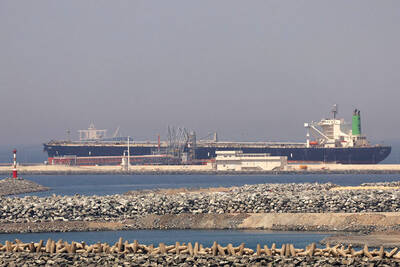
The breakwater stretches out to sea from the sprawling Kaohsiung port in southern Taiwan. Normally, it’s crowded with massive tankers ferrying liquefied natural gas from Qatar to be stored in the bulbous white tanks that dot the shoreline. These are not normal times, though, and not a single shipment from Qatar has docked at the Yongan terminal since early March after the Strait of Hormuz was shuttered. The suspension has provided a realistic preview of a potential Chinese blockade, a move that would throttle an economy anchored by the world’s most advanced and power-hungry semiconductor industry. It is a stark reminder of
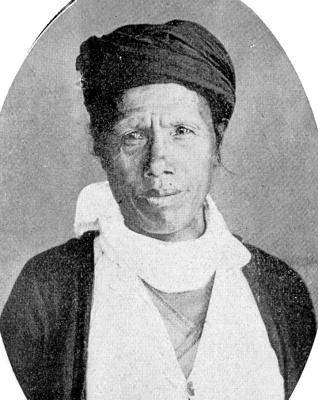
May 11 to May 17 Traversing the southern slopes of the Yushan Range in 1931, Japanese naturalist Tadao Kano knew he was approaching the last swath of Taiwan still beyond colonial control. The “vast, unknown territory,” protected by the “fierce” Bunun headman Dahu Ali, was “filled with an utterly endless jungle that choked the mountains and valleys,” Kano wrote. He noted how the group had “refused to submit to the measures of our authorities and entrenched themselves deep in these mountains … living a free existence spent chasing deer in the morning and seeking serow in the evening,” even describing them as

As a different column was being written, the big news dropped that Chinese Nationalist Party (KMT) caucus whip Fu Kun-chi (傅?萁) announced that negotiations within his caucus, with legislative speaker Han Kuo-yu (韓國瑜) of the KMT, party Chair Cheng Li-wun (鄭麗文), Taichung Mayor Lu Shiow-yen (盧秀燕) and Taiwan People’s Party (TPP) Chair Huang Kuo-chang (黃國昌) had produced a compromise special military budget proposal. On Thursday morning, prior to meeting with Cheng over a lunch of beef noodles, Lu reiterated her support for a budget of NT$800 or NT$900 billion — but refused to comment after the meeting. Right after Fu’s
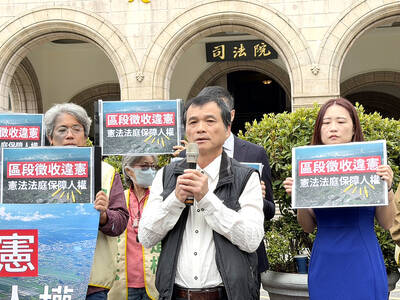
What government project has expropriated the most land in Taiwan? According to local media reports, it is the Taoyuan Aerotropolis, eating 2,500 hectares of land in its first phase, with more to come. Forty thousand people are expected to be displaced by the project. Naturally that enormous land grab is generating powerful pushback. Last week Chen Chien-ho (陳健和), a local resident of Jhuwei Borough (竹圍) in Taoyuan City’s Dayuan District (大園) filed a petition for constitutional review of the project after losing his case at the Taipei Administrative Court. The Administrative Court found in favor of nine other local landowners, but


 RSS
RSS