


Old-style wooden Japanese houses have had a rough time over the last few decades, many left to moulder away, neglected or abandoned, if they have not been utterly demolished to make way for soulless modern apartments. A few have been the subject of high profile government sponsored restoration projects, and this has provided an impetus for the private sector, who have also begun to see the potential of these old buildings. The Japanese restaurant Fireweeds (野草居食屋), which opened last week just off Tongan Street in Taipei’s Zhongzheng District (中正區), is a splendid example of what can be achieved when the restoration project is approached with the right balance of ambition and humility.
The restaurant references the name of the original house, which belonged to a professor of agricultural chemistry at National Taiwan University who was known for his important work on wild grasses and weed control. The interior of the house also retains the original wooden beams, which are exposed, giving the low dining area much greater height. The overall effect is of a refined rusticity rather than luxury, which fits in with the style of food that is served.
The menu is elegant both in design and in content, with the usual standards mixed in with some unexpected items to tempt the tastebuds. A mixed sashimi platter (綜合生魚片, NT$350) came with a bowl of marinated salmon that put a totally new spin on this rather weary standard. It was notable particularly due to the careful balancing of the marinade, which was quite spicy, but did not overwhelm the flavor of the fish.
Photo: Ian Bartholomew, Taipei Times
The platter was a good indicator of the philosophy behind Fireweeds. It provides good food and interesting flavors to be eaten in a spirit of bonhomie, best enjoyed with friends along with a few glasses of beer or sake. Fireweeds has a good selection of high quality sakes, bottled Kirin beer (NT$150 for 630ml) and draft Asahi beer (NT$100 for 340ml). These are ideally suited to washing down the vast array of good things that come from the semi-open kitchen located behind a dining counter.
From subtly flavored cold noodle dishes to big flavors of grilled meats, the chefs at Fireweeds do a splendid job of providing variety and interest, making Fireweeds suitable for a late night snack of a couple of dishes, to a knees-up with abundant food and drink.
A particular favorite at Fireweeds is the cold udon noodles (烏龍涼麵, NT$100), which are light and cool, though the noodles themselves have a firm, almost robust quality and the broth a deep, memorable flavor. The fried udon noodles (炒烏龍麵, NT$120), is also delicious, though not as outstanding, but serves as an excellent filler to go with a selection of skewers or with grilled fish.
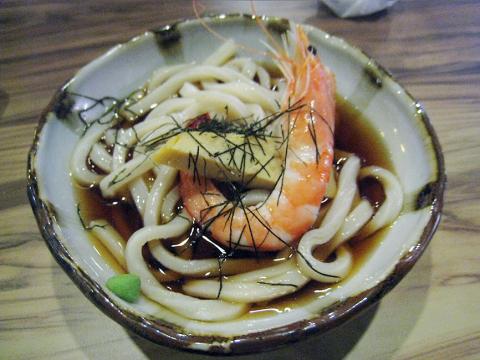
Photo: Ian Bartholomew, Taipei Times
Fireweeds offers a wide range of skewers, the most interesting of which are the cheese and yogurt pork skewers (起士優格豬串燒, NT$150 for three), which add a luscious milkiness to the lean pork loin. Lamb, chicken, duck and a variety of seafoods are also offered on skewers, with prices ranging from NT$80 for grilled green peppers to NT$240 for abalone.
Grilled fish also lend themselves to being picked over while talking and drinking, and Fireweeds offers a wide variety in this category as well, from grilled ayu (烤香魚, NT$180) to thick cuts of grilled cod (烤圓鱈西京燒, NT$360). This latter is one of the highlights of the grill menu, with the flavor of the cod intensified by long marinating in a sweet miso paste.
With its emphasis on strongly flavored foods that go well with alcoholic beverages, Fireweeds resembles an izakaya, a traditional Japanese style drinking shop, except that it offers a wider range of food. As with conventional izakaya, there is a bar counter at which guests can sit and watch the chefs at work, as well as tables where larger parties can congregate.
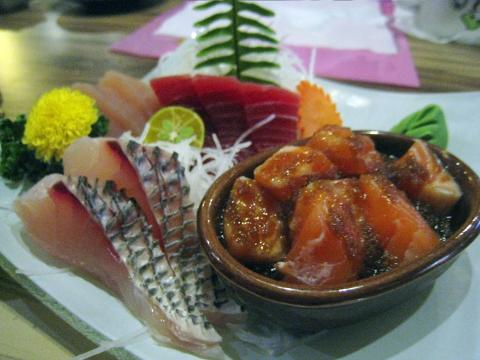
Photo: Ian Bartholomew, Taipei Times
Oddly, the slightly rustic vibe of Fireweeds is enhanced by the casual attire of the staff, mostly young women in denim shorts, cotton T-shirts and canvas sneakers, which is reminiscent of an American diner. The service is quick and helpful but not very sophisticated, and only the simplest explanations about the dishes can be elicited from staff.
Interesting surroundings, good food and a vibrant atmosphere make Fireweeds a good addition to the middle price range of Japanese dining.

If one asks Taiwanese why house prices are so high or why the nation is so built up or why certain policies cannot be carried out, one common answer is that “Taiwan is too small.” This is actually true, though not in the way people think. The National Property Administration (NPA), responsible for tracking and managing the government’s real estate assets, maintains statistics on how much land the government owns. As of the end of last year, land for official use constituted 293,655 hectares, for public use 1,732,513 hectares, for non-public use 216,972 hectares and for state enterprises 34 hectares, yielding

The small platform at Duoliang Train Station in Taitung County’s Taimali Township (太麻里) served villagers from 1992 to 2006, but was eventually shut down due to lack of use. Just 10 years later, the abandoned train station had become widely known as the most beautiful station in Taiwan, and visitors were so frequent that the village had to start restricting traffic. Nowadays, Duoliang Village (多良) is known as a bit of a tourist trap, with a mandatory, albeit modest, admission fee of NT$10 giving access to a crowded lane of vendors with a mediocre view of the ocean and the trains

For many people, Bilingual Nation 2030 begins and ends in the classroom. Since the policy was launched in 2018, the debate has centered on students, teachers and the pressure placed on schools. Yet the policy was never solely about English education. The government’s official plan also calls for bilingualization in Taiwan’s government services, laws and regulations, and living environment. The goal is to make Taiwan more inclusive and accessible to international enterprises and talent and better prepared for global economic and trade conditions. After eight years, that grand vision is due for a pulse check. RULES THAT CAN BE READ For Harper Chen (陳虹宇), an adviser

Traditionally, indigenous people in Taiwan’s mountains practice swidden cultivation, or “slash and burn” agriculture, a practice common in human history. According to a 2016 research article in the International Journal of Environmental Sustainability, among the Atayal people, this began with a search for suitable forested slopeland. The trees are burnt for fertilizer and the land cleared of stones. The stones and wood are then piled up to make fences, while both dead and standing trees are retained on the plot. The fences are used to grow climbing crops like squash and beans. The plot itself supports farming for three years.


 RSS
RSS