


This afternoon, folk musicians and artists from Greenland, Finland, Tuva, Inner Mongolia and Taiwan will be congregating at a Taiwanese Aboriginal village in the mountains of Hsinchu County to perform at the Gathering for Indigenous Peoples’ Dance and Music (音樂上山.部落樂舞會).
The free event, which is being organized by the Indigenous Peoples Cultural Foundation (原住民族文化事業基金會), a Taipei-based nonprofit group, and world music label Trees Music and Art (大大樹音樂圖像), aims to bring together indigenous artists and performers from across the globe.
The event was also conceived as venue for cultural exchange and a study opportunity for Atayal youths in Jianshih Township (尖石鄉), according to a press release from the organizers. The visiting performers have spent the past week living in the township, holding music and dance workshops for students of all ages at Sinle Elementary School (新樂國小), where today’s performances will be held.

Photos courtesy of Trees Music and Art
Tuvan-style throat-singing was among the musical styles that the students got to try, and visitors at Sinle Village today will get to hear such music today when Yat-Kha takes to the stage as one of the headlining groups.
Led by singer Albert Kuvezin, Yat-Kha performs the folk music of its homeland, Tuva, an autonomous Russian state bordering Mongolia and Siberia. Kuvezin is known for combining throat-singing with heavy metal and hard rock, as well as avant-garde music.
Another pair of far-flung musicians, Ailo and Inger Biret Gaup of Norway, will perform traditional yoiks, an a cappella song form. The Gaups, a brother-sister duo, are Sami, an indigenous group that is spread across the Arctic regions of Finland, Sweden and Norway.
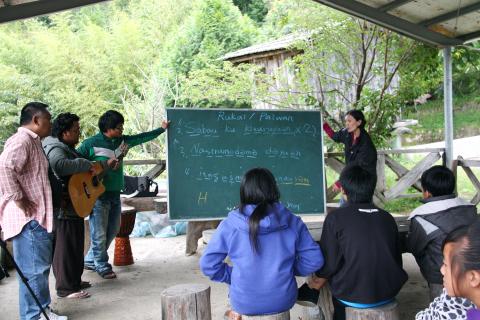
Photo courtesy of Trees Music and Art
There will also be a mask and dance performance by Norwegian actor Kristian Molgaard, who is of Inuit descent and was born in Greenland.
Rounding out the program are Mongolian female vocalist Urna Chahar-Tugchi and local Aboriginal performers, including Atayal singer Inka Mbing (雲力思), Paiwan vocalist Ngner-ngner (林廣財) and Amis indie-pop musician Suming (舒米恩).
The students who participated in this week’s workshops also get to show off what they learned. Dubbed “the Atayal Youth Creativity Camp” (泰雅部落青少年), audiences can expect to hear Atayal youths performing Tuvan folk songs, Sami yoiks and Inuit dances, among the indigenous art styles featured this afternoon.
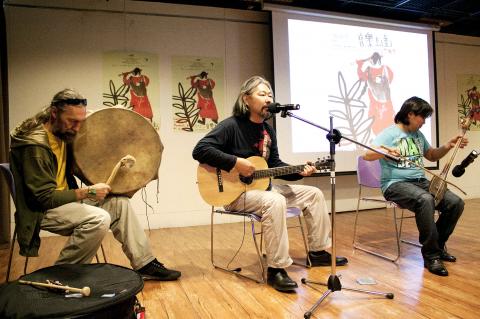
Photo courtesy of Trees Music and Art
If one asks Taiwanese why house prices are so high or why the nation is so built up or why certain policies cannot be carried out, one common answer is that “Taiwan is too small.” This is actually true, though not in the way people think. The National Property Administration (NPA), responsible for tracking and managing the government’s real estate assets, maintains statistics on how much land the government owns. As of the end of last year, land for official use constituted 293,655 hectares, for public use 1,732,513 hectares, for non-public use 216,972 hectares and for state enterprises 34 hectares, yielding

The small platform at Duoliang Train Station in Taitung County’s Taimali Township (太麻里) served villagers from 1992 to 2006, but was eventually shut down due to lack of use. Just 10 years later, the abandoned train station had become widely known as the most beautiful station in Taiwan, and visitors were so frequent that the village had to start restricting traffic. Nowadays, Duoliang Village (多良) is known as a bit of a tourist trap, with a mandatory, albeit modest, admission fee of NT$10 giving access to a crowded lane of vendors with a mediocre view of the ocean and the trains

For many people, Bilingual Nation 2030 begins and ends in the classroom. Since the policy was launched in 2018, the debate has centered on students, teachers and the pressure placed on schools. Yet the policy was never solely about English education. The government’s official plan also calls for bilingualization in Taiwan’s government services, laws and regulations, and living environment. The goal is to make Taiwan more inclusive and accessible to international enterprises and talent and better prepared for global economic and trade conditions. After eight years, that grand vision is due for a pulse check. RULES THAT CAN BE READ For Harper Chen (陳虹宇), an adviser

Traditionally, indigenous people in Taiwan’s mountains practice swidden cultivation, or “slash and burn” agriculture, a practice common in human history. According to a 2016 research article in the International Journal of Environmental Sustainability, among the Atayal people, this began with a search for suitable forested slopeland. The trees are burnt for fertilizer and the land cleared of stones. The stones and wood are then piled up to make fences, while both dead and standing trees are retained on the plot. The fences are used to grow climbing crops like squash and beans. The plot itself supports farming for three years.


 RSS
RSS