


Russian director Aleksander Sokurov’s Faust, a new take on the German legend about the quest for knowledge at all cost, has won the Golden Lion prize at the Venice Film Festival.
Faust tells the tale of a professor, played by Johannes Zeiler, who craves knowledge and sells his soul for the love of Margarete, played by Isolda Dychauk. The Mephistopheles character is played by Anton Adasinskiy.
Dense and difficult to watch, Faust was nevertheless one of the critics’ top choices among the 23 in-competition films at Venice this year. It marks the final chapter in Sokurov’s four-film look at the relationship between man and power that began with Moloch in 1999 about Hitler, Taurus a year later about Lenin and the 2005 film The Sun about Japanese Emperor Hirohito.
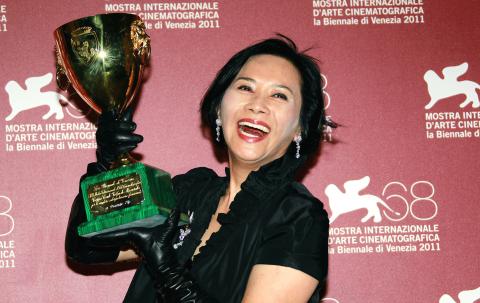
Photo: Reuters
At a post-award news conference Saturday, Sokurov made an impassioned plea for governments to continue supporting culture with state funds.
“Culture is not a luxury! It is the basis for the development of the society,” he said, adding that he had even raised the issue with Russian Prime Minister Vladimir Putin in a phone call just after he won. “And so I am making an appeal to the Italian minister of culture: Thank you for existing! Insist with all methods you have on keeping culture.’’
Sokurov said working with the German cast was one of the most impressive experiences he has had in years, even if he still wonders whether a German director would have been better suited for the task.
“German culture is a fundamental one in Europe,” he said.
Venice’s best actor award went to Michael Fassbender for his portrayal as a sex addict in Steve McQueen’s Shame, while the best actress award went to Deanie Ip (葉德嫻), who plays an aging domestic servant opposite her master in Hong Kong director Ann Hui’s (許鞍華) A Simple Life (桃姐).
“I can’t believe how young and beautiful and sexy this woman is!’’ jury chair Darren Aronofsky gushed of Ip after the awards ceremony. He said the jury, which included David Byrne and Andre Techine, was moved by the message of Hui’s film.
“It’s an issue we deal with in every part of the world and ... to see a journey from health to death with such generosity was very touching,” he said of A Simple Life.
Ip, for her part, said the film made her realize that she wasn’t getting any younger.
“I don’t want to be a burden to anybody, and I really don’t want to go to a senior home, so I will start planning when I go back to Hong Kong,” she said.
Fassbender said he never had a doubt about taking on the graphic role of Brandon, a 30-something Manhattanite obsessed with sex. He said he had full faith in McQueen after taking part in his 2008 film Hunger, which won the new director’s prize in Cannes.
“He mentioned this to me in 2008 but I didn’t need a script,” Fassbender told reporters. “I was always going to jump on board with Steve. He always addresses the elephant in the room, and it was a matter of me not letting him down.”
The Silver Lion prize for best director went to this year’s surprise entry at the Lido, Beijing-based Shangjun Cai (蔡尚君) for People Mountain People Sea (人山人海). And the special jury prize went to the Italian-French production Terraferma, about the influx of migrants to a tiny Italian island, by Emanuele Crialese.
All contenders at the world’s oldest film festival were world premieres.
The Winners
Russian director Alexander Sokurov’s Faust, loosely based on Goethe’s classic German text, won the Golden Lion for best picture at the Venice Film Festival on Saturday. Following is a list of all the main prize winners decided by a jury led by US director Darren Aronofsky.
BEST FILM GOLDEN LION: Faust, by Alexander Sokurov (Russia)
BEST DIRECTOR SILVER LION: Shangjun Cai (蔡尚君), for People Mountain People Sea (人山人海) (China)
SPECIAL JURY PRIZE: Terraferma, by Emanuele Crialese (Italy)
BEST FIRST FEATURE: La-Bas, by Guido Lombardi (Italy)
BEST ACTRESS: Deanie Ip (葉德嫻), for A Simple Life (桃姐) (Hong Kong)
BEST ACTO: Michael Fassbender, for Shame (Britain)
EMERGING PERFORMER: Shota Sometani and Fumi Nikaidou, for Himizu (Japan)
BEST SCREENPLAY: Alpis (Alps), by Yorgos Lanthimos (Greece)
BEST CINEMATOGRAPHY: Wuthering Heights, directed by Andrea Arnold (Britain)
Source: Reuters
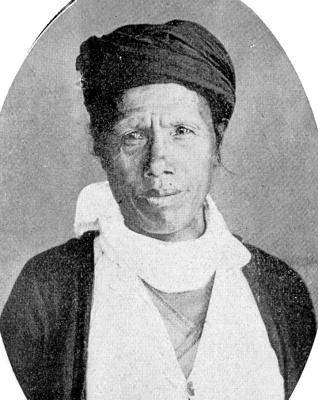
May 11 to May 17 Traversing the southern slopes of the Yushan Range in 1931, Japanese naturalist Tadao Kano knew he was approaching the last swath of Taiwan still beyond colonial control. The “vast, unknown territory,” protected by the “fierce” Bunun headman Dahu Ali, was “filled with an utterly endless jungle that choked the mountains and valleys,” Kano wrote. He noted how the group had “refused to submit to the measures of our authorities and entrenched themselves deep in these mountains … living a free existence spent chasing deer in the morning and seeking serow in the evening,” even describing them as

As a different column was being written, the big news dropped that Chinese Nationalist Party (KMT) caucus whip Fu Kun-chi (傅?萁) announced that negotiations within his caucus, with legislative speaker Han Kuo-yu (韓國瑜) of the KMT, party Chair Cheng Li-wun (鄭麗文), Taichung Mayor Lu Shiow-yen (盧秀燕) and Taiwan People’s Party (TPP) Chair Huang Kuo-chang (黃國昌) had produced a compromise special military budget proposal. On Thursday morning, prior to meeting with Cheng over a lunch of beef noodles, Lu reiterated her support for a budget of NT$800 or NT$900 billion — but refused to comment after the meeting. Right after Fu’s

Yesterday, the Democratic Progressive Party (DPP) nominated legislator Puma Shen (沈伯洋) as their Taipei mayoral candidate, the Chinese Nationalist Party (KMT) put their stamp of approval on Wei Ping-cheng (魏平政) as their candidate for Changhua County commissioner and former legislator Tsai Pi-ru (蔡壁如) of the Taiwan People’s Party (TPP) has begun the process to also run in Changhua, though she has not yet been formally nominated. All three news items are bizarre. The DPP has struggled with settling on a Taipei nominee. The only candidate who declared interest was Enoch Wu (吳怡農), but the party seemed determined to nominate anyone
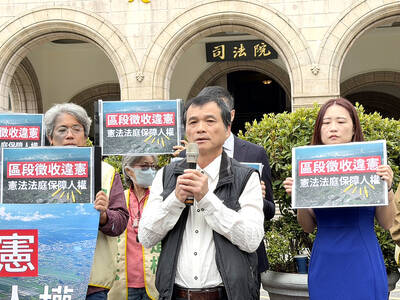
What government project has expropriated the most land in Taiwan? According to local media reports, it is the Taoyuan Aerotropolis, eating 2,500 hectares of land in its first phase, with more to come. Forty thousand people are expected to be displaced by the project. Naturally that enormous land grab is generating powerful pushback. Last week Chen Chien-ho (陳健和), a local resident of Jhuwei Borough (竹圍) in Taoyuan City’s Dayuan District (大園) filed a petition for constitutional review of the project after losing his case at the Taipei Administrative Court. The Administrative Court found in favor of nine other local landowners, but


 RSS
RSS