


The Killer Who Never Kills (殺手歐陽盆栽)
Adapted from a short story by best-selling writer Jiubadao (九把刀 or “Nine Knives,” real name Giddens Ko, 柯景騰) and starring pop idol Jam Hsiao (蕭敬騰), this genre flick packs action, romance and comedy into a 108-minute ride aimed at young audiences. Hsiao plays Ouyang, a reluctant hit man who prefers caring for plants to killing people. He is contracted to work for a ruthless underworld boss, but instead of carrying out his assignments, he puts together a team to save his targets. The story has great potential to be funny, and the movie does have several bright moments, such as a self-reflexive joke about Hsiao’s rise from the talent show One Million Star (超級星光大道). Unfortunately, director Li Feng-po (李豐博) needs to work on his character development skills, as the film is populated with cardboard cutouts.
Submarine
British coming-of-age comedy of adolescent sexual frustration that manages to put a fresh spin on a well-worn genre. The debut feature of Richard Ayoade, probably best known as the computer geek Moss in The IT Crowd, Submarine tells the story of Oliver Tate, whose objectives in life are to lose his virginity before his next birthday and to extinguish the relationship between his mother and an ex-lover who has come back into her life. It blends foot-in-mouth tactlessness with endearing naivete to create characters with no sense of how their words and actions affect others. Smart screenplay that is amusing and touching by turns, and a willingness to dig into the real issues of growing up, make this an unusually satisfying movie.
The Joneses
An amusing concept comedy about an apparently perfect family. They have the best of everything and are the envy of everyone. In fact, the Joneses are not a family at all, but a marketing unit aimed at encouraging everyone else to keep up with the latest products. The “family” members, headed by Demi Moore and David Duchovny, inevitably encounter problems with their own sense of self and their total lack of integrity in everything they do and say. The clever script goes with the clever idea, and there is a real irony in the film as its subject makes product placement necessary rather than purely mendacious and venal.
Midnight in Paris
The latest of Woody Allen’s romantic comedies is a rather fluffy concoction, but it has the virtue of a partial return of his comic wit, which has been sadly off form for some of his more recent releases. Allen’s love affair with Europe is still in full swing, and for Midnight in Paris he allows himself to indulge a love for the City of Light. Helping him to do this are Owen Wilson and Rachel McAdams, an unlikely duo for such a task. Through a quirk of time, Owen finds himself wondering through a Paris of the 1920s, meeting a host of famous names played as a string of wonderful cameos played by another string of famous names, including Adrien Brody as Salvador Dali. A delightful puff pastry of a film — luscious but essentially empty.
Lover’s Discourse (戀人絮語)
Movie made up of six love stories woven together to create a picture of love in all its many forms. Eason Chan (陳奕迅), Karena Lam (林嘉欣), Mavis Fan (范曉萱) and Eddie Peng (彭于晏) head up the strong cast of beautiful people who inhabit the film, flitting between tales of love triangles, unrequited love, self love, lost love, passionate love and tragic love. Directed by Derek Tsang (曾國祥), son of the veteran director Eric Tsang (曾志偉), the film cleverly intertwines the stories to give its rather whimsical material some sense of unity. The cast is assured enough to carry this insubstantial material for a moody two hours of gently amorous reflection.
Beat the World
Hip-hop crews from around the world gather once again, this time for a dance contest in Detroit with a US$100,000 prize. Yuson (Tyron Brown) believes he can lead his crew to a victory that will give him a down payment on making the big time. The gimmick, and there always is a gimmick, is that he will mix dance with parkour, an extreme sport involving daredevil stunts. There are of course rivals who will do anything to stop him, and romantic encounters with a female crew. Packed with cliches, but plenty of dance moves and an inspiring message for those who need it.
Red Mist
Kenneth is a bit of a misfit, but at a student party he tries to fit in by participating in a drinking game and ends up in a coma. His “friends” leave him for dead. In his comatose state, he manages to manipulate those around him, killing them one by one. Catherine (Arielle Kebbel) has a bit of a conscience but not nearly enough to make her really sympathetic, and the rest of the interchangeable young people clearly deserve everything they get. Adequate slasher material vaguely reminiscent of the much better Australian film Patrick (1978).
Flamenco, Flamenco
Big splashy movie showcasing contemporary flamenco performances. Gorgeous to look at and filled with skillful dancers, the film shows the new directions that flamenco has taken in the hands of some of its newest and most innovative practitioners. From director Carlos Saura, whose 1995 documentary Flamenco, to which this is something of a sequel, received glowing reviews. A must for dance fans.
Troubleshooter
Conspiracy thriller from South Korean director Kwon Hyeok Jae that offers loads of fast-paced action and high-tech treachery. Starring Sol Kyung-gu, best known for his starring role in the popular action franchise Public Enemy. The director keeps him busy as he battles his way through a slew of villains and corrupt bureaucrats. The action is embedded in a competently woven plot that mixes revelations and twists, keeping the audience involved to the very end. Good, old-fashioned action thriller.

Taiwan’s English education system is being pulled apart by three opposing forces. Bilingual Nation 2030 pulls students toward English and global communication. Artificial Intelligence (AI) readiness pulls them toward digital judgment, verification and AI-mediated work. But Taiwan’s old exam culture pulls them back toward memorization, grammar drills, timed reading and correct answers. If the education system keeps using old exams to define success, it risks producing graduates who are neither genuinely bilingual nor genuinely AI-ready, but trained for tasks machines can already perform. The first force is Bilingual Nation 2030. Launched in 2018, the policy aimed to “help Taiwan’s workforce connect

It seems every few days one bumps into one of those “real man” comments in which Taiwan is urged to “face reality” or similar, and “make a deal,” with the speaker implying that soon it will be too late. “Deal” advocates always present themselves as having a superior grip on reality, and the manly ability to make the “hard choice.” Their testosterone-laden language often echoes that of Taiwan sellout advocates. Note that such commentary always specifies a process (“make a deal, work with, make progress”), never the end state of what occupation by a violent authoritarian colonialist state will entail. In

“Taiwan’s Opposition Leader Comes to US With a Message Straight Out of Beijing” read a May 31 headline in the Wall Street Journal. Top US administration officials and members of Congress almost certainly read the WSJ, and if there was a bullet point takeaway that people in Washington should absorb ahead of Chinese Nationalist Party (KMT) Chair Cheng Li-wun’s (鄭麗文) arrival in DC on June 9, that headline is it. The last few columns have discussed this very topic, and the timing is not coincidental. While those top officials likely do not read the Taipei Times, judging by the number
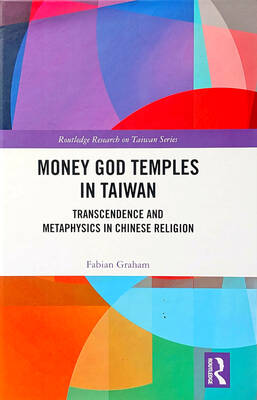
As someone who normally steers clear of books with “transcendence” or “metaphysics” in their subtitles, this reviewer — a casual observer of local belief systems since the 1990s — found Fabian Graham’s Money God Temples in Taiwan a challenging read. Those who’ve only dipped their toes into temple culture will likely need to parse several sections with special care if they’re to keep up with the author, a British ethnographic researcher whose previous books have investigated religious practices among ethnic Chinese in Southeast Asia. This scholarly volume examines a facet of Taiwan’s religious landscape that didn’t exist a century ago, and


 RSS
RSS