


Since opening last year in Bellavita mall’s food court, Sanyuan’s (三源) creative variations on soup dumplings have earned it a roster of celebrity clients, including Edison Chen (陳冠希), whose autograph graces a bamboo steamer. Taipei-based food bloggers have also gone wild over Sanyuan’s chocolate xiaolongbao (巧克力小籠包, NT$220 for five), and with good reason.
Filled with molten hot chocolate and wrapped in chewy rice cake, the xiaolongbao are worth every calorie. Freshly prepared (make sure to order them at the beginning of your meal), they arrive at your table steaming hot. Wait a minute or two for the steamer to cool down and then gently pick up one of the chubby little dumplings with your chopsticks. Take a bite and enjoy the wonderful feeling of the rice cake giving way as your teeth slice through it and the creamy chocolate as it envelops your tongue. Five dumplings aren’t nearly enough, especially if you are splitting them with a companion.
Sanyuan has been featured by several Japanese media outlets and some of their items, such as the “superb xiaolongbao” (御品小籠包), which cost NT$500 for a steamer of five, seem designed to grab the attention of tourists willing to splurge on a novelty. The pork filling with lots of tiny shrimp and plump pieces of scallop was tasty and the bit of gold leaf that graced each dumpling added an amusingly luxe touch, but they were still not worth NT$100 each.
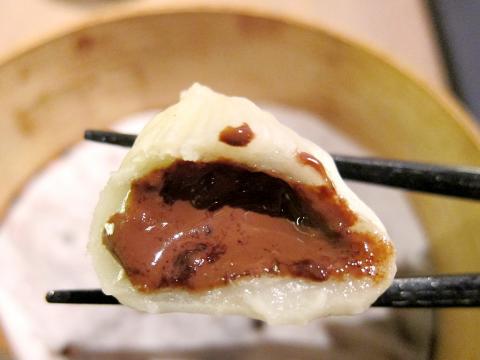
Photo: Catherine Shu, Taipei Times
Money is much better spent on Sanyuan’s version of the classic steamed crab roe and pork xiaolongbao (21摺小籠包, NT$280 for eight). The dumplings’ freshly made wrappers are thin but have just enough spring when you bite through them, and each is filled with rich, savory juice.
The menu features several items flavored with Li Xue (李雪) chili sauces and oils, which are named after the television personality who launched the condiment line. Li based her recipes on her Sichuan-born mother’s home cooking. The dishes are ranked in order of spiciness; not wanting to test my luck, I went with the mildest version of the Li Xue chili fried rice (李雪辣椒炒飯, NT$160). It was prepared with a liberal amount of chili oil, but not to the point of greasiness. On a separate visit, I ordered the Li Xue chili knife noodles (李雪油撥辣子刀削麵, NT$200), also in the mild version. The noodles, cut directly from a block of dough, were wonderfully al dente. There were just enough Sichuan peppers used in the chili oil to make my tongue tingle pleasantly, but neither dish was particularly piquant, even though my waiter had warned me that Sanyuan’s “mild” dishes are still quite spicy. Both were delicious, but anyone who wants flames shooting from their mouths should try the “super hot” (極辣) versions.
Sanyuan caters to vegetarian clientele with plenty of clearly marked meatless dishes. The steamed loofah xiaolongbao (翡翠絲瓜小籠包, NT$260) had a very delicate flavor, with just a touch of sweetness. The moist chunks of loofah provided a unique textural contrast to the dumpling wrapper. Another of Sanyuan’s specialties is fresh mantou (手工饅頭), which look like little hedgehogs with rows upon rows of spikes and a tiny snout, all shaped out of dough. The mantou aren’t extraordinary tasting, but at NT$70 for three, they are the least expensive thing on the menu and incredibly cute.
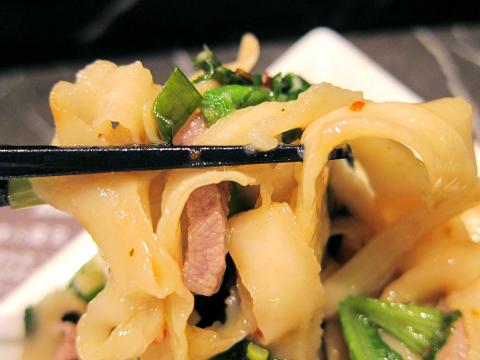
Photo: Catherine Shu, Taipei Times
Sanyuan’s staffers are very attentive and quick to answer all questions about the restaurant’s food. Despite being located in one of the most ridiculously opulent luxury malls in Taipei, Sanyuan maintains a casual atmosphere, with an open kitchen and caricatures of the cooks and servers illustrating the menus and placemats.

Taiwan’s English education system is being pulled apart by three opposing forces. Bilingual Nation 2030 pulls students toward English and global communication. Artificial Intelligence (AI) readiness pulls them toward digital judgment, verification and AI-mediated work. But Taiwan’s old exam culture pulls them back toward memorization, grammar drills, timed reading and correct answers. If the education system keeps using old exams to define success, it risks producing graduates who are neither genuinely bilingual nor genuinely AI-ready, but trained for tasks machines can already perform. The first force is Bilingual Nation 2030. Launched in 2018, the policy aimed to “help Taiwan’s workforce connect
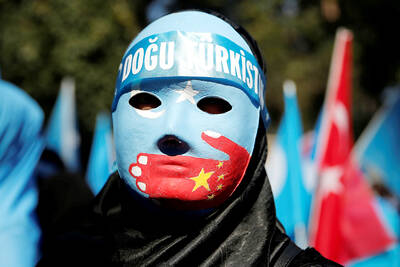
It seems every few days one bumps into one of those “real man” comments in which Taiwan is urged to “face reality” or similar, and “make a deal,” with the speaker implying that soon it will be too late. “Deal” advocates always present themselves as having a superior grip on reality, and the manly ability to make the “hard choice.” Their testosterone-laden language often echoes that of Taiwan sellout advocates. Note that such commentary always specifies a process (“make a deal, work with, make progress”), never the end state of what occupation by a violent authoritarian colonialist state will entail. In

“Taiwan’s Opposition Leader Comes to US With a Message Straight Out of Beijing” read a May 31 headline in the Wall Street Journal. Top US administration officials and members of Congress almost certainly read the WSJ, and if there was a bullet point takeaway that people in Washington should absorb ahead of Chinese Nationalist Party (KMT) Chair Cheng Li-wun’s (鄭麗文) arrival in DC on June 9, that headline is it. The last few columns have discussed this very topic, and the timing is not coincidental. While those top officials likely do not read the Taipei Times, judging by the number
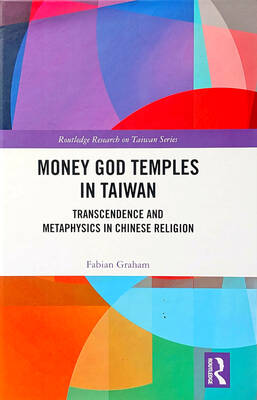
As someone who normally steers clear of books with “transcendence” or “metaphysics” in their subtitles, this reviewer — a casual observer of local belief systems since the 1990s — found Fabian Graham’s Money God Temples in Taiwan a challenging read. Those who’ve only dipped their toes into temple culture will likely need to parse several sections with special care if they’re to keep up with the author, a British ethnographic researcher whose previous books have investigated religious practices among ethnic Chinese in Southeast Asia. This scholarly volume examines a facet of Taiwan’s religious landscape that didn’t exist a century ago, and


 RSS
RSS