


Championing women’s rights based on the teachings of the Koran may sound like fighting a losing battle, but for Malaysia’s leading women’s rights activist, Islam’s sacred text should be a source of liberation for women, not discrimination.
“For much of Islamic history, it is men who have interpreted the Koran and the traditions for us. The woman’s voice, the woman’s experience, the woman’s realities had been largely silent and silenced in the reading and interpretation of the [Koran] — as if God did not speak to women’s suffering and questioning,” Zainah Anwar wrote in one of several e-mail exchanges with the Taipei Times.
Anwar will discuss her more than 20 years of experience trying to improve the rights of women in a lecture titled What Islam? Whose Islam? Listen to the Voice of Sisters in Islam, to be held by the Lung Yingtai Cultural Foundation (龍應台文化基金會) on Saturday.
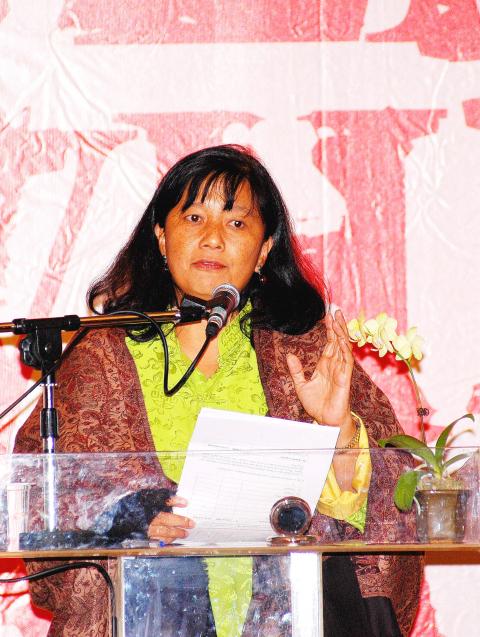
photo courtesy of the Lung Yingtai Cultural Foundation
Lung Yingtai (龍應台), a University of Hong Kong professor and popular cultural critic, will moderate the lecture as part of the foundation’s Taipei Salon (台北沙龍) lecture series.
Born into a moderate Muslim family, Anwar witnessed firsthand the emergence of political Islamism in Malaysia during the 1970s and 1980s. Anwar and like-minded activists founded Sisters in Islam in 1988 to lobby for equal rights and justice for women. In 2007, Anwar played a pivotal role in the establishment of Musawah (Arabic for “equality”), an organization that promotes gender equality within the Muslim world at the global level.
Taipei Times: You have written that rejecting Islam is not an option for most Muslim women. Why is this the case?
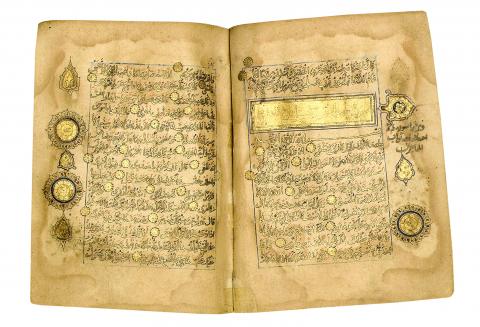
PHOTO: Bloomberg
Zainah Anwar: Because we were brought up to believe in God and religion is a very important aspect of our lives and our identity. I grew up with parents who never missed their five daily prayers, I went to a religious school for five years, I was brought up to be grateful to God for all the good things that happen in life and to believe that God will help those who help themselves. As an adult, when I was confronted with the reality that so much discrimination against women was justified in the name of Islam, I chose to go back to the source of my religion, the Koran, to find out if it really discriminates against women.
TT: What does the Koran say about women’s rights?
ZA: Going back to the Koran with a feminist lens was the most liberating and spiritually uplifting experience for me ... I wanted to know if God really regarded women as inferior to men, if God really said a man had a right to beat his wife, a right to take four wives, a right to demand obedience, a right to force a woman to submit to his sexual commands.
I remember to this day the excitement I felt when I discovered what the Koran said on polygamy. It was the first issue we had decided to deal with when we opened the Koran again because so many women were complaining to us of the pain and misery they and their children suffered because their husbands had taken second wives.
Yes, the verse on polygamy does say “marry two, three or four,” but it goes on to say: “If you fear you cannot do justice, marry only one; that will be best for you to prevent you from doing injustice.” How come the part of the verse that says “marry two, three or four” is known throughout the world but the second half of the verse that says “marry only one” is not heard of?
TT: Why is there this difference in interpretation?
ZA: It dawned on us that when men read the verse, they only saw “marry up to four wives,” and they stopped reading. In that phrase, they saw the word of God validated their desire and their experience. When women read the verse, we saw “if you fear you cannot deal justly with women, then marry only one.”
These were the words of Allah that spoke to our fears of injustice. We understood that the supposed right to polygamy was conditional, and if a man cannot fulfill those conditions of equal and just treatment, then Allah said marry only one. In fact the verse goes on to say that “this will be best to prevent you from doing injustice.” What further validation do we need to argue that polygamy is not an unconditional right in Islam, but is actually a responsibility allowed only in very exceptional circumstances?
It was empowering for us to discover that our yearning to be treated as human beings of equal worth and dignity were rooted in our tradition, in our faith. We felt validated in our struggle. We were convinced more than ever that it is not Islam that oppresses women, but interpretations of the Koran influenced by cultural practices and values of a patriarchal society which regard women as inferior and subordinate to men.
TT: How does this compare to the reality in today’s Malaysia?
ZA: This ethical voice of the Koran, which insistently enjoins equality of all individuals, has been largely absent in the body of political and legal thought in the Islamic tradition. When women decided to read the Koran for themselves, they discovered this ethical message of equality and justice in Islam. They began to question why this voice was silent in the interpretive texts of the religion and the codification of the laws.
We wanted the Malaysian public, and Muslims in particular, to know of this egalitarian message of the Koran. We questioned why this message of equality, justice and compassion is not reflected in the laws that govern marriage and family in Malaysia. We felt this was an affront to God’s message of equality and justice.
TT: Who are the most formidable opponents to your goal of reforming laws and empowering women in Malaysia?
ZA: The patriarchs who do not want their privileged status in life to change. And they hide behind God and religion to claim that what we are demanding is against the teachings of Islam. What we are demanding is against their patriarchal misogynistic understanding of Islam. There is nothing divine about this. Their understanding is a human understanding of God’s message, and therefore fallible and changeable.
TT: What is the biggest area of dispute?
ZA: What we are arguing for is the need to respect everyone’s right to seek to understand God’s message. We are arguing against the authoritarian tendency, sadly so marked among many conservative religious scholars and Islamist ideologues, to imagine that their own understanding of God’s word is absolute and binding on everyone else and that this must be a source, if not the only source, of law and public policy. This is not right in a democratic society, in a country like Malaysia which has a constitution that recognizes equality and prohibits discrimination on the basis of gender.
TT: The “Islamic feminist” movement over the past few decades is, in the main, led by women from elite families such as yourself. How do you appeal to a broader base of grassroots supporters?
ZA: The feminist movement might have been led by educated women in the cities, but the impact of the work has been widespread. The Sisters in Islam leadership, staff and members today reflect the diversity of Malaysia. We have a second generation of leaders who come from small towns, who went to Islamic universities, who wear the hijab [headscarf], and who want the same rights that supposedly Westernized elite women want.
The Sisters in Islam training on women’s rights in Islam has been extremely well received in the more conservative and poorer states of Malaysia. This is because women from less privileged backgrounds suffer injustice on a daily basis. These women know exactly what we are talking about because they are very tired of the irresponsible men in their lives who have abandoned them, taken second wives, failed to pay maintenance to them and their children. They want change and they believe in our message that change is possible.
TT: You left Sisters in Islam in 2009 to help launch Musawah. How does its scope differ from Sisters in Islam?
ZA: I am very much, and very proudly, still a part of Sisters in Islam. I am on the board of directors and remain involved in many Sisters in Islam activities. Musawah is really the impact of Sisters in Islam work at the global level. There was much interest in our framework of working with religion from a rights perspective. As Sisters in Islam staff and members traveled all over the world, there was a realization of the frustration many activists in Muslim contexts felt about the resistance to their demands for equality and justice, for reform of the discriminatory Muslim family laws. We felt it was time for all of us who have been in this struggle for decades to come together and create a very powerful visible presence of Muslim women demanding equality and justice in the Muslim family at the national, regional and international levels.
TT: What role have women been playing in the uprisings that have recently swept the Middle East?
ZA: Women were out there in the streets by the thousands in Egypt and Tunisia. And even in a more conservative country like Bahrain, you see pictures of women joining the men in the demonstrations. I have many activist friends in Egypt, and they were in Tahrir Square every day and night.
The Egyptians successfully toppled a dictator in 18 days, but it’s going to take years to build a democratic state and a democratic culture in the polity. This is the big challenge now and it has just begun. And it will be a struggle because there are very strong organized forces against women’s equality. We already saw this in the demonstrations on March 8 when men confronted the women who had marched to Tahrir Square to celebrate International Women’s Day and taunted them to go home and stay in the kitchen. So it is important that the women’s groups organize and build public support for the positions they are taking and play an active and strategic role in the transition processes to create a new democratic constitution and institutions.
TT: Do you foresee moderate, transparent and democratic governments emerging throughout the Middle East? Or will political Islamists fill the power vacuum?
ZA: While the Islamist movements in Egypt and Tunisia remain the largest political forces, and there is worry that they might step into any political vacuum and commandeer power, this is not the world of 1979. Back then, the Iranian revolution, which had brought diverse social and political forces together, was hijacked by the Islamists and transformed into an Islamic revolution.
Thirty-two years of Islamic rule has not brought Iran the social justice, democracy, and freedom the people yearned for. A despotic monarchy was replaced by despotic theocratic rule.
This is the 21st century, and Muslims have seen the failure of the Islamic state experiment in Iran, Sudan and Afghanistan after the overthrow of secular regimes. The return of Rashed Ghannouchi, the 69-year-old leader of the Tunisian Islamist movement Al-Nahda [also known as Ennahdha], after a long exile in London is not the return of a Khomeini ready to impose vilayet-e-faqih, rule of the jurisconsult as God’s representative on Earth. In interviews, he has rejected this notion and criticized the Egyptian Muslim Brotherhood for its party position that an Ulama Council should supervise parliament as in Iran where the all-powerful Guardian Council must approve all bills passed and has the power of veto if it considers them inconsistent with the Constitution and the Shariah.
He also criticized the Muslim Brotherhood’s position against Copts and women running for the presidency. Instead, he sees the AKP (Justice and Development Party) in Turkey as a model to follow, and the Scandinavian socio-economic model as the closest to his Islamic vision. He believes in democracy and calls on Islamists to relinquish their ambition to monopolize Islam and impose a single, all-powerful interpretation, which has proven to be inherently unstable and temporary, he said.
In the end, the proof of the pudding of course must be in the eating, but Ghannouchi is wise and strategic enough to capture the imagination and the mood of the times. Today, democracy, freedom, human rights, and women’s rights constitute the dominant ethical paradigm of the modern world. These were the slogans held up by the Arabs in the streets. It is the yearning of all human beings, not just Westerners or Westernized elites in the Muslim world.
This interview has been condensed and edited.
‧ MediaTek Lectures, What Islam? Whose Islam? Listen to the Voice of Sisters in Islam will take place at the National Central Library Conference Hall (國家圖書館國際會講廳), 20 Zhongshan S Rd, Taipei City (台北市中山南路20號). The talk will be conducted in English, with simultaneous interpretation in Mandarin (headphones can be rented for NT$200). Admission is free, but those attending must preregister online at www.civictaipei.org or by calling (02) 3322-4907
‧ April 2, from 2pm to 4pm

Taiwan’s English education system is being pulled apart by three opposing forces. Bilingual Nation 2030 pulls students toward English and global communication. Artificial Intelligence (AI) readiness pulls them toward digital judgment, verification and AI-mediated work. But Taiwan’s old exam culture pulls them back toward memorization, grammar drills, timed reading and correct answers. If the education system keeps using old exams to define success, it risks producing graduates who are neither genuinely bilingual nor genuinely AI-ready, but trained for tasks machines can already perform. The first force is Bilingual Nation 2030. Launched in 2018, the policy aimed to “help Taiwan’s workforce connect
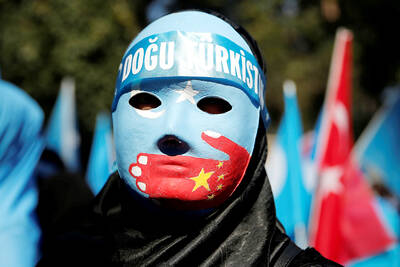
It seems every few days one bumps into one of those “real man” comments in which Taiwan is urged to “face reality” or similar, and “make a deal,” with the speaker implying that soon it will be too late. “Deal” advocates always present themselves as having a superior grip on reality, and the manly ability to make the “hard choice.” Their testosterone-laden language often echoes that of Taiwan sellout advocates. Note that such commentary always specifies a process (“make a deal, work with, make progress”), never the end state of what occupation by a violent authoritarian colonialist state will entail. In

“Taiwan’s Opposition Leader Comes to US With a Message Straight Out of Beijing” read a May 31 headline in the Wall Street Journal. Top US administration officials and members of Congress almost certainly read the WSJ, and if there was a bullet point takeaway that people in Washington should absorb ahead of Chinese Nationalist Party (KMT) Chair Cheng Li-wun’s (鄭麗文) arrival in DC on June 9, that headline is it. The last few columns have discussed this very topic, and the timing is not coincidental. While those top officials likely do not read the Taipei Times, judging by the number
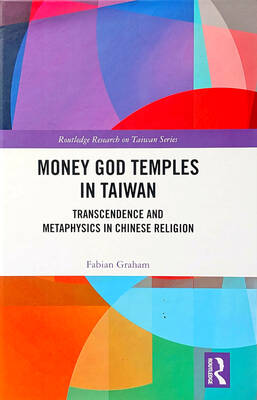
As someone who normally steers clear of books with “transcendence” or “metaphysics” in their subtitles, this reviewer — a casual observer of local belief systems since the 1990s — found Fabian Graham’s Money God Temples in Taiwan a challenging read. Those who’ve only dipped their toes into temple culture will likely need to parse several sections with special care if they’re to keep up with the author, a British ethnographic researcher whose previous books have investigated religious practices among ethnic Chinese in Southeast Asia. This scholarly volume examines a facet of Taiwan’s religious landscape that didn’t exist a century ago, and


 RSS
RSS