


The first question about Black Swan that should be dispensed with is whether or not it is a ballet movie. There has been much discussion about how accurately the film portrays the cloistered world of professional ballet, and about how well Natalie Portman performs as a ballerina. It would seem that those who know most about ballet found the film the most difficult to enjoy, but that doesn’t spoil the pleasure for the rest of us.
The UK’s Guardian newspaper canvassed the opinions of a number of principal dancers and artistic directors of ballet companies after giving them a special screening of the film, and virtually every one was horrified at the negative cliches of ballet that the film purveyed. “This is a very lazy movie, featuring every ballet cliche going,” Tamara Rojo, a principal dancer with the Royal Ballet, is quoted as saying. Cassa Pancho, artistic director of Ballet Black, recommended that people should not “worry about the ballet — go for the great lesbian action and the horror.”
In Black Swan, ballet is treated as something akin to an extreme sport, exacting a tremendous physical and psychological toll. It is this toll, the price of perfection, that director Darren Aronofsky is primarily interested in. The scenes in which ballet is performed are primarily a setting for all kinds of psycho-sexual tricks. Melodramas are often filled with cliches, and their success or failure depends on how the director manipulates them. In Black Swan, Aronofsky does a splendid job of using the things we all think we know about ballet and then taking them to an extreme, creating a world of psychological horror into which the audience is happy to be drawn. Reality can be cheerfully dispensed with. It’s no wonder hackles have been raised in the ballet community.

Photo Courtesy of 20th Century Fox
While the picture drawn of the inner workings of a ballet company might not chime with reality, what is beyond doubt is that Portman does a dazzling job of portraying the character of Nina Sayers, a young ballerina who is given the role of her life and breaks under the stress of creating perfection.
Nina is a prissy girl smothered by an almost psychopathic mom (a frighteningly believable Barbara Hershey) and has been brought up, almost from birth, to become a prima ballerina. She is committed to perfection, and when she wins the role of the Swan Queen in what the artistic director Thomas Leroy describes as a “visceral” production of Swan Lake, she fights her own personality to give full expression to both the white swan and her evil twin sister, the black swan of the title.
Crossing over to the dark side of her tortured soul, Nina’s tendency toward self-harm begins to get out of control, and her grasp on reality slips. This destructive process is shepherded along by Leroy, who hopes to crack Nina’s icy fragility and bring out a hotter passion for artistic, and perhaps also personal, reasons.
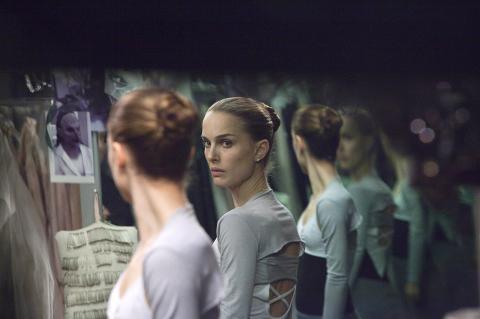
Photo Courtesy of 20th Century Fox
Providing contrast to Nina’s inner struggle is Beth, the ballet company’s former principal dancer whose career is coming to a premature close. The casting of Winona Ryder, a talented actress who has done so much to destroy her own career, was a stroke of genius, akin to what Aronofsky achieved when he brought Mickey Rourke out of the Hollywood deep freeze for The Wrestler (2008). Another character who unwittingly adds to Nina’s psychological instability is Lily (Mila Kunis), a free-spirited dancer who is used by Leroy to show Nina the passionate being she could release from within if she only had the courage.
Sexuality, both in its expression and suppression, runs through this movie like a raging torrent, and Aronofsky delights in injecting scenes with a perverse eroticism. The film is a complex tapestry of sexual symbolism that links up the myth of Swan Lake, the pain and passion of dance, submission, domination, and a whole lot more. It is sexy as hell, and ties in well with the pop psychology that most of us have floating around in our heads about sex, death, passion and pain. But in the end you don’t really learn much about ballet, about Swan Lake, or even about the character of Nina. Is the fact that Black Swan doesn’t really add up to much a problem? Probably not. It is an entrancing parlor game of a movie in which the director expertly plays with our expectations, mostly to show us a good time. It is also living proof that old-fashioned melodrama, with a little contemporary spit-and-polish, still has the power to enrapture.
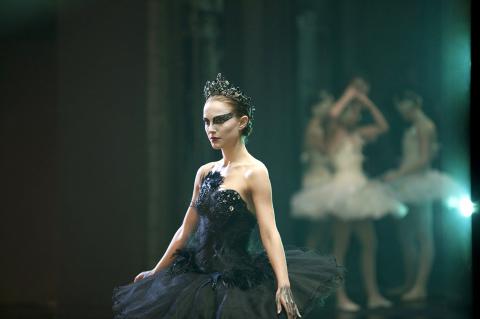
Photo Courtesy of 20th Century Fox

The Portuguese never established a presence on Taiwan, but they must have traded with the indigenous people because later traders reported that the locals referred to parts of deer using Portuguese words. What goods might the Portuguese have offered their indigenous trade partners? Among them must have been slaves, for the Portuguese dealt slaves across Asia. Though we often speak of “Portuguese” ships, imagining them as picturesque vessels manned by pointy-bearded Iberians, in Asia Portuguese shipping between local destinations was crewed by Asian seamen, with a handful of white or Eurasian officers. “Even the great carracks of 1,000-2,000 tons which plied
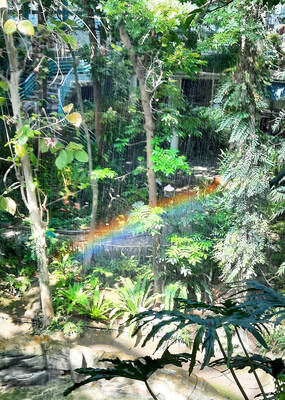
It’s only half the size of its more famous counterpart in Taipei, but the Botanical Garden of the National Museum of Nature Science (NMNS, 國立自然科學博物館植物園) is surely one of urban Taiwan’s most inviting green spaces. Covering 4.5 hectares immediately northeast of the government-run museum in Taichung’s North District (北區), the garden features more than 700 plant species, many of which are labeled in Chinese but not in English. Since its establishment in 1999, the site’s managers have done their best to replicate a number of native ecosystems, dividing the site into eight areas. The name of the Coral Atoll Zone might

On Monday morning, in quick succession, the Chinese Communist Party (CCP) and the Chinese Nationalist Party (KMT) released statements announcing “that the Central Committee of the Communist Party of China and General Secretary Xi Jinping (習近平) have invited KMT Chairwoman Cheng Li-wun (鄭麗文) to lead a delegation on a visit to the mainland” as the KMT’s press release worded it. The KMT’s press release added “Chairwoman Cheng expressed her gratitude for the invitation and has gladly accepted it.” Beijing’s official Xinhua news release described Song Tao (宋濤), head of the Taiwan Work Office of the CCP Central Committee, as
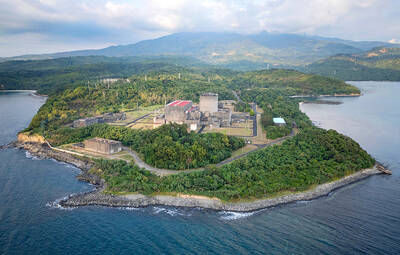
Nuclear power is getting a second look in Southeast Asia as countries prepare to meet surging energy demand as they vie for artificial intelligence-focused data centers. Several Southeast Asian nations are reviving mothballed nuclear plans and setting ambitious targets and nearly half of the region could, if they pursue those goals, have nuclear energy in the 2030s. Even countries without current plans have signaled their interest. Southeast Asia has never produced a single watt of nuclear energy, despite long-held atomic ambitions. But that may soon change as pressure mounts to reduce emissions that contribute to climate change, while meeting growing power needs. The


 RSS
RSS